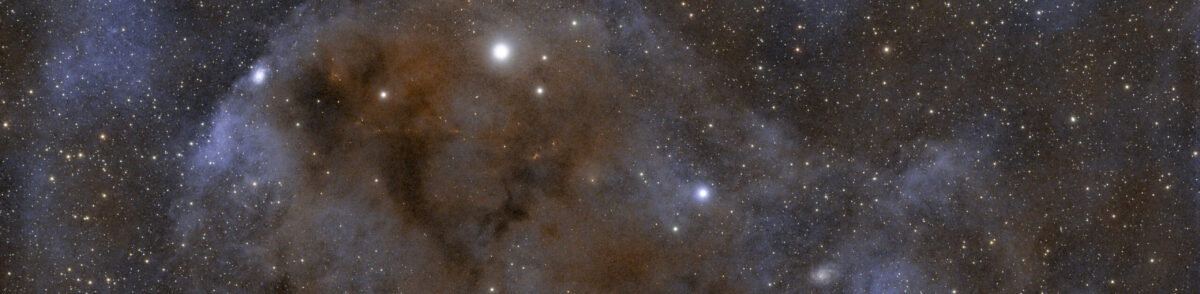

Sh2-268 (Sharpless 2-268) is a large, extremely faint emission nebula (H II region) located in the northern part of the constellation Orion, near the top of Orion’s raised club.
The nebula region is situated in northeastern Orion, just south of the star Xi Orionis (70 Ori), at approximately Right Ascension 06h 10m and Declination +13° 20′ (J2000).
Sh2-268 lies roughly 3,600 to 4,000 light-years away from Earth. While Sharpless cataloged its core diameter at around 30′ to 60′ (up to 1 degree, or ~85 light-years across), deep exposures show diffuse nebulosity extending nearly twice that size.
The gas cloud is ionized primarily by HD 42352, a hot B1 III blue giant star. It is also part of the broader OriGem Loop, a massive ancient supernova remnant structure spanning the Orion-Gemini border.
Portions of this nebula are cross-referenced in the Lynds’ Catalogue of Bright Nebulae as LBN 873 and LBN 874.
Because its surface brightness is exceptionally low, Sh2-268 is virtually impossible to see visually through amateur telescopes.
This target radiates predominantly in hydrogen-alpha (Hα). A dedicated astronomy camera paired with a filter is strongly recommended to isolate the faint glow from background sky brightness.
Because of its wide angular span, a wide-field refractor (around 300mm–500mm focal length) works best. I shot this with an 840mm refractor. Framing Sh2-268 allows you to capture other compelling neighboring targets in the same field of view:
- NGC 2169 (“The 37 Cluster”). A bright, distinctive open star cluster shaped like the number “37” located right on the edge of the nebulosity.
- NGC 2194. A rich, distant open cluster nearby.
- Sh2-267, Sh2-269, and Sh2-270. Smaller, much brighter compact H II regions clustered within the same 2-degree square patch of sky, creating a great contrast against Sh2-268’s broad, wispy structure.
Long total exposure times (often 10 to 25+ hours of sub-exposures) under dark skies to cleanly bring out the faintest outer filaments without excessive noise. This image consists of 165 300″ subs, or approx 15 hours of integration time.
Astrobin link for the details – https://astrob.in/a68zkj/0/
