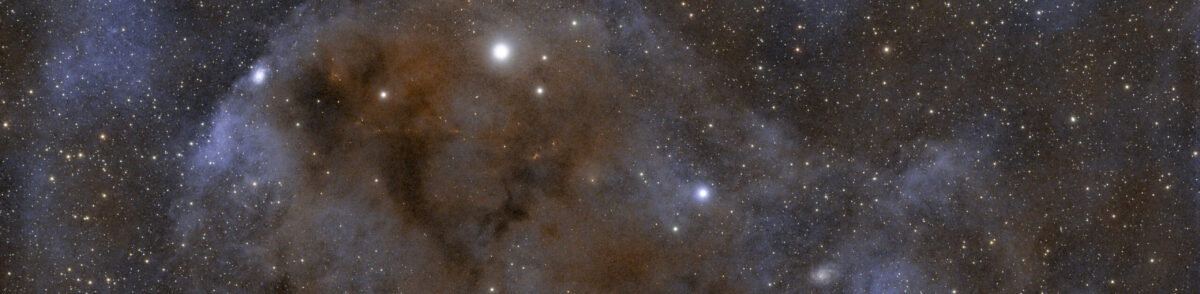
LDN 673: A Dark Nebula in the Aquila Rift

LDN 673 - Dark Nebula of the Milky Way

Next I pointed the scope at a splotch of Dark Nebula in Aquila. It is cataloged as Lynds’ Dark Nebula 673 and is a dense, fractured dark molecular cloud complex located about 400 to 600 light-years from Earth in the constellation Aquila. It is situated near the center of the Aquila Rift, a massive lane of dark molecular clouds running along the summer Milky Way.

It appears as a dark, irregular void silhouetted against a rich backdrop of background stars. It consists of sub-micrometer-sized dust particles coated with frozen carbon monoxide and nitrogen that completely block visible starlight. The dense cloud contains active star-forming regions where newborn stars occasionally illuminate parts of the surrounding dust wisps.

Imaged over 2 nights the image consists of a touch over 6 hours of exposure from an Esprit 120ED and ASI2600MC atop an Eq6r Pro mount.

Astrobin link for all the details – https://astrob.in/7g6vhi/0/

Seahorse Nebula (LDN 1082): Astrophotography in Cepheus

Seahorse in Cepheus

As September rolled around I chose to point my Esprit 120 towards the constellation Cepheus, specifically at a dark filamentary molecular cloud structure that appears like a seahorse.

LDN 1082, also known as Barnard 150 or the Seahorse Nebula, is a dark cloud of dust and gas about 1,200 light-years from Earth.

Taken from my driveway here in the hills of western N.C. over a couple of very warm nights, this image consists of 110 5 minute exposures. Image acquisition with APT using the Esprit 120ED at 840mm FL.

Astrobin link for this image – https://astrob.in/rwraub/B/

M81 and M82: Interacting Galaxies 12 Million Light-Years Away

Ursa Major Galaxy Pair

M81 and M82 are a famous pair of interacting galaxies located approximately 12 million light-years away in the constellation Ursa Major.

They are popular targets for amateur astronomers because they are bright enough to be seen with binoculars and often fit within the same telescopic field of view.

As the pair are circumpolar, I chose to end my nightly winter sessions with this pair. I’ll add more data if the opportunity presents itself over the remainder of our winter as we head into galaxy season. Imaged with a wide-field Esprit 120ED refractor telescope and ZWO ASI2600MC camera atop an Eq6r Pro mount.

M 81 is commonly known as Bode’s Galaxy. It is a “grand design” spiral galaxy discovered by Johann Bode in 1774. It features a bright nucleus and well-defined spiral arms filled with blue star clusters and pinkish hydrogen gas clouds.

M 82 is known as the Cigar Galaxy due to its elongated, edge-on appearance, M82 is a prototypical starburst galaxy. It is undergoing an intense period of star formation, creating new stars 10 times faster than the entire Milky Way. It is famous for bright red filaments of ionized hydrogen gas blasting out from its central regions, driven by strong galactic winds from supernova explosions.

I always encourage you to look at the astrobin link for all of the technical details concerning image capture. https://astrob.in/g6elck/B/

Verified by MonsterInsights