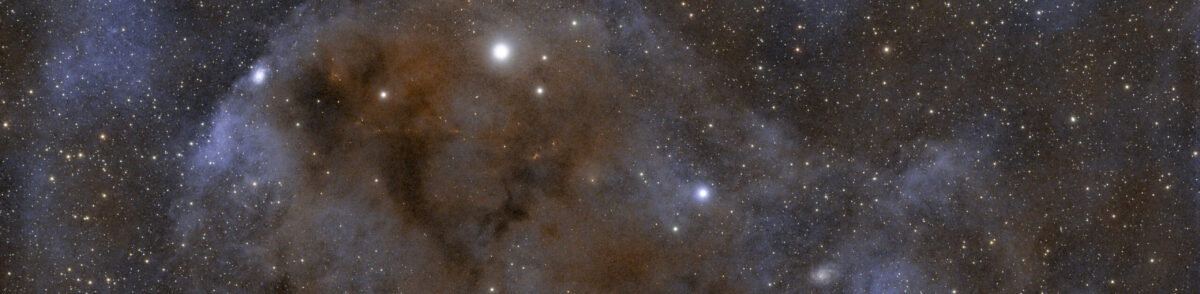

I found this little Nebula as I was having a look around Orion for potential targets. It’s very dim so I knew time would be required. I began collecting data on this in November 2025 but couldn’t get enough to complete the image. I added 3 more night sin November 2026 and now have a total of 12.5 hours of exposure.
The main object in this image is LBN 878 (Lynds’ Bright Nebula 878). It is the red and brown nebula dominating the field. The full nebula complex is a combination of emission and dark nebulae. The complex blends emission nebulae glowing with ionized hydrogen gas and dark nebulae that obscure background starlight, creating a striking celestial portrait. Included in this overall object structure is LBN 879 which is in association with the variable star FU Ori. LBN 879 is the small bright nebula in the center and is also known as CED 59. The dark nebula Barnard 35 encompasses the LBN 879 structure. The very dark portion of the red part of LBN 878 is the dark nebula LDN 1594.
Barnard 35 and its illuminated rim (LBN 878) form part of the larger Sharpless 264 (Sh2-264) region, commonly called the Lambda Orionis Ring. This colossal star-forming complex combines a giant molecular cloud with an expansive H II region, centered around the massive star Lambda Orionis. The yellow-tinged Cederblad 59 nebula (LBN 879), which envelops FU Orionis, serves as a visual anchor within Barnard 35’s dark clouds, illustrating the dynamic processes of stellar birth and evolution in this active Orion neighborhood.
Have a look at my Astrobin image as it provides all the acquisition details as well as a plate solving of the image where these items mentioned above can be seen. https://astrob.in/bfxqvu/B/
