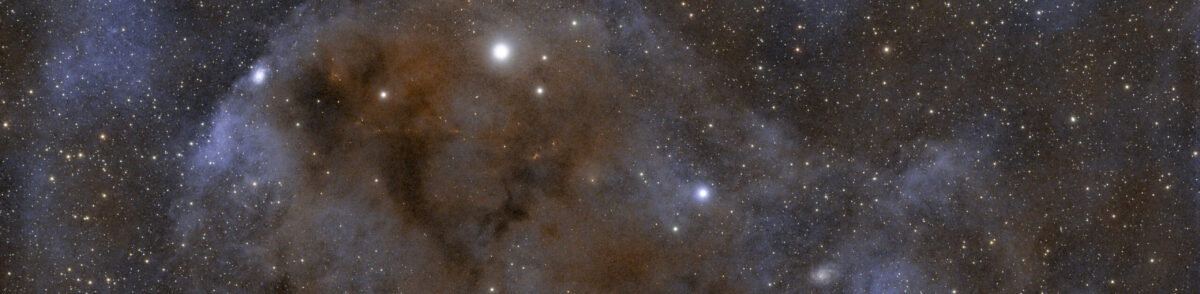

LDN 1295, popularly known as the Giraffe Nebula, is a cold, dense dark molecular cloud located in the northern constellation of Cassiopeia. Because it is a dark nebula composed of interstellar dust grains, it does not emit its own visible light. Instead, it acts like a cosmic curtain, absorbing and obscuring the light from the rich background star fields of the Milky Way behind it.
The “Giraffe” Silhouette: Astro-photographers and visual observers describe the nebula as looking like a giraffe facing right, with its neck stretched high and long legs in mid-stride (though some see a squirrel).
The acronym LDN stands for Lynds’ Catalogue of Dark Nebulae, a compilation published in 1962 by astronomer Beverly Lynds. It is also closely associated with the reflection nebula LBN 603 and adjacent dust lane LDN 1296.
Like other dark nebulae, LDN 1295 is a stellar nursery. The thick, icy dust particles shield the interior from harsh interstellar radiation, allowing the cloud to remain incredibly cold. This allows gravity to condense pockets of gas into protostars and eventual planetary systems.
LDN 1295 has been a favorite target for advanced deep-sky astro-photographers due to the complex, wispy textures of the dust.
Because it is exceptionally faint, imaging LDN 1295 requires significant integration time — often upwards of 20 to 25 hours under dark skies—to separate the dark dust profiles from the ambient glow of the background stars. It is this very challenge that inspired me to attempt this target. I selected 230 5 minute subframes taken with my Skywatcher Esprit 120ED telescope and ZWO ASI071MC Astro camera cooled to 14f.
Check out my Astrobin image for all of the technical acquisition data, hardware and software used. There are a lot of little components working together to achieve a desired result. https://astrob.in/w4vfr0/0/
