In the foothills of North Carolina, our dark skies began to brighten a little after 9pm. It was a night with little to no moon. I was also beginning to image galaxy NGC 4725 with my RC8. I noticed that my third image had a weird gradient. The next image had a red hue.
I went outside and realized what was happening. I grabbed my DSLR and a tripod. I took a few photos over the course of the next 45 minutes.
They had forecast a slight possibility that we could see this around midnight if we had a view to our north. No one forecast what we saw. It was awesome – at 35 degrees latitude!
These images were taken with my canon 1Ds Mark III and a 28mm lens on a tripod. 3″ timer delay, 4″ exposures.
It’s funny because my astro imaging continued – guiding wasn’t the best but it did continue. The red gradient looked a lot like the sky glow during a full moon
Messier 16 is also known as the Eagle Nebula or the Star Queen Nebula. It is considered an emission nebula in the constellation Serpens. It contains the Pillars of Creation. It’s located in the Milky Way’s Sagittarius Arm, about 7,000 light-years away from Earth. Parts of the Eagle Nebula are emission nebulas. The clouds of gas and dust are so hot they produce their own light. Other parts are dark nebulas. They are made of cold gas. These parts are only visible because of the silhouettes they create against the nebula’s glowing backdrop.
The Pillars of Creation are wispy columns of gas and dust in the nebula’s southern region that hide newborn stars. The Hubble Space Telescope’s 1995 image of the Pillars of Creation made them famous. The nebula’s dark silhouette near its center, which includes the Pillars of Creation, inspired the names “Eagle” and “Star Queen”.
The Eagle Nebula also contains the young star cluster NGC 6611. The nebula has several active star-forming regions. One of these is the Pillars of Creation. Here, gravity pulls gas clumps together to form stars. The wavy lines at the edges of some pillars are ejections from forming stars that collide with clouds of material. These collisions can also create bow shocks, which can form wavy patterns. The crimson glow comes from energetic hydrogen molecules that result from these jets and shocks.
This image was created from 117 240″ exposures captured using APT and calibrated/integrated using PixInsight. APT coordinates all of the technology used in imaging. This includes the cooled astro camera (ASI2600MC). It also includes the Telescope and its focusing (SW Esprit 120ED). Additionally, it includes the Eq6r Pro Mount that tracks with the stars.
A barred spiral galaxy located in the constellation Coma Berenices, about 40 million light-years away. It is an intermediate galaxy. It has a prominent ring structure. It is roughly the size of the Milky Way at over 100,000 light-years across. NGC 4725 is unique in that it only has one spiral arm, while most spiral galaxies have two or more. The galaxy’s center has a bar of stars. It is surrounded by a ring of stars. Astronomers call this formation a ringed barred spiral galaxy.
In this sharp color composite image, the solo spira mirabilis seems to wind from a prominent ring of bluish, newborn star clusters. It appears to originate from a distinct ring. The ring consists of bluish, newborn star clusters. It also appears to wind from red tinted star forming regions. The odd galaxy also sports obscuring dust lanes a yellowish central bar structure composed of an older population of stars. Also included in the frame is NGC 4712. It sports a noticeably more traditional spiral galaxy look. NGC 4712 is a more distant background galaxy.
Imaged 5/1, 5/10 and 5/11. The night of 5/10 was our Aurora Borealis event. Imaged from 21:30 to 02:00 each of these evenings. 136 4 minute subs were included, or 9 hours of exposure. Gear includes an f8 GSO RC8 telescope at 1625mm, an ASI071MC astro camera cooled to 15f, and an EQ6r Pro mount.
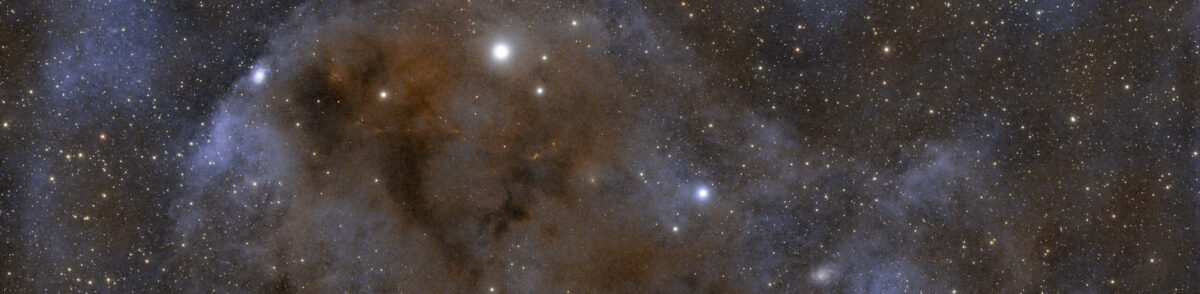
I continue my efforts in imaging reflection nebula from the vdB catalog. IC 4601, or vdB 103, is a bluish reflection nebula. It is located in the constellation Scorpius, about 420 light-years away from Earth.
It’s part of a larger area called the Blue Horsehead. Reflection nebulae are clouds of gas and dust. They shine by reflecting light from nearby stars. They do not create their own light. vdB 103’s blue color comes from the blue light reflected by the nebula’s gas and dust. This light is from two bright blue giant stars on the right. A double star on the left also contributes. The nebula’s brightness depends on the density and size of the reflecting grains. It also depends on the color and brightness of nearby stars.
The Monkey Head Nebula (also known as NGC 2174 and Sharpless Sh2-252) is a star-forming region located 6,400 light-years away in the constellation Orion in which bright, newborn stars near the center of the nebula illuminate the surrounding gas with energetic radiation. The nebula is mostly composed of hydrogen gas. The cloud is sculpted by ultraviolet light carving into the cool hydrogen gas and dust. As the interstellar dust particles are warmed from the radiation from the stars in the center of the nebula, they heat up and begin to glow at infrared wavelengths.
The prime source of energy in the nebula is the massive, hot star named HD 42088. This star has a mass 30 times that of our Sun and a surface temperature 6 times greater. Such stars emit extraordinary amounts of ultraviolet radiation. The high-energy particles in these stars’ outer atmospheres are being blown away in high-speed “stellar winds.”
The ultraviolet radiation causes the nebula to shine. In combination with the stellar wind, this radiation also causes the nebula to expand. Dust and gas are being evaporated and scattered by the energy from the hot star. Where there is a very dense condensation, a pillar is formed pointing toward the star, because the knot shields the material behind it.
If the knot is dense enough, rather than scattering, it may be pushed to collapse into a new star. Such an event is occurring in a pillar above center right of the image. This cannot be seen in visible light, because those wavelengths are blocked by the pillar’s dust. The new star will eventually shed its dusty cocoon and emerge to be seen in optical wavelengths.
This image was captured January 22nd and 23rd 2021 and is made up of 163 240s subs. It was taken with an ASI071MC Pro camera, with OPT Radian Quad Ultra filter, attached to a WO Z73 refractor telescope riding a SkyWatcher EQ6r Pro mount. Guding via a WO 50mm guidescope and ASI120mm mini camera. Pegasus PBA provides power distribution and USB connectivity. QHY Polemaster for precise polar alignment. Senso Sesto electronic focuser.
Flame and Horsehead Nebula in the Orion Molecular Cloud
The Orion Molecular Cloud Complex is situated close to the celestial equator and, as such, it is at least partly visible from both hemispheres in certain times of the year. This means that astrophotographers all over the world are able to share their images of the areas targets including this Flame, Horsehead, Orion, Running Man and De Marian’s Nebula among others. Here in the northern hemispehere its a winter target. Clear cold nights allow for stunning images.
This image captures several distinct items. The Flame Nebula, designated as NGC 2024 and Sh2-277, is an emission nebula situated just next to the very bright star Alnitak. It is about 900 to 1,500 light-years away. That bright star Alnitak (ζ Ori), the easternmost star in the Belt of Orion, shines energetic ultraviolet light into the Flame and this knocks electrons away from the great clouds of hydrogen gas that reside there. Much of the glow results when the electrons and ionized hydrogen recombine. Additional dark gas and dust lies in front of the bright part of the nebula and this is what causes the dark network that appears in the center of the glowing gas. In this center is a concentrated cluster of newly formed stars.
The Flame Nebula is part of the Orion Molecular Cloud Complex, a star-forming region that includes the famous Horsehead Nebula. The Horsehead Nebula (also known as Barnard 33) is a small dark nebula in the constellation Orion. The nebula is located just to the south of that bright star, Alnitak, the easternmost star of Orion’s Belt within the Orion Molecular Cloud Complex. It appears within the southern region of the dense dust cloud known as Lynds 1630, along the edge of the much larger, active star-forming H II region called IC 434, which is the backdrop of the Horsehead.
The Horsehead Nebula is approximately 422 parsecs or 1,375 light-years from Earth. It is one of the most identifiable nebulae because of its resemblance to a horse’s head. The nebula was first recorded in 1888 by Scottish astronomer Williamina Fleming on a photographic plate taken at the Harvard College Observatory. One of the first descriptions was made by E. E. Barnard, describing it as: “Dark mass, diam. 4′, on nebulous strip extending south from ζ Orionis”, cataloguing the dark nebula as Barnard 33 The dark cloud of dust and gas is a region in the Orion Molecular Cloud Complex where star formation is taking place.
Colour images reveal a deep-red colour that originates from ionised hydrogen gas (Hα) predominantly behind the nebula, and caused by the nearby bright star Sigma Orionis. Magnetic fields channel the gases, leaving the nebula into streams, shown as foreground streaks against the background glow. A glowing strip of hydrogen gas marks the edge of the enormous cloud, and the densities of nearby stars are noticeably different on either side.
Heavy concentrations of dust in the Horsehead Nebula region and neighbouring Orion Nebula are localized into interstellar clouds, resulting in alternating sections of nearly complete opacity and transparency. The darkness of the Horsehead is caused mostly by thick dust blocking the light of stars behind it. The lower part of the Horsehead’s neck casts a shadow to the left. The visible dark nebula emerging from the gaseous complex is an active site of the formation of “low-mass” stars. Bright spots in the Horsehead Nebula’s base are young stars just in the process of forming.
There’s so much going on in this image. I try to describe it all but take a moment and enjoy all there is within. Three distinct Nebulae and two star clusters – one image of a tiny piece of the sky.
Sharpless 157, sometimes referred as the Lobster Claw Nebula, is an emission nebula in the constellation Cassiopeia. The predominantly yellowish part of the top of the nebula is a very large H II region that is ring-shaped by the stellar wind of several giant stars. The blueish colored arms at the bottom part of the Ha region mainly consist of highly ionized oxygen (OIII) and other gases.
Located to the right of the lobsters claws in the middle of the image is NGC 7635, also known as the Bubble Nebula, or Sharpless 162. It is a very bright H II region emission nebula, also in the constellation Cassiopeia. It lies close to the direction of the open cluster Messier 52. The “bubble” is created by the stellar wind from a massive hot, 8.7 magnitude young central star, SAO 20575. The nebula is near a giant molecular cloud which contains the expansion of the bubble nebula while itself being excited by the hot central star, causing it to glow. It was discovered in 1787 by William Herschel.
Cassiopeia Salt & Pepper Cluster Messier 52 or M52, also known as NGC 7654, is an open cluster of stars in the northern constellation of Cassiopeia. It was discovered by Charles Messier on September 7, 1774. In the image it is located just to the lower-right of the buble nebula. It’s a dense cluster with colorful stars with a nebulous backdrop.
NGC 7538, Northen Lagoon Nebula (Brain Nebula), near the more famous Bubble Nebula, is located in the constellation Cepheus. It is a region of active star formation including several luminous near-IR and far-IR sources. It also is very bright and is located at the bottom middle of the image. You’ll notice the nebulosity to the right of NGC 7538 – it’s part of the cepheus nebula region which reaches all the way over to NGC 7000.
NGC 7510, Dormouse Cluster, is an open cluster of stars located around 11,400 light years away in the constellation Cepheus, near the border with Cassiopeia. In this image it’s located on the bottom of the left “claw”, a mix of OIII and Ha gases.
I certainly hope you enjoy this image as much as I do. Such a lovely part of our night sky.
Orion Nebula (M42); De Mairan’s Nebula (M43); Running Man Nebula (Sh2-279)
The Orion Nebula (also known as Messier 42, M42, or NGC 1976) is a diffuse nebula situated in the Milky Way south of Orion’s Belt in the constellation of Orion. It is one of the brightest nebulae, and is visible to the naked eye in the night sky. M42 is located at a distance of 1,344 light years and is the closest region of massive star formation to Earth. The M42 nebula is estimated to be 24 light years across. It has a mass of about 2,000 times that of the Sun.
De Mairan’s Nebula (M43) is a star-forming nebula with a prominent H II region in the equatorial constellation of Orion. It was discovered by the French scientist Jean-Jacques Dortous de Mairan some time before 1731, then catalogued by French astronomer Charles Messier on March 4, 1769. The De Mairan’s Nebula is part of the Orion Nebula (M42), being separated from the main nebula by a dense lane of dust known as the northeast dark lane. It is part of the much larger Orion Molecular Cloud Complex.
The main ionizing star in this nebula is HD 37061, which is positioned near the center of the H II region and located 1,300ly from the Sun. This is a triple star system with the brighter component being a single-lined spectroscopic binary. The main component is a blue-white hued B-type main-sequence star with a stellar classification of B0.5V or B1V. It has 19 times the mass of the Sun and 5.7 times the Sun’s radius. The star is radiating over 26,000 times the Sun’s luminosity from its photosphere at an effective temperature of 31,000 K. It is spinning rapidly with a projected rotational velocity of around 200 km/s.
The H II region of M43 is a roundish volume of ionized hydrogen centered on HD 37061. There is a dark lane crossing in front of the region from north to south, known as the M43 dark lane.
Sh2-279 (Running Man Nebula) is an HII region and bright nebulae that includes a reflection nebula located in the constellation Orion. It is the northernmost part of the asterism known as Orion’s Sword, lying 0.6° north of the Orion Nebula. The reflection nebula embedded in Sh2-279 is popularly known as the Running Man Nebula. The Running Man Nebula is a popular target for amateur astrophotographers, as it lies close to the Orion Nebula and has many nearby guide stars. The outline of the running man shows up primarily in photographs; it is difficult to perceive visually through telescopes, though the reflection nebula itself is visible in small to medium apertures in dark skies.
The Orion Nebula is one of the most scrutinized and photographed objects in the night sky, and is among the most intensely studied celestial features. While that may be true, it was a very difficult target to photograph without blowing out the core and the large stars. It is surrounded by hydrogen gas as seen in the red hues thoughout. The dark nebula of M43 as well as the Running Man nebula add character to the image.
The nebula has revealed much about the process of how stars and planetary systems are formed from collapsing clouds of gas and dust. Astronomers have directly observed protoplanetary disks, brown dwarfs, intense and turbulent motions of the gas, and the photo-ionizing effects of massive nearby stars in the nebula.
The Nebula is visible with the naked eye even from areas affected by some light pollution. It is seen as the middle “star” in the “sword” of Orion, which are the three stars located south of Orion’s Belt. The star appears fuzzy to sharp-eyed observers, and the nebulosity is obvious through binoculars or a small telescope.
The Orion Nebula contains a very young open cluster, known as the Trapezium due to the asterism of its primary four stars. Two of these can be resolved into their component binary systems on nights with good seeing, giving a total of six stars. The stars of the Trapezium, along with many other stars, are still in their early years. The Trapezium is a component of the much larger Orion Nebula Cluster, an association of about 2,800 stars within a diameter of 20 light years. Two million years ago this cluster may have been the home of the runaway stars AE Aurigae, 53 Arietis, and Mu Columbae, which are currently moving away from the nebula at speeds greater than 100 km/s (62 mi/s).
There has been speculation that the Mayans of Central America may have described the nebula within their “Three Hearthstones” creation myth; if so, the three would correspond to two stars at the base of Orion, Rigel and Saiph, and another, Alnitak at the tip of the “belt” of the imagined hunter, the vertices of a nearly perfect equilateral triangle with Orion’s Sword (including the Orion Nebula) in the middle of the triangle seen as the smudge of smoke from copal incense in a modern myth, or, in an ancient one, the literal or figurative embers of a fiery creation.
I encourage you to have a read of the wikipedia information available. The observing and photographic history of this complex is very interesting. Who knew that in the 1600’s people made telescopes?
NGC 6910 is an open cluster in the constellation Cygnus and is located half a degree east-north east of Gamma Cygni, also known as Sadr.
This image is a stack of 23 4 min light frames at 20f, 30 darks, flats and dark-flats. Taken Aug 2, 2020 in below-average seeing & transparency during a full moon (99% illuminated, age 14 days). Was impossible to achieve good focus in a hazy sky with 99% humidity.
This night was a test of guiding under PHD2 as I added a guide scope and camera to my configuration as well as automated scripts for the evenings shooting plan (limited success) Hopefully guiding will allow me to extend the exposure times in these Nebula images to 10 minutes. Do to learning issues, 7 frames of the 30 taken had to be tossed into the junk bin.
Gear: EQ6R mount; WO Z73 w/flat73a; ZWO ASI071MC Pro camera, WO 50mm guide scope; ZWO ASI120mm mini guide scope; Senso Sesto focuser; Pegasus PBA; OPT L-enhance filter; Acer Netbook
Software: APT for acquisition; PHD2 guiding; DSS stacking; PI processing with final touches in PS.
My imaging rig being set up in the afternoon.
Much more time on a clear night is desirable. Subscribe below to receive update notifications for future images and posts. Cheers!