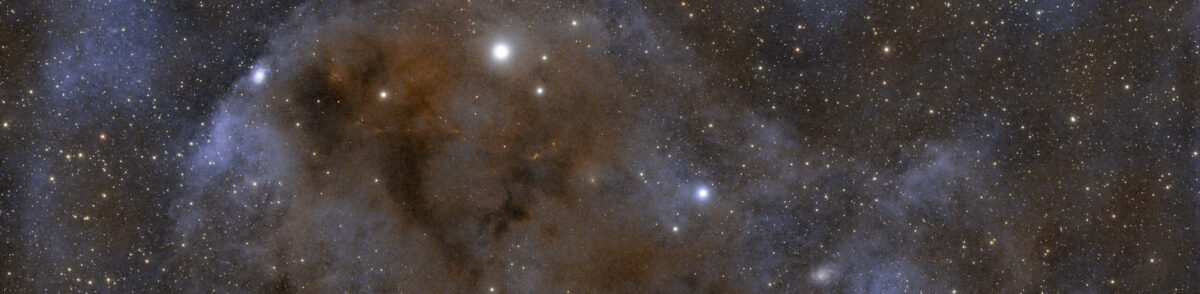
NGC 2355 Insights: Chemical Evolution and Star Formation

An Open Cluster in Gemini - NGC 2355

NGC 2355, also known as NGC 2356, is an old open star cluster in the constellation Gemini. It is approximately a billion years old. The cluster is located about 5,400 light-years from the Solar System. It is 1,100 light-years above the Milky Way galaxy’s plane.

NGC 2355 is useful for studying the chemical and dynamical evolution of the Galactic disk. Recent studies using Gaia DR3 data have identified over 400 member stars within the cluster. They have also discovered dozens of variable stars. These include eclipsing binaries and pulsating stars.

NGC 2355 is located in the outer disk and elevated above the plane. This position makes it an important probe for understanding the evolution and structure of the Milky Way’s galactic disk. It is particularly valuable for studying star formation and dynamical processes in less dense regions.

NGC 2355 lies near the celestial equator. It is observable from both the Northern and Southern Hemispheres. It favors northern latitudes where Gemini rises higher in the sky. In the Northern Hemisphere, it is best viewed during winter months from December to March. During this time, the constellation is prominent in the evening sky. From mid-northern latitudes such as 40°N, the cluster culminates at an altitude of approximately 63° above the horizon. This provides favorable viewing conditions away from atmospheric distortion.

I photographed this cluster from my driveway in the foothills of the Blue Ridge Mountains. I use APT for session management, image acquisition, and automation. 71 60sec subframes for just a touch over an hour of integration. Calibrated, aligned, integrated, and processed manually using PixInsight.

Astrobin link for acquisition details and annotated image.

Exploring the Beauty of Reflection Nebulae: IC 2169

Dreyer's Nebula - Reflections in Monoceros

Perhaps among the most beautiful targets to image in our night sky. There are no less than five reflection nebulae in the photograph. They are contrasted by large areas of ionized hydrogen showing as red in the image.

IC 2169, popularly known as Dreyer’s Nebula, is a large blue reflection nebula located in the constellation Monoceros (the Unicorn). It is a primary feature of the Monoceros R1 complex. This is a region of active star formation situated approximately 2,500 to 2,700 light-years away from Earth. It’s in a massive starfield!

The nebula has a distinctive blue hue. This color occurs as interstellar dust particles scatter blue light from nearby hot, young stars. It is primarily illuminated by the massive B-type stars of the young open cluster Collinder 95. Some sources also associate its glow with the variable star T Orionis or the star HD 45677.

The Nebula is often referred to as Dreyer’s Nebula. This name honors John Dreyer, who compiled the NGC and IC catalogs. However, it was actually discovered by Barnard. The nebula is also designated as IC 447. This duplication exists because it was recorded twice in the Index Catalogue (IC) due to separate observations by Edward Barnard. It is located about 2 degrees west of the more famous Cone Nebula and the Christmas Tree Cluster (NGC 2264). It is often imaged alongside smaller reflection nebulae such as IC 446, NGC 2245, and NGC 2247.

I took this photograph from my driveway in the foothills of the Blue Ridge Mountains in western North Carolina. Here, I enjoy a bortle 4/5 sky. Continued development pushes it ever closer to a 5. Imaged with a Skywatcher Esprit 120ED telescope at 840mm focal length and a ZWO ASI2600MC camera cooled to 14f. These are mounted on a Skywatcher Eq6r Pro equatorial mount. It runs EQMOD and guides via PHD2. This is done through a ZWO OAG and an ASI290mm mini guide camera.

Component control is done by APT. Session automation and image acquisition are also managed by APT. These are the magic dust in getting the 143 5 minute subframes. The subframes were manually calibrated, debayered, aligned, integrated, and processed to the targets natural colors using PixInsight.

Astrobin link for acquisition details and annotated image.

IC 2177: The Stunning Seagull Nebula Explained

IC 2177 - The Seagull in Monoceros

The first thing that struck me was the vast number of stars. I noticed them as I began to see this image unfold in the illuminated sky. Varying temperatures are seen in the gases with hot Hydrogen gases glowing in reddish hues with cooler gases expanding outward.

IC 2177 is a region of nebulosity that lies along the border between the constellations Monoceros and Canis Major. The name Seagull Nebula is sometimes applied by astronomers to this emission region. It resembles a gull in flight. It also includes the neighboring regions of star clusters, dust clouds, and reflection nebulae.

Astronomers catalog the nebula as IC 2177. This cosmic cloud is one of many sites of star formation within the Milky Way galaxy. It is located 3,800 light-years away from Earth. It resides inside the Orion spur. This is the same partial spiral arm of the Milky Way where our solar system is located. The nebula is nearly 240 light-years across.

NGC 2327 is located in IC 2177. It is also known as the Seagull’s Head, due to its larger presence in the Seagull nebula. The region near the seagull’s eye (or lizard’s hip) is listed as NGC 2327 by astronomers. It contains a cluster of stars born about 1.5 million years ago. The eye is the brightest and hottest of the newborn stars in the entire nebula. It heats up the dust. Consequently, the dust glows in infrared light.

The complex of gas and dust clouds is dominated by the reddish glow of atomic hydrogen. It spans over 100 light-years. Bright young stars are within it at an estimated distance of 3,800 light-years.

Astrobin link for acquisition details and annotated image.

Exploring The Great Lacerta Nebula – Sh2-126

Sh2-126 - The Great Lacerta Nebula

Sh2-126, also known as the Great Lacerta Nebula, is a large red emission nebula located in the constellation Lacerta. It is part of the massive star-forming region Lacerta OB1, approximately 1,200 light-years from Earth. The nebula’s glowing hydrogen gas is ionized by the intense ultraviolet radiation from the bright, blue star 10 Lacertae.

A unique feature is a “stellar funnel” in the center. It appears greyish in this image as it reflects light from nearby stars. It is part of the LBN 437 molecular cloud. Another striking feature is a bright reflection nebula associated with the young star V375 Lacertae, which also produces Herbig-Haro objects.

APT managed and controlled my imaging sessions. It helped acquire 148 300s subframes. This amounts to a touch over 12 hours of exposure during our few clear nights in October. PixInsight was used to calibrate, debayer, integrate, and process to its natural color.

Astrobin link for the details.

Sh2-158 Northern Lagoon Nebula

Sh2-158  Northern Lagoon Nebula

SH2-158 is also known as the Northern Lagoon Nebula or NGC 7538. It is an active star-forming H II region in the constellation Cepheus. This nebula is located about 9,100 light-years away. It is home to massive young stars and protostars. It includes one exceptionally large O-type protostar. It is part of the Cassiopeia OB2 complex in the Perseus Arm of the Milky Way.

Sh2-158 is often overlooked by amateur astrophotographers due to its proximity to the larger and more famous Bubble Nebula. However, it is a challenging and rewarding target. I was intrigued by the name alone. I have imaged the Lagoon Nebula and hadn’t heard of the Northern Lagoon Nebula. A quick search led to a few examples but not many, so I set my sights on the target.

Sh2-158 is an active star-forming region embedded within a large molecular cloud. As an emission nebula, Sh2-158 glows. However, its light is spread out over a large area. This distribution makes its surface brightness very low. Long total exposure times are needed. Often, multiple hours are required to gather enough light. These times help distinguish the nebula from the sky’s background noise. The surrounding dust clouds absorb and scatter light, further diminishing the nebula’s brightness and obscuring fine details within it. This makes revealing the nebula’s structure challenging and requires advanced processing techniques. The dust also causes reddening, altering the color balance of images and requiring careful calibration during post-processing.

Image acquisition details in astrobin image

I imaged it over the course of three nights in Sept 2025. I used a RC8 telescope at 1625 mm paired with an AI071MC camera atop an Eq6r Pro mount. I used a Radian Ultra Quadband filter.

Sh2-86 Cloud Sculpting Star Cluster

Cloud Sculpting Star Cluster

Sh2-86 is a faint emission nebula in the constellation Vulpecula, located approximately 6,000 light-years from Earth. It contains the young, hot open star cluster NGC 6823. This cluster illuminates the surrounding nebula. It gives the nebula its distinctive shape.

The nebula has “pillar-like” structures. These structures are similar to “elephant trunks.” It also has Bok globules. These globules are denser regions of gas shielded from the intense radiation of the young stars.

This image consists of 81 exposures. Each exposure was 5 minutes long. They were taken from my driveway with an Esprit 120ED telescope and ZWO ASI2600MC camera. Image acquisition using APT. Image processed manually in PixInsight. Acquisition details in this astrobin link.

IC 434 – The Horsehead Nebula

The Horsehead Nebula (B33) is a small dark nebula in the constellation Orion. It is perhaps the most recognizable nebula because of its resemblance to a horse’s head. The Nebula is located just to the south of Alnitak, the easternmost star of Orion’s Belt.

IC 434 is an active star forming H II region located at a distance of approx. 1,260 ly from the Sun. This is an H II region that is being ionized by ultraviolet radiation from the nearby Sigma Orionis multi-star system. The Horsehead Nebula is a dark nebula that is silhouetted against the diffuse background of IC 434.

The photograph consists of 300 180s subs. They were acquired from my driveway using the APT session control software. I used a RC8 telescope and an ASI071MC Pro camera. The camera was riding an Eq6r pro german equatorial mount.

M 15 – Great Star Cluster in Pegasus

The Great Star Cluster in Pegasus

Messier 15 or M15 (also designated NGC 7078 and sometimes known as the Great Pegasus Cluster) is a globular cluster. It is located in the constellation Pegasus.

M 15 is about 35,700 light-years from Earth, and 175 light-years in diameter. It has an absolute magnitude of −9.2, which translates to a total luminosity of 360,000 times that of the Sun. Messier 15 is one of the most densely packed globulars known in the Milky Way galaxy. Its core has undergone a contraction known as “core collapse.” It has a central density cusp. An enormous number of stars surround what may be a central black hole.

The cluster is home to over 100,000 stars. It is notable for containing a large number of variable stars (112) and pulsars (8). One of these pulsars includes a double neutron star system, M15-C. It also contains Pease 1, the first planetary nebula discovered within a globular cluster in 1928. Just three others have been found in globular clusters since then.

Elephant’s Trunk Nebula – IC 1396

Elephant's Trunk Nebula

The Elephant’s Trunk Nebula in the constellation Cepheus is a popular object for Astro photographers. It is ideal for imaging during late summer and early fall. The trunk itself is a dark, dense, and elongated globule cloud. It consists of interstellar gas and dust within the much larger ionized gas region IC 1396.

This globule is commonly called the Elephant’s Trunk nebula. The name comes from its appearance at visible light wavelengths. It is the dark, dense globule IC 1396A. This globule features a dark patch with a bright, sinuous rim. The bright rim is the surface of the dense cloud. A very bright, massive star (HD 206267) just to the east of IC 1396A illuminates and ionizes it.

The massive blue star is in the center of the image. This star ionizes the entire IC 1396 region. Dense globules can protect themselves from the star’s harsh ultraviolet rays.

I chose to photograph this with the Skywatcher Esprit 120 telescope. I used an ASI2600MC Pro Astro camera. Additionally, I used a Radian Ultra Quad-band Narrow band filter. My session management software is APT 4.56. Running on a mini-pc mounted on the telescope it controls everything, coordinating the activities of several pieces of technology. This photograph contains 248 subs for a total exposure of 13.88 hours. Two entire nights, Sept 8 & 9, 2024.

I’m presenting the image in two color palettes. The first is its natural color, with no color mapping applied. IC 1396 is a large cloud of faintly glowing gas, composed mainly of hydrogen which appears very red in long exposure photography. The second palette is known as the Hubble palette, HOO. In this the Ha and Oiii channels are blended to achieve a more pleasing optical presentation of the image. Very common approach.

I hope you enjoy!

M 8 – Lagoon Nebula

The Lagoon in Sagittarius

NGC 6530 / Messier 8 – Lagoon Nebula

I used the star cluster as the central focus for this image. 112 3 minute exposures with an 840mm Skywatcher Esprit 120ED refractor telescope paired with a ZWO ASI2600MC astro camera.

NGC6530 is a young, open cluster of stars. It is in the southern constellation of Sagittarius. It is located some 4,300 light years from the Sun. The cluster exists within the H II region known as the Lagoon Nebula, or Messier 8. More than two dozen stars are visible.

Like many nebulae, M8 appears reddish in time-exposure color photos. However, it looks gray to the eye peering through binoculars or a telescope. This is because human vision has poor color sensitivity at low light levels.

The nebula contains a number of Bok globules. These are dark, collapsing clouds of protostellar material. The most prominent globules have been catalogued. The platesolved and annotated version in this astrobin link shows everything within the frame. https://astrob.in/y6m8f5/0/

The Lagoon Nebula also contains at its centre a structure known as the Hourglass Nebula.

Verified by MonsterInsights