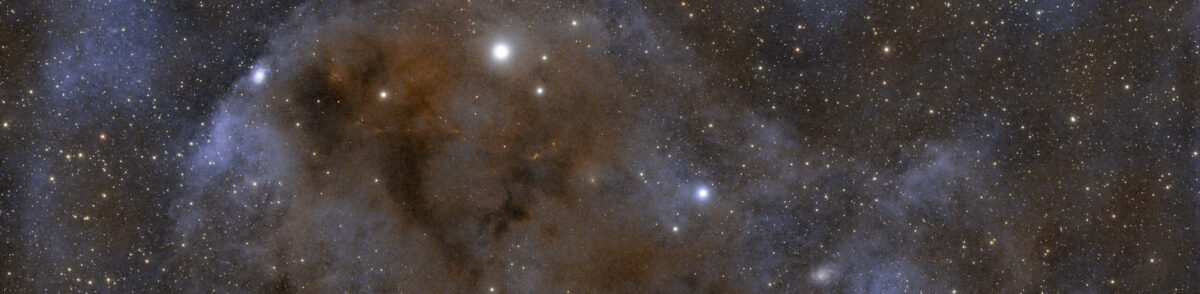
LBN 406 – Laughing Skull molecular cloud

LBN 406 - Laughing Skull molecular cloud - Draco

The Laughing Skull Nebula in Draco

Beverly Lynds Bright Nebula (LBN) 406 is a very faint molecular cloud of dust. It reflects nearby star shine in the constellation Draco. On her brightness scale of 1 to 6, Lynds classified this nebula as a barely visible, 1. The stellar winds have created some interesting shapes. This area is often called The Laughing Skull Nebula, focus on the center of the image.

At the very bottom center is the small galaxy, UGC 10548, that looks like the planet Saturn. A Higher resolution telescope reveals two distinct arms and not a ring.

This image is 125 8 minute exposures, or 16.5 hours, over several early mornings in March 2025. Imaged with a Skywatcher Esprit 120ED and Antlia Quad LP filter. Imaging camera is an ASI2600MC. Both riding n EQ6r Pro mount. Imaging session control and acquisition by APT 4.62. Image calibration, alignment, integration and processing done manually in PixInsight.

Cheers!

Galaxies of Virgo (Great Galactic Face; The Eyes; Markarian’s)

The Virgo constellation

I used NGC 4425 as the centering coordinates for this image. Multiple galaxies are within the field of view. These include components of Markarian’s Chain, the Great Galactic Face, The “Eyes,” and another 10 galaxies. The Virgo constellation is chalk full of galaxies. Be sure to look at my annotated version in Astrobin. It identifies all the galaxies in the image. It also provides the acquisition details for the photo.

NGC 4425 is a Barred Spiral Galaxy located in the constellation of Virgo in the equatorial region. NGC 4425’s distance from Earth is 54.7 million light years. NGC 4425 is cataloged in the New General Catalogue (NGC). This catalogue is a list of deep space objects. John Louis Emil Dreyer compiled it in 1888. His work was an update to John Herschel’s earlier work. NGC 4425 is not a Messier Object and doesn’t have a Messier Number. The galaxy is separate and distinct, not in Milky Way galaxy or The Solar System.

When we observe the NGC 4425, we are not looking at it as it currently appears. Instead, we see it as it used to appear 54.7 million years ago, given how long light takes to reach us from there.

NGC 4425 is situated close to the celestial equator. Thus, it is at least partly visible from both hemispheres at certain times of the year.

Each of the 20+ galaxies in this image have a history, a unique story.

A deep look into Sh2-280

Sh2-280 Hii nebula cloud in Monoceros

Sh2-280 is a faint, diffuse emission nebula situated in constellation Monoceros. It is mainly an ionized hydrogen cloud. There is also a little oxygen around the bow-shock of the ionizing star at the center – HD46573. Sh2-280 is approximately 5,500 light-years away and near the Rosette Nebula.

This target sits very low in my southern sky. I imaged this over 4 nights in March 2025 using a Skywatcher Esprit 120ED telescope and an ASI2600MC camera. APT 4.62 – image acquisition and session control. Image calibrated, aligned, integrated and processed manually in PixInsight.

Acquisition details and annotated image here.

Messier 64 – The Black Eye Galaxy

The Black Eye Galaxy

The Black Eye Galaxy is also called Sleeping Beauty Galaxy or Evil Eye Galaxy. It is designated Messier 64, M 64, or NGC 4826. It is a relatively isolated spiral galaxy 17 million light-years away in the mildly northern constellation of Coma Berenice’s.

Messier 64 (M64) has a spectacular dark band of absorbing dust in front of the galaxy’s bright nucleus. This feature gives rise to its nicknames, the “Black Eye” or “Evil Eye” galaxy.

I photographed this galaxy for over 12 hours from my driveway in March 2025.

Astrobin link for acquisition details, etc.

NGC 2903 – Beautiful Spiral Galaxy in Leo

NGC 2903 - Spiral Galaxy in Leo

NGC 2903 is a beautiful, barred spiral galaxy located in the constellation Leo, approximately 30 million light-years away from Earth.  It is known for its dust lanes and blue regions of newly formed stars. The core region features “hot spots” that are actually newly formed globular clusters.

An odd fact about this galaxy is its dual identification. It is also cataloged as NGC 2905. This is a rare duplication of a New General Catalog entry.

Imaged with the RC8 scope at 1625mm, 071MC osc camera, and the Eq6r Pro mount.

https://astrob.in/iqjf4k/B

Exploring Messier 67: The Golden Eye Cluster

M 67 - Golden Eye Cluster

Messier 67 is also known as M67 or NGC 2682. It is sometimes called the King Cobra Cluster or the Golden Eye Cluster. It is an open cluster in the southern, equatorial half of Cancer. Estimates of its age range between 3.2 and 5 billion years. Distance estimates are likewise varied, but typically are 2,600 – 2,900 ly.

M67 is not the oldest known open cluster. Several Milky Way clusters are known to be older. However, they are farther than M 67. It is a paradigm study object in stellar evolution. It is well-populated and has negligible amounts of dust obscuration. All its stars are at the same distance and age, except for approximately 30 anomalous blue stragglers.

It has more than 100 stars similar to the Sun, and numerous red giants. The total star count has been estimated at well over 500.

Astrobin version link

Exploring the Little Beehive Cluster

M 41 - Little Beehive Cluster

Messier 41 (also known as M 41 or NGC 2287) is an open star cluster in the constellation Canis Major. It is sometimes called the Little Beehive Cluster. It slightly resembles a smaller version of the regular Beehive Cluster, M 44. It was discovered by Giovanni Batista Hodierna before 1654 and was perhaps known to Aristotle about 325 BC. It lies about four degrees almost exactly south of Sirius (the brightest star in the sky). Together, it forms a roughly equilateral triangle with Nu2 Canis Majoris to the west. All three figure in the same field in binoculars.

The cluster covers an area about the size of the full moon. It contains about 100 stars, including several red giants the brightest of which has spectral type K3, apparent magnitude 6.3 and is near the center, and some white dwarfs.  The cluster is estimated to be moving away from us at 23.3 km/s. The diameter of the cluster is 25–26 light-years. It is estimated to be 190 million years old. Cluster properties and dynamics suggest a total life expectancy of 500 million years for this cluster. It will have disintegrated by then.

The primary yellow stars are annotated in the astrobin version here.

Peering into Sh2-308, the Dolphin Head Nebula

Sh2-308 - Dolphin Head Nebula

Sh 2-308 is commonly known as the Dolphin-Head Nebula. It is an H II region located near the center of the constellation Canis Major. The region is composed of ionized hydrogen. It is about 8 degrees south of Sirius, the brightest star in the night sky.

The nebula is bubble-like and surrounds a Wolf–Rayet star named EZ Canis Majoris. This star is in the brief, pre-supernova phase of its stellar evolution.

Sh2-308 sits at a declination of -23 degrees, which means it’s just above my tree tops to the south. Unobstructed for a couple of hours per night it takes a while to gather significant data. With weather, life and the moon impacts this will be all I get of it this year.

Astrobin view of all objects in this photo.

The image consists of 67 5 minute exposures captured using APT 4.60 over 3 nights in Feb ’25.

Calibration, registration, integration and processing manually in PixInsight.

Peering into the Needle Galaxy in Coma Berenices

The Needle Galaxy

NGC 4565 / Caldwell 38 is an edge-on spiral galaxy. It is about 30 to 50 million light-years away in the constellation Coma Berenices. It lies close to the North Galactic Pole and has a visual magnitude of approximately 10. It is known as the Needle Galaxy for its narrow profile.

The astrobin link annotates several other objects in the image.

This image consists of 169 3 minute exposures captured over two nights in Feb 2025. A GSO RC8 paired with the ASI071MC Pro was used atop a SW Eq6r Pro.

Session management by Astro Photography Tool (APT 4.60). These exposures were manually calibrated, aligned, integrated and processed in PixInsight 1.92

Exploring M 53/NGC 5053 – a globular cluster pair in Coma Berenices

A Globular pair in Coma Berenices

A globular star Cluster (M 53) is located in Coma Berenices. It is one of the most distant globular clusters, situated 59k ly from earth. Globular star clusters are found in the galactic plane of our Milky Way Galaxy. They cause the massive glow of our core.

Astrobin link for this image.

M 53 appears to be connected to the nearby globular cluster NGC 5053 by a tidal bridge-like structure. To the right is a low mass globular cluster cataloged as NGC 5053 – 56k ly from earth. This is a metal-poor cluster. This means the stars have a low abundance of elements other than hydrogen and helium. Astronomers term this “metallicity”. As recently as 1995, it was considered the most metal-poor globular cluster in the Milky Way.

The chemical abundances of the stars in NGC 5053 are similar to those in the dwarf galaxy. Specifically, they resemble the Sagittarius Dwarf Spheroidal Galaxy. They differ from those in the Milky Way halo. The kinematics of the globular cluster support this idea. This suggests that NGC 5053 may have been stripped from the dwarf galaxy.

Verified by MonsterInsights