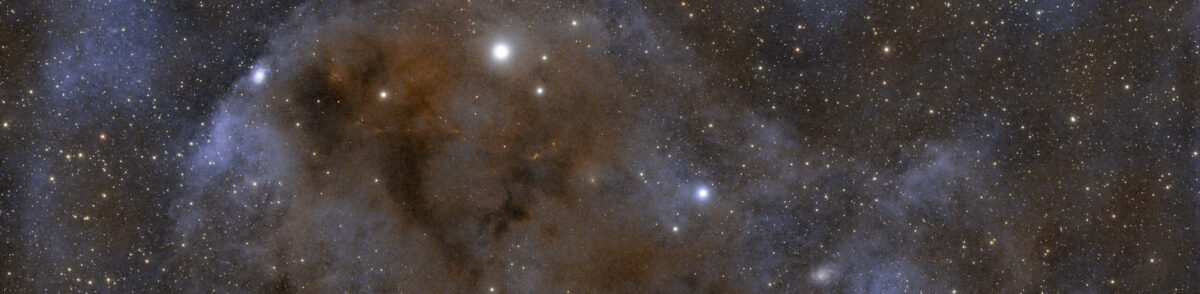
Sh2-168 in Cassiopeia

Sh2-168 in Cassiopeia

SH2-168 is a striking nebula in the constellation Cassiopeia, about 5,200 light-years from Earth. It’s a part of the Sharpless catalog, a collection of bright nebulae that emit light due to ionized hydrogen. SH2-168 is often nicknamed a “star nursery.” It is a stellar birthplace where young, hot stars ignite. They light up the surrounding gas.

In this image we get two targets in one. Sh2-168 is centered and bright. Sh2-169 is the very faint nebula just to the left in this image resembling a shadow or mirror reflection. I spent two nights photographing this target in Nov ’25. This was during the full moon. I used an Antlia Quad broadband LP filter. APT controlled the hardware, imaging, and automation. Hardware includes a Skywatcher Esprit 120ED scope, ASI2600MC camera, atop a Skywatcher Eq6r Pro mount. Pixinsight was used to calibrate, debayer, align, and integrate the 159 subs.

This nebula is a region filled with hydrogen gas. It glows in red and pink hues when it’s ionized by radiation from young, massive stars. This radiation strips electrons from hydrogen atoms, which later recombine, releasing energy in the form of colorful light. The main source of this illumination is thought to be an energetic B-type star, known for its intense ultraviolet radiation. This radiation “excites” the nebula, leading to the glowing effect that astronomers observe.

SH2-168 lies near the more prominent Heart and Soul Nebulae. It is part of the Perseus Arm of the Milky Way. This arm is one of the galaxy’s spiral arms rich in star-forming regions. Studying SH2-168 and similar nebulae helps scientists understand star formation. They also learn about the life cycle of gas clouds and the influence of massive stars on their surroundings. As these young stars evolve, they sculpt and disperse the gas, often leading to the formation of new stars. This ongoing cycle of creation within SH2-168 offers a small glimpse into the dynamic processes. These processes shape galaxies over millions of years.

Astrobin link for image acquisition details.

Exploring The Great Lacerta Nebula – Sh2-126

Sh2-126 - The Great Lacerta Nebula

Sh2-126, also known as the Great Lacerta Nebula, is a large red emission nebula located in the constellation Lacerta. It is part of the massive star-forming region Lacerta OB1, approximately 1,200 light-years from Earth. The nebula’s glowing hydrogen gas is ionized by the intense ultraviolet radiation from the bright, blue star 10 Lacertae.

A unique feature is a “stellar funnel” in the center. It appears greyish in this image as it reflects light from nearby stars. It is part of the LBN 437 molecular cloud. Another striking feature is a bright reflection nebula associated with the young star V375 Lacertae, which also produces Herbig-Haro objects.

APT managed and controlled my imaging sessions. It helped acquire 148 300s subframes. This amounts to a touch over 12 hours of exposure during our few clear nights in October. PixInsight was used to calibrate, debayer, integrate, and process to its natural color.

Astrobin link for the details.

IC 2087 – The Little Flame in Taurus

IC 2087 - The Little Flame in Taurus

IC 2087 is a reflection nebula located in the constellation Taurus, approximately 430–450 light-years from Earth. It is embedded within the massive dark Taurus Molecular Cloud, which is a large stellar nursery.

The nebula is often described as resembling a small, yellowish “flame.” It stands out against the dark dust of the surrounding molecular cloud. Most reflection nebulae are blue. However, IC 2087 appears yellow or orange in some images. This is due to the “Taurus reddening law”.

I found the target difficult to image as there are limited stars visible due to the dark molecular cloud present. Guiding was difficult as their were few guide stars to lock on to. Several times my plate-solving failed during goto++ operations at the meridian flip due to the limited stars. Fortunately APT uses the background during auto focus as there weren’t many stars. Not a target for sleeping while imaging.

I managed to capture 198 300s subframes using APT, for a total of 16.5 hours of exposure. Processed manually in PixInsight to achieve a natural color image.

Sh2-165 in Cassiopeia

Sh2-165 in Cassiopeia

Sh2-165 is a small bright Hii emission nebula approximately 5,200 light years away in Cassiopeia. Not often imaged I find many of the Sharpless catalog items appealing. As with most Sharpless targets it is rich in Ha with little Oiii, if any.

I used APT for image acquisition and control. This photo was produced using a GSO f8 RC8 steel tube telescope at 1625mm fl. I used a ZWO ASI071MC Pro camera cooled to 15f. A Skywatcher Eq6r Pro mount supported the payload and tracked the stars.

General PixInsight processing to achieve a natural color palette included several steps. These steps included calibration, debayer, star alignment, and integration. Other processes used were gradient correction, background neutralization, and noise reduction. Finally, GHS stretch and curves were applied. 220 subframes at 300s exposures were integrated for this photo.

Astrobin link for Sh2-165 acquisition details.

Sh2-263 – The Strawberry Nebula

Sh2-263 "Strawberry Nebula"

The SH2-263 region, aka the Strawberry Nebula, is located approximately 1,300 light years away in the Orion constellation. This region contains multiple classified objects. The most prominent are the red emission nebula SH2-263 and the blue reflection nebula vdB 38.

The central star, HD34989, is relatively young and energetic. It ionizes the hydrogen that makes up SH2-263. It illuminates the local molecular cloud to create the blue reflection nebula.

Astrobin link for acquisition details and an annotated image.

The Phantom Tiara Nebula – NGC 1333

NGC 1333 - Phantom Tiara Nebula

NGC 1333 is a reflection nebula located in the northern constellation Perseus. It is positioned next to the southern constellation border with Taurus and Aries. This nebula is in the western part of the Perseus molecular cloud. It is a young region with very active star formation.

This is a bright but small object surrounded by thick interstellar dust clouds. Some of these clouds are so thick that they completely hide the light behind them. NGC 1333 is commonly referred to as the Embryo Nebula, or the Phantom Tiara.

Session management and acquisition control by APT. Processed manually in PixInsight. Astrobin link for acquisition details and annotated contents.

Exploring LBN 646 – Fish Head Nebula in Cassiopeia

Fish Head of Cassiopeia

LBN 646 is a part of the Fish Head Nebula (IC 1795). It is a star-forming region about 6,000 light-years away in the constellation Cassiopeia. It is adjacent to the larger Heart Nebula (IC 1805).

This region is known for the bright NGC 896. It contains young, hot stars that excite the surrounding gas and cause it to glow. The bright region NGC 896 is rich with young, massive stars. These stars emit strong ultraviolet light. This ultraviolet light causes the surrounding gas to become luminous.

The entire complex of star-forming regions, including LBN 646, is about 70 light-years across.

Image acquisition was controlled by APT using an RC8 telescope with an ASI071MC camera atop an Eq6r Pro mount. The radian Ultra Quad-band filter was used in acquiring the 541 300s subs. Subs processed manually in PixInsight. In processing, I stayed true to the natural Hii color. I made a very slight enhancement in the SHO palette. This approach avoided the false blue/yellow colors. Astrobin link for acquisition details.

WR 134 – Cygnus Star Field

WR 134 - Cygnus star field

WR 134 is a variable Wolf-Rayet star located about 6,000 light-years away in the constellation of Cygnus. This star is bright and massive. It has a radius that is five times greater than our own Sun’s radius. Its temperature is 63,000K, making it 400,000 times more luminous! It is surrounded by a faint bubble nebula formed by this star’s intense radiation and solar wind.

There is an excellent article in Wikipedia covering WR 134 in depth. I urge you to have a read – https://en.wikipedia.org/wiki/WR_134

I imaged his target in mid-Oct 2025. 170 5 minute subs or approx. 14 hrs. Cloudy nights prevented an earlier start on this target. These few nights I was imaging post-meridian flip. I was impressed by the intensity and density of the starfield. Limited time per session. Target acquisition control using APT. Imaged with an Esprit 120ED and ASI2600MC atop an Eq6r Pro mount. Processed manually in PixInsight using a natural color palette.

Astrobin link for this image – acquisition details.

Sh2-154 a Molecular Hydrogen Cloud in Cepheus

Sh2-154

Sh2-154 is a large emission nebula in the constellation Cepheus, located approximately 3,260 light-years away, within a star-forming region. It is cataloged in the Sharpless catalog. This nebula is noted for being a faint, but sizable, region of double-ionized hydrogen. It is surrounded by dust.  The giant B-type star (LS III +60 28) is responsible for ionizing the nebula.

Sh2-154 is situated in the same larger star-forming complex as the more famous Cave Nebula, also known as Sh2-155. It is often pictured alongside Sh2-155 in wide-field astrophotography.   The ionizing radiation from (LS III +60 28) may be compressing nearby molecular clouds. This action could potentially trigger the birth of new stars.  The open cluster NGC 7419 is located close to Sh2-154.  Because Sh2-154 is an emission nebula, it appears mostly red in images and is effectively captured using a hydrogen-alpha filter.

I use APT for image acquisition control and automation.  The Skywatcher Esprit 120ED f7 840mm fl telescope was paired with the ZWO ASI2600MC camera. It was atop an Eq6r Pro mount. Together, they collected the 151 5 minute light frames over three nights in Sept 2025.  I used PixInsight to create and process the image. Astrobin link for acquisition details.

Sh2-158 Northern Lagoon Nebula

Sh2-158  Northern Lagoon Nebula

SH2-158 is also known as the Northern Lagoon Nebula or NGC 7538. It is an active star-forming H II region in the constellation Cepheus. This nebula is located about 9,100 light-years away. It is home to massive young stars and protostars. It includes one exceptionally large O-type protostar. It is part of the Cassiopeia OB2 complex in the Perseus Arm of the Milky Way.

Sh2-158 is often overlooked by amateur astrophotographers due to its proximity to the larger and more famous Bubble Nebula. However, it is a challenging and rewarding target. I was intrigued by the name alone. I have imaged the Lagoon Nebula and hadn’t heard of the Northern Lagoon Nebula. A quick search led to a few examples but not many, so I set my sights on the target.

Sh2-158 is an active star-forming region embedded within a large molecular cloud. As an emission nebula, Sh2-158 glows. However, its light is spread out over a large area. This distribution makes its surface brightness very low. Long total exposure times are needed. Often, multiple hours are required to gather enough light. These times help distinguish the nebula from the sky’s background noise. The surrounding dust clouds absorb and scatter light, further diminishing the nebula’s brightness and obscuring fine details within it. This makes revealing the nebula’s structure challenging and requires advanced processing techniques. The dust also causes reddening, altering the color balance of images and requiring careful calibration during post-processing.

Image acquisition details in astrobin image

I imaged it over the course of three nights in Sept 2025. I used a RC8 telescope at 1625 mm paired with an AI071MC camera atop an Eq6r Pro mount. I used a Radian Ultra Quadband filter.

Verified by MonsterInsights