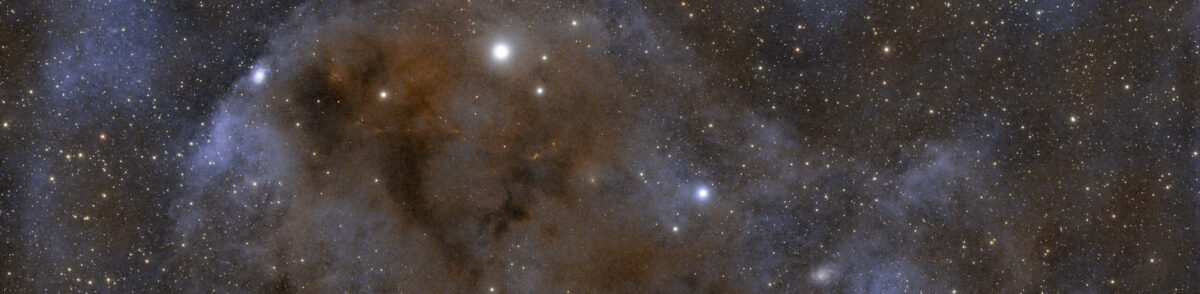
vdB 27 – a Reflection in Taurus

vdB 27

Sometimes you are pleasantly surprised by what comes from these reflection nebula. Other times not so much. This image was centered on VdB 27 (catalogued also as Ced 31) – a small reflection nebula in the constellation Taurus. The nebula is illuminated by the radiation of the variable star RY Tauri.

All the image acquisition info, along with an annotated version of this image, is here in my Astrobin page. A dark nebula (B 214) and a bright nebula (LBN 785) along with a few stars.

This small reflection nebula is usually captured as part of a wide field image of this part of the Taurus Molecular cloud. From my driveway here in the hills of NC, I chose to narrow that view a bit and image it with a RC8 at a focal length of 1628mm using the ASI071MC Pro camera with a Antlia Quadband light pollution filter.

This is 110 3 minute exposures taken Feb 13 and 14, 2024 for 5.5 hours of total exposure.

M 51 – Whirlpool Galaxy

M 51 – the Whirlpool Galaxy

M51, also known as Messier 51a or NGC 5194, is a spiral galaxy in the constellation Canes Venatici. It’s located 31 million light-years from Earth. M51’s arms are made of long lanes of stars, dust, and gas, and appear like a staircase. Sometimes the designation M51 is used to refer to the pair of galaxies, in which case the individual galaxies may be referred to as M51a (NGC 5194) and M51b (NGC 5195).

The Whirlpool Galaxy has two, very prominent spiral arms that wind clockwise. One arm deviates from a constant angle significantly. The pronounced spiral structure of the Whirlpool Galaxy is believed to be the result of the close interaction between it and its companion galaxy NGC 5195.

As a result of the Whirlpool Galaxy’s interaction with NGC 5195, a variety of tidal features have been created. The largest of these features is the so-called Northwest plume, which extends out to 43 kiloparsecs (140,000 light-years) from the galaxy’s center. This plume is uniform in color and likely originated from the Whirlpool Galaxy itself due to having diffuse gas. Adjacent to it are two other plumes that have a slightly bluer color, referred to as the Western plumes due to their location. These plumes are what I was trying to capture and highlight in my image. Very faint trailing dust.

NGC 5195 (also known as Messier 51b or M51b) is a dwarf galaxy that is interacting with the Whirlpool Galaxy (also known as M51a or NGC 5194). Both galaxies are located approximately 31 million light-years away in the constellation Canes Venatici. Together, the two galaxies are one of the most widely studied interacting galaxy pairs.

A plate-solved and annotated version is available on my Astrobin page.

NGC 2170 – The Angel Nebula

NGC 2170, also known as the Angel Nebula

The Angel Nebula is a reflection nebula and stellar nursery in the Monoceros constellation. It is located about 2,400 light-years away at the edge of the star-forming molecular cloud Monoceros R2.

In this classic celestial still life created with a digital paintbrush the Angel Nebula shines near the image center. Reflecting the light of nearby hot stars, NGC 2170 is joined by other bluish reflection nebulae, a red emission region, many dark absorption nebulae, and a backdrop of colorful stars.

I’ve presented this in a portrait mode to highlight the angel appearance.

Sh2-232 “Great Pumpkin” of Auriga

Sh2-232, Sharpless 232, referred to as the Great Pumpkin Nebula.

Sh2-232 is a faint, small, and diffused nebula ball in the constellation Auriga. It is located in the pentagon of Auriga, about 3 degrees northeast of IC405.

Sh2-232 is the largest and faintest of a group of diffuse nebulae in Auriga. It is ionized by two giant stars, the O9.5 III HD 37737 and an anonymous B0 II class star.

A unique feature of this target is the Planetary Nebula found in the middle of those three central stars (blue dot) – it’s named PK173+03.1. LDN1525 also features prominently as a black vein. SH2-235 looks like a companion ball of gases.

Galaxies of Canes Venatici

Annotated version – NGC 4232

NGC 4232

This image is taken from within the constellation Canes Venatici. My intention was to capture as many galaxies as I could within an image and have them resolvable at a focal length of 840mm.

NGC 4231 and NGC 4232 are the two galaxies at the center of this image. NGC 4232 is a Spiral Galaxy in the Canes Venatici constellation. NGC 4232 and NGC 4231 are situated north of the celestial equator and, as such, are more easily visible from the northern hemisphere. NGC 4231 is a Lenticular Galaxy.

NGC 4218 is an intermediate spiral galaxy between NGC 4232 and M 106. It is 57 million light-years from Earth.

The giant in the image is Messier 106. It is an intermediate spiral galaxy about 23 million light-years from earth. It is one of the largest and brightest nearby galaxies, similar in size and luminosity to the Andromeda Galaxy.

NGC 4217 is an edge-on spiral galaxy at the top of the image, which lies approximately 60 million light-years away. It is a possible companion galaxy to Messier 106. One supernova, SN 2022myz (type I, mag. 19), was discovered in NGC 4217 on 19 June 2022.

To the bottom left is the spiral galaxy, NGC 4220. Estimated at 63.8 million light-years away.

M 82 – The Cigar Galaxy

Messier 82 (M82)

A bright Starburst galaxy located in the constellation Ursa Major, about 12 million light-years away.  It’s also known as the Cigar Galaxy because of its elliptical shape.

M 82 is generally photographed with M 81, Bode’s Galaxy. I pointed the 8″ RC telescope at it to get as much detail as I could on just this galaxy.

M82 is a spiral galaxy that’s undergoing a starburst, a massive burst of star formation in its core.  It has a gravitatioonal interaction with its nearby galaxy, M81, which causes it to have an extremely high rate of star formation.

M82 is a prototype starburst galaxy and the second-largest member of the M81 group.  It’s bright at infrared wavelength and has over 30 billion stars.

M82 can be found in the northern skies in the direction of Ursa Major, also known as the Great Bear.

Cosmic Bat in Orion

Stars, reflections and space dust!

Hidden in the outskirts of the Orion constellation, close to the Witchhead Nebula (IC 2118), we can find an area rich in interstellar gas and dust around the reflection nebula NGC 1788. This bright deep sky object attracts our attention among all that faint dust and gas. It is flanked by the dark nebula known as Lynds 1616.  

I began imaging NGC 1788 on January 1st and continued on the nights of Jan 4th, 7th, 10th and 11th. I acquired a touch over 200 5 minute exposures. I remember it was bloody cold! This was imaged with the Skywatcher Esprit 120ED telescope at 840mm focal length using a ZWO ASI2600MC camera.

NGC 1788 is about 2,000 light years away from Earth and is sometimes called the “Cosmic Bat” nebula.  It is made up of blue reflection regions, lots of dust, and a glowing area of hydrogen gas. It is close to the celestial equator, so it is sometimes visible from both hemispheres at certain times of the year.  The brightest star in the nebula is 10th magnitude and is in the northwest sector. 

Although this ghostly cloud is rather isolated from Orion’s bright stars, their powerful winds and light have a strong impact on the nebula, forging its shape and making it a home to a multitude of newborn stars.

I’ve enjoyed imaging these reflection nebula showing something a little different in our night sky.

Cheers!

M 16 – Eagle Nebula

The Eagle
M16 – Eagle Nebula

Eagle Nebula – “Pillars of Creation” –
(also known as the Star Queen Nebula and The Spire) is a young open cluster of stars in the constellation Serpens.

Both the “Eagle” and the “Star Queen” refer to visual impressions of the dark silhouette near the center of the nebula.

The nebula contains several active star-forming gas and dust regions, including the aforementioned Pillars of Creation. The Eagle Nebula lies in the Sagittarius Arm of our Milky Way.

This image results from 366 subframes (~19 hours of exposure) captured in May, June & July 2021 using a WO Z73 scope & ASI 071MC Pro camera riding the SW EQ6r Pro mount. Supporting cast includes WO 120mm guide scope, ASI 120mm-mini, QHY Polemaster, Pegasus PBA, Senso Sesto focuser & radian ultra quad filter.

Image acquisition using APT & PHD2 on a windows platform ran remotely from inside my home. Image processing Pixinsight.

C 9 – Cave Nebula

The Cave Nebula is 2,400 Light-years from earth in the constellation Cepheus.

Cave Nebula
Cave Nebula in Cepheus

Sh2-155 (also designated Caldwell 9) is a very faint diffuse nebula located 2,400 light-years away in the constellation Cepheus. It is widely known as the Cave Nebula.

The image consists of subs taken from the hills of Burke County, NC from Nov & Dec ’20 along with subs from Jan, May, June & July of ’21 – 220 subs totaling 19.5 hours of exposure.

Acquisition hardware: EQ6r Pro, WO Z73, ASI071MC Pro, Radian Quad Ultra, Polemaster, Senso Sesto 2, WO 50-200mm guidescope, ASI 120mm, and NUC.

Acquisition software: APT, PHD2, EQMOD, W10 pro.

Processed manually in Pixinsight.

Roughly 2,400 light-years away and lying in the plane of our Milky Way galaxy, the Cave Nebula is a diffuse emission nebula, within a larger nebula complex that includes a reflection nebula, and dark nebula. It is formed of gases that emit their own light. The bright arc that forms the mouth of the cave is an active birthplace for stars, known as an H II region, where hot clouds of atomic hydrogen have become ionized.

Having a magnitude of about 8 and a span of roughly 40 light-years, Caldwell 9 is a diffuse and low-contrast object, so it can still be difficult to find in the sky. Caldwell 9 is tantalizing to researchers because, according to radio and near-infrared studies of this nebula, the area is bursting with young, hot stars popping into existence.

The amazing wonders of nature.

IC 1805: The Heart Nebula

IC 1805 - Heart Nebula
The Heart Nebula

The Heart Nebula lies some 7500 light years away from Earth and is located in the Perseus Arm of the Galaxy in the constellation Cassiopeia. It was discovered by William Herschel on 3 November 1787. It is an emission nebula showing glowing ionized hydrogen gas and darker dust lanes.

The brightest part of the nebula (a knot at its western edge) is separately classified as NGC 896 and known as the Fish Head Nebula, because it was the first part of the nebula to be discovered.

The nebula’s intense red output and its morphology are driven by the radiation emanating from a small group of stars near the nebula’s center. This open cluster of stars at the Heart’s heart, known as Melotte 15, contains a few bright stars nearly 50 times the mass of our Sun, and many more dim stars that are only a fraction of our Sun’s mass.

This image is comprised of 40 images of 4 min exposures each for a total integration of 2hrs 40mins. Each image was shot at 100 gain & 20 offset in a ZWO ASI071MC Pro camera cooled to 20f. 20 darks, 20 flats, 20 bias frames as calibration frames.

This nebula is in a late rising constellation in our summer months. I was able to begin imaging at 2AM and photographed continuously until a few minutes past 5AM. Do you see the heart? How about the fishhead? There’s also a soul nebula located just outside of this images frame. I’ll image that in the future. The FOV of my Z73 is just a touch to narrow to get them both in the same shot.

Post a comment if you have questions or an observation. Subscribe to be notified when updates are made if you wish.

Cheers!

Verified by MonsterInsights