Sh2-206 is also known as NGC 1491 or the Fossil Footprint Nebula. It is an emission nebula located approximately 10,700 light-years away in the constellation Perseus. The nebula gets its deep red coloration from the ionized hydrogen gas. The “Fossil Footprint” nickname comes from its distinctive shape in images.
This image contains 187 3 minute subframes captured from my driveway using APT. This natural color image was calibrated, integrated, and processed using PixInsight.
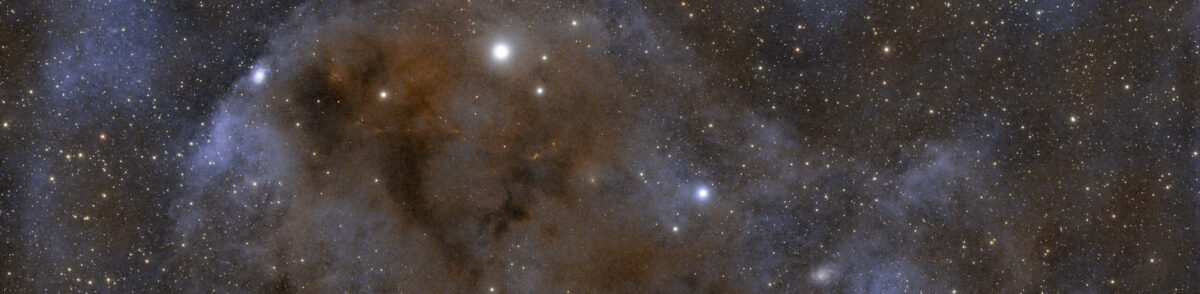
LBN 746 is a reflection nebula located approximately 947 light-years away in the constellation Aries. It is part of the Lynds’ Catalogue of Bright Nebulae. It is often identified as a portion of the larger vdB 16 (van den Bergh 16) nebulosity.
LBN 746 is embedded within a dense region of cosmic dust. It is surrounded by dark nebulae. These include LDN 1452 and several Barnard objects such as Barnard 202, 203, 204, and 206.
LBN 746 is situated near the border of Aries and Taurus. It lies about 7 degrees northwest of the Pleiades star cluster. For Astro photographers, this region is known for its complex mix of “light and dust.” Capturing the subtle interactions between the blue reflection light of vdB 16 is a detailed process. Observing the surrounding dark molecular clouds requires time. Long exposure photography is necessary.
Image acquisition and session automation using APT. This image consists of approximately 12 hours of exposure. The equipment used included an RC8 telescope and an ASI071MC Pro camera. They were mounted on a skywatcher Eq6r Pro Mount. Subframe calibration, alignment, integration, and processing performed manually in PixInsight. Astrobin link for all the details.
The object listed as Sh2-229 in the Sharpless catalog is the Flaming Star Nebula. It is also known as IC 405 or Caldwell 31. It is a combination emission and reflection nebula located in the constellation Auriga. The nebula surrounds the hot, bluish, irregular variable star AE Aurigae. This massive O-type star (about 23 solar masses) is responsible for illuminating the surrounding gas and dust.
Sh2-229 displays both emission (reddish glow from ionized hydrogen gas) and reflection (bluish cast from dust scattering starlight) properties. The “flaming” appearance is largely due to the bright red hydrogen emission.
I captured 166 240s subframes from my driveway. I used a Skywatcher Eq6r Pro mount, a Skywatcher Esprit 120ED telescope, and an ASI2600MC Pro camera cooled to 15f. APT was used for session management and automation. PixInsight was used to calibrate, align, integrate and process the image.
Messier 95 (M95 or NGC 3351) is a barred spiral galaxy. It is located approximately 33 million light-years away. You can find it in the constellation Leo. It is a notable member of the Leo I galaxy group. The group also includes other Messier objects like M96 and M105.
M95 has a prominent linear bar structure that crosses its core. It also has tightly wound spiral arms that form a nearly circular inner ring. This inner ring is an active region with a high rate of star formation. It sparkles with the light of countless young, blue stars.
Another of the Sharpless catalog objects is Sh2-119. It is also known as the Clamshell Nebula. This nebula is a large emission nebula in the constellation Cygnus. It is an active star-forming region located approximately 2,200 light-years from Earth.
Its shape has been described as resembling an open clam shell with a “pearl” inside. The nebula glows due to the intense ultraviolet radiation. Powerful stellar winds come from the bright, fifth-magnitude star 68 Cygni. The star is located near the center. These winds also cause the nebula to glow. This radiation ionizes the surrounding hydrogen gas, causing it to emit light. This image is of the core of the clamshell with 68 Cygni at the center.
The region contains a complex network of gas and dust clouds. This network includes several darker nebulae and Bok globules where new stars are forming. Sh2-119 is situated a few degrees east of the more famous and brighter North America Nebula (NGC 7000). Astro photographers often overlook it because of its proximity to the Pelican Nebula.
APT was used for session management and automation acquiring 123 4 minute images over two nights. Cygnus passes meridian right at dark here in the hills of WNC. PixInsight was used to calibrate, integrate, and process the image.
Messier 1 (M 1), the Crab Nebula, is a really beautiful cosmic structure. Its unique aspect is that it was the first astronomical object recognized as being connected to a supernova explosion.
In the early twentieth century, scientists analyzed early photographs of the nebula taken several years apart. The analysis revealed that it was expanding. Tracing the expansion back revealed that the nebula must have become visible on Earth about 900 years before. Historical records revealed the original supernova was extremely bright. Chinese astronomers recorded it in 1054 AD as a “guest star.” It was visible in the daytime for several weeks and at night for nearly two years.
At its center is a rapidly spinning neutron star, or pulsar (the Crab Pulsar). It rotates about 30 times per second. This rotation powers the nebula’s intense radiation across the electromagnetic spectrum.
With an apparent magnitude of 8.4, the Crab Nebula is not visible to the naked eye. It can be spotted with binoculars or a small telescope. It appears as a faint, oval patch of light. This is best viewed during winter months in the Northern Hemisphere. You need larger telescopes to discern the intricate details. Long-exposure astrophotography reveals the filamentary structure that gives the nebula its name.
This image consists of 331 subframes, or 18 hours of 3 min exposures. These were taken from my driveway with a RC8 telescope at 1625mm fl @ f8. I used an ASI071MC camera cooled to 15f. This setup involved a Radian Ultra quad-band narrow-band filter. APT was used for image acqusition and session automation. Pixinsight was used to calibrate, integrate, and process the image. Link for acquisition details and annotated image.
I learned of this a very long time ago in school. I think it’s just awesome that I took a photograph of it 50 years later. It exists out there in space, about 6,500 light years from earth!
A faint diffused Nebula in Cassiopeia. I chose it because of the dark nebula amid the apparent reflection nebula. There are 7 cataloged LDN targets in this image. These clouds of dust are so dense. They block all light behind them. This creates the subtle illusion of rivers running through the clouds. It is indeed a faint cloud of Hii gas.
Astrobin link for acquisition details and annotated image.
An uncommon bonus is that this image includes three members of the Sharpless Catalog of 313 HII regions. These are emission nebulae in the northern hemisphere. They are Sh2-192; Sh2-193; and Sh2-194. Sh2-192 is the very faint nebula in the middle of the image. Sh2-193 is the larger, still faint, nebula just below Sh2-192. Sh2-194 is the larger bright ball of gas to the right of both of the others.
Sh2-192 is an emission nebula located in the constellation Cassiopeia. Sh2-192 is part of a small group of nebulae. This group includes Sh2-193 and Sh2-194. They are located near the larger and well-known Heart and Soul Nebulae (IC 1805 and IC 1848).
Image captured using APT for session management and automation. Processed manually in PixInsight to its natural color.
See the Astrobin link for gear used, exposures, annotated image, etc.
This is round two for me on this target. The first experienced significant reflections from the Antlia Quad Broadband LP filter. So, I’m back at it during the full moon using the Radian Ultra Quad-Band narrow band filter. This beautiful but faint planetary nebula was imaged from my driveway at home. It was discovered in 1983 by the astronomers Herbert Hartl, Johann Dengel, and Ronald Weinberger. In 1987, further narrowband observations detected a large faint outer halo extending further than the central shell. However, it wasn’t confirmed to be a true genuine planetary nebula until 2017.
It has been given the name of Bear Claw Nebula for the imprint found on the central shell. Looks a lot like a bears print. This could be the faintest object I’ve ever attempted to image. After many hours of integration the Nebula began to appear. Individual subs showed absolutely nothing but stars and it is an impressive starfield! This is 15 hours of exposure using 156 6 minute subs.
Imaging sessions controlled and automated by Astro Photography Tool (APT 4.65.2). Two nights from 11/3/2025 using 360″ exposures on a RC8 telescope and ASI071MC camera atop an Eq6r Pro mount. 15 hours of exposure. Processed manually in Pixinsight.
The main object in this image is LBN 878. It is the red and brown nebula dominating the field. The full nebula complex is a combination of emission and dark nebulae. The complex blends emission nebulae. They glow with ionized gas. Dark nebulae obscure background starlight. Together, they create a striking celestial portrait.
Included in this overall object structure is LBN 879 which is in association with the variable star FU Ori. LBN 879 is the small bright nebula in the center and is also known as CED 59. The dark nebula Barnard 35 encompasses the LBN 879 structure. The very dark portion of the red part of LBN 878 is the dark nebula LDN 1594. Here’s the annotated astrobin image. It has all the acquisition detail and identifies every object in the photograph.
Barnard 35 and its illuminated rim (LBN 878) are part of the larger Sharpless 264 (Sh2-264) region. This area is commonly called the Lambda Orionis Ring.
This colossal star-forming complex combines a giant molecular cloud. It also features an expansive H II region. These elements are centered around the massive star Lambda Orionis. The yellow-tinged Cederblad 59 nebula (LBN 879) envelops FU Orionis. It serves as a visual anchor within Barnard 35’s dark clouds. This nebula illustrates the dynamic processes of stellar birth and evolution in this active Orion neighborhood.
I took this photograph during a full moon from my driveway in the hills of the Blue Ridge Mountains. I used a skywatcher Esprit 120ED scope. I paired it with an ASI 2600MC camera cooled to 15f and an Antlia Quad Broadband light pollution filter. The kit sits atop a skywatcher Eq6r Pro mount. APT controls the image acquisition and automation. Pixinsight used for image calibration, alignment, integration, and processing.