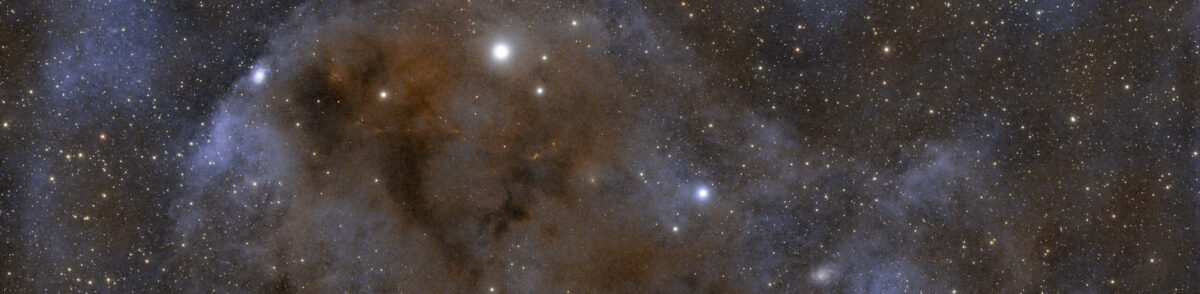
Capturing Nebula Sh2-239: A Challenge in Astrophotography

Sh2-239 - a dark cloud in Taurus

I’ll start by sharing that this may very well be the most difficult target I have ever imaged. It is shrouded in dark nebula. So much dust that there was at most two guide stars for the OAG on the RC8 to guide on. Processing wasn’t much easier. A slight reflection in the dust off my Antlia Quad-band light pollution filter has caused me to stop it’s use. Going back to the LPro. This target truly needs to be shot with a mono camera.

Cataloged as Sh2-239 and LDN 1551, the region lies near the southern end of the Taurus molecular cloud complex. It is some 450 light-years distant. The region stretches for nearly 3 light-years. It abounds with signs of embedded young stellar objects. These objects drive dynamic outflows into the surrounding medium.

Near the center of the frame is a compact, tell-tale red jet of shocked hydrogen gas. It is close to the position of infrared source IRS5. IRS5 is known to be a system of protostars surrounded by dust disks. Just below it are the wings of HH 102. They are broader and brighter. HH 102 is one of the region’s many Herbig-Haro objects. These are nebulosity’s linked to newly born stars. Estimates suggest that the star forming LDN 1551 region contains a large amount of material. This amount is equivalent to about 50 times the mass of the Sun.

The image was captured with a RC8 f/8 telescope. The focal length was 1625mm. An ASI071MC camera was used atop a Skywatcher Eq6r Pro mount. Imaged from my driveway in the hills of western North Carolina. Session management by Astro Photography Tool (APT 4.60). Image calibrated, aligned, integrated, and processed in a natural colors manually in PixInsight.

Exploring Sh2-284: The Colorful Emission Nebula

Sh2-284 & LBN 984 - space dust in Monoceros

Sh2-284 is a colorful emission nebula in the constellation Monoceros. It is the southernmost in a chain of nebulae below the Rosette Nebula. It is by far the most interesting of the three. It does not have a nickname, but is often mistakenly called the Little Rosette Nebula (which is in fact Sh2-270).

There is so much in this image I much prefer to look at the annotated version in Astrobin. I encourage you to have a look, no strings!

Sh2-284 can be found in Monoceros in the Winter sky. It is not far from the brightest star in the sky: Sirius, as well as Betelgeuse in Orion. Sh2-284 can be seen from a dark site using a telescope or a pair of binoculars. It looks similar to the Rosette Nebula, but slightly fainter and much smaller.

Sh2-284 is a star formation region, and at its center there is a cluster of young stars, dubbed Dolidze 25. The radiation from this cluster is powerful enough to ionize the hydrogen gas in the nebula’s cloud. It is this ionization that produces its bright orange and red colors.

This image consists of 231 exposures, each 300 seconds long. They were taken with a Skywatcher Esprit 120ED telescope and an ASI2600MC OSC camera at f/15. The setup was atop a Skywatcher Eq6r Pro mount. Astro Photography Tool (APT4.60) handled the acquisition session management and automation coordinating all of the gear used. These images were calibrated, aligned, integrated and processed manually in its natural colors using PixInsight.

Exploring Sh2-290: The Ancient Planetary Nebula

Sh2-290 Planetary Nebula in Cancer

Sh2-290 (also known as Abell 31 or PK 219+31.1) is an ancient planetary nebula in the constellation of Cancer. It is estimated to be about 2,000 light years away.

Although it is one of the largest planetary nebulae in the sky, it is not very bright. The central star of the planetary nebula is a white dwarf with a spectral type of DAO. A planetary nebula is created when a low-mass star blows off its outer layers at the end of its life. The white dwarf is the dead remains of a star that existed but had died leaving behind Sh2-290. This is exactly what is expected of our star when it runs out of fuel in about 5 billion years.

Sh2-290 is made mostly of hydrogen and oxygen gas. The red gas signifies hydrogen gas, and the greenish hues signify the oxygen gas. The nebula has a bright central region being most of the nebula and a red ring around this blue/green region. The nebula, due to its ancient age, has its gas being dispersed into the interstellar medium.

This image was captured over five nights in January 2025. The image consists of 192 exposures, each lasting 5 minutes. These were taken with an f/8 RC8 telescope at 1626mm fl. An asi071MC color camera, cooled to 15f, was used atop a Skywatcher Eq6r pro mount. Image acquisition using Astro Photography Tool (APT) and processed manually in PixInsight.

Astrobin Link

Sh2-278 Nebula in Orion

Sh2-278 in Orion

Sh2-278 sits halfway between M 42 and the Witch’s Head Nebula in the Orion constellation, about 2.5° north of Rigel. It has a triangular structure that is prominent in H-alpha. This structure is surrounded by several faint reflection nebulae. These include LBN 964 to the east, LBN 945 to the northwest, and LBN 937/LBN 942 to the north. It is an incredibly pretty and unique object, but it is very faint. The combination of dim molecular cloud with ionized hydrogen makes it challenging both to capture and to process.

The glow here may be extended red emission. It sits just off the edge of the Orion A molecular cloud. This is the cloud containing M42. However, it is not clear if it is a remnant of that group or a distinct cloud.

Imaged from my driveway in the hills of WNC. Session management with Astro Photography Tool (APT 4.60), image processed manually with PixInsight processes.

It’s referred to as the Wolf Head Nebula, but I don’t see it.

Astrobin Link ==> https://astrob.in/6j0jyd/0/

NGC 3079 – Phantom Frisbee Galaxy

NGC 3079 - The Phantom Frisbee Galaxy

A barred spiral galaxy about 50 million light-years away, and located in the constellation Ursa Major. I found this to be bright, small, and colorful. At 1625mm fl with the RC8 it still looks small. Session management with Astrophotography Tool (APT); processing in PixInsight.

50 Million Light-Years..

LBN 673 – The Soul Nebula core

LBN 673 - The Soul Nebula core

A beautiful range of starry peaks, known as LBN 673, connects two cloud structures within the Soul Nebula (IC 1848). The Soul Nebula is a large emission nebula located in Cassiopeia and is often associated with its companion Heart Nebula.

LBN 673 is an emission nebula contained with the Soul Nebula. A close look at the structures within was my goal. I see a troll guarding the bridge in a crevasse between two peeks, but that’s just me. The entire area reminds me of those Rorschach tests the shrinks use. Have a go. See what you see?

https://astrob.in/bwo2o7/0 Astrobin link for this image.

Sh2-227 – Hii in Auriga

Sh2-227 - Hii in Auriga

You don’t see a lot of images of Sh2-227. It’s really faint, and it is outshone by nearby IC405 (Flaming Star Nebula) and IC410 (The Tadpoles). I initially wanted to capture it to see what structure I could reveal. After 8 hours, I felt like I’d got a fair image of the regions. However, I wanted less noise. So, I spent another 7.5 hours on it.

Sh2-227 is an emission nebula visible in the constellation Auriga. It is located within the large pentagon that constitutes the constellation. It is a short distance from the open cluster NGC 1857, seen at the bottom of this image. The best period for its observation in the evening sky falls between the months of October and March. Observers find it considerably easier to observe in the regions of the Earth’s northern hemisphere.

Sh2-212 – The Tribbles

Sh2-212 - The Tribbles

NGC 1624, also known as Sh2-212 in the Sharpless catalog, is a very young open cluster. It is located in the constellation Perseus inside an emission nebula. Sh2-212 is the large Hii ball of emission nebula on the right side of my photograph. Sh2-211 is the smaller ball of gas on the left. Together they are known as the Tribbles, I assume from StarTrek lore – “Spock: “Most curious creature, Captain. Its trilling seems to have a tranquilizing effect on the human nervous system.”” – Star Trek “Trouble with Tribbles”

SH2-212 is ~20,000 light-years away. Latest estimates put it very young at only 4 million years old. SH2-211 is embedded in the same CO cloud. It is around the same distance and age. In the image, there are also beautiful dark and light dust lanes and a handful of galaxies. A couple of the galaxies are very interesting to me for their sheer distance from us.

Sh 2-212 is located high above the galactic plane in the outer galaxy. It contains the star cluster NGC 1624 and may be embedded in the same CO cloud as Sh 2-211.

The data for this photograph was acquired using Astro Photography Tool (APT 4.60) running on a NUC mounted to my OTA over the course of 4 nights in December 2024 using a Skywatcher Esprit 120ED telescope at 860mm fl, ASI2600MC camera cooled to 15f, aboard a Skywatcher Eq6r Pro mount. A touch over 10 hours of exposure.

Processed manually in Pixinsight. Steps included Image Calibration, Cosmetic Correction, Debayer, and SFS. This was followed by Star Align and SA Ref frame integration. Star Align used the reference frame. Lnorm Ref Frame integration and Local Normalization with a reference frame were also conducted. Image Integration and Drizzle Integration 1X were performed with a 0.9 drop with Lnorm data applied. The edges were cropped. Then, Image Solve and SpFC with filters were used. MsGC was applied, and Blurx Correction only was done. SPCC with background neutralization was followed by BlurX, NoiseX, and StarX. GHS was applied to the stars, and curves were adjusted for star saturation. GHS was applied to the starless image. Curves and mask iterations were used. LHE was performed. Finally, the stars were blended back into the starless image. Save as a Tiff for saving as a jpeg in PS Camera Raw.

Cheers!

M 100 – Blowdryer Galaxy

M 100 - The Blow Dryer Galaxy

Messier 100 (also known as NGC 4321 or the Blow Dryer Galaxy) is a grand design intermediate spiral galaxy. It is located in the southern part of the mildly northern Coma Berenices. It is one of the brightest galaxies in the Virgo Cluster. It is also one of the largest. The galaxy is approximately 55 million light-years from our galaxy.

It was one of the first spiral galaxies to be discovered. Lord William Parsons of Rosse listed it as one of fourteen spiral nebulae in 1850. NGC 4323 and NGC 4328 are satellite galaxies of M100. NGC 4323 is connected to M100 by a bridge of luminous matter.

Messier 100 is considered a starburst galaxy. The strongest star formation activity is concentrated in its center. This occurs within a ring, which is actually two tightly wound spiral arms. These are attached to a small nuclear bar with a radius of one thousand parsecs. Star formation has been taking place here for at least 500 million years in separate bursts.

As usual on spiral galaxies of the Virgo Cluster, the rest of the disk shows truncated star formation. It also contains neutral hydrogen. M100 is deficient in these elements compared to isolated spiral galaxies of similar Hubble type. This truncation is caused by interactions with the intracluster medium of Virgo.

This image was captured from my driveway in the hills of North Carolina in Bortle 4ish skies. It consists of 192 240″ exposures through an RC8 scope paired with an ASI071MC camera atop an Eq6r Pro mount. Image session management with APT 4.60 and processed manually in PixInsight.

Verified by MonsterInsights