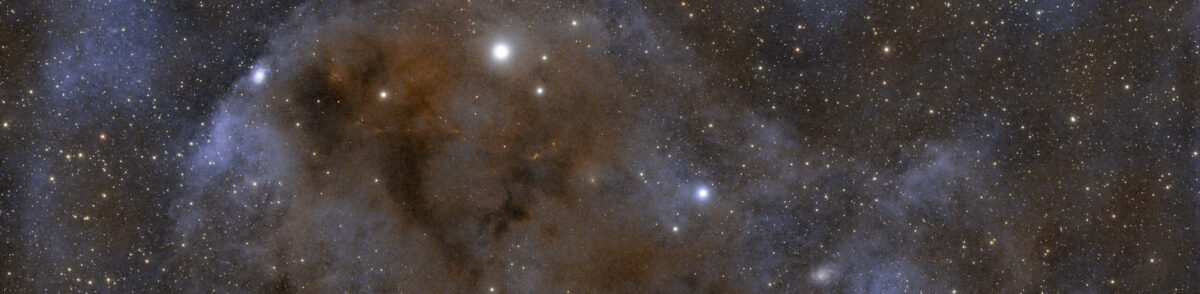
You don’t see a lot of images of Sh2-227. It’s really faint, and it is outshone by nearby IC405 (Flaming Star Nebula) and IC410 (The Tadpoles). I initially wanted to capture it to see what structure I could reveal. After 8 hours, I felt like I’d got a fair image of the regions. However, I wanted less noise. So, I spent another 7.5 hours on it.
Sh2-227 is an emission nebula visible in the constellation Auriga. It is located within the large pentagon that constitutes the constellation. It is a short distance from the open cluster NGC 1857, seen at the bottom of this image. The best period for its observation in the evening sky falls between the months of October and March. Observers find it considerably easier to observe in the regions of the Earth’s northern hemisphere.
NGC 1624, also known as Sh2-212 in the Sharpless catalog, is a very young open cluster. It is located in the constellation Perseus inside an emission nebula. Sh2-212 is the large Hii ball of emission nebula on the right side of my photograph. Sh2-211 is the smaller ball of gas on the left. Together they are known as the Tribbles, I assume from StarTrek lore – “Spock: “Most curious creature, Captain. Its trilling seems to have a tranquilizing effect on the human nervous system.”” – Star Trek “Trouble with Tribbles”
SH2-212 is ~20,000 light-years away. Latest estimates put it very young at only 4 million years old. SH2-211 is embedded in the same CO cloud. It is around the same distance and age. In the image, there are also beautiful dark and light dust lanes and a handful of galaxies. A couple of the galaxies are very interesting to me for their sheer distance from us.
Sh 2-212 is located high above the galactic plane in the outer galaxy. It contains the star cluster NGC 1624 and may be embedded in the same CO cloud as Sh 2-211.
The data for this photograph was acquired using Astro Photography Tool (APT 4.60) running on a NUC mounted to my OTA over the course of 4 nights in December 2024 using a Skywatcher Esprit 120ED telescope at 860mm fl, ASI2600MC camera cooled to 15f, aboard a Skywatcher Eq6r Pro mount. A touch over 10 hours of exposure.
Processed manually in Pixinsight. Steps included Image Calibration, Cosmetic Correction, Debayer, and SFS. This was followed by Star Align and SA Ref frame integration. Star Align used the reference frame. Lnorm Ref Frame integration and Local Normalization with a reference frame were also conducted. Image Integration and Drizzle Integration 1X were performed with a 0.9 drop with Lnorm data applied. The edges were cropped. Then, Image Solve and SpFC with filters were used. MsGC was applied, and Blurx Correction only was done. SPCC with background neutralization was followed by BlurX, NoiseX, and StarX. GHS was applied to the stars, and curves were adjusted for star saturation. GHS was applied to the starless image. Curves and mask iterations were used. LHE was performed. Finally, the stars were blended back into the starless image. Save as a Tiff for saving as a jpeg in PS Camera Raw.
Messier 100 (also known as NGC 4321 or the Blow Dryer Galaxy) is a grand design intermediate spiral galaxy. It is located in the southern part of the mildly northern Coma Berenices. It is one of the brightest galaxies in the Virgo Cluster. It is also one of the largest. The galaxy is approximately 55 million light-years from our galaxy.
It was one of the first spiral galaxies to be discovered. Lord William Parsons of Rosse listed it as one of fourteen spiral nebulae in 1850. NGC 4323 and NGC 4328 are satellite galaxies of M100. NGC 4323 is connected to M100 by a bridge of luminous matter.
Messier 100 is considered a starburst galaxy. The strongest star formation activity is concentrated in its center. This occurs within a ring, which is actually two tightly wound spiral arms. These are attached to a small nuclear bar with a radius of one thousand parsecs. Star formation has been taking place here for at least 500 million years in separate bursts.
As usual on spiral galaxies of the Virgo Cluster, the rest of the disk shows truncated star formation. It also contains neutral hydrogen. M100 is deficient in these elements compared to isolated spiral galaxies of similar Hubble type. This truncation is caused by interactions with the intracluster medium of Virgo.
This image was captured from my driveway in the hills of North Carolina in Bortle 4ish skies. It consists of 192 240″ exposures through an RC8 scope paired with an ASI071MC camera atop an Eq6r Pro mount. Image session management with APT 4.60 and processed manually in PixInsight.
A bright moon and gusty winds didn’t deter the creation of this image. Poor seeing, operator error, and clouds for a couple of hours also didn’t stop it. This is most likely my last image of 2024. The forecast for clear nights after the full moon passes doesn’t look promising.
I present my version of the “Dusty Hand Galaxy.” Also known as NGC 2146, it is a barred spiral galaxy in the constellation Camelopardalis. It is unique due to the dusty spiral arm that is looping the core from our perspective. Potentially the result of a galaxy merge at its end stage. A result is intense star formation, to such an extent that NGC 2146 is referred to as a starburst galaxy. This is a common state for barred spirals. However, the extra gravitational disruption that NGC 2146 is enduring no doubt exacerbates the situation. This compression of hydrogen-rich nebulas triggers stellar birth.
Image acquisition via Astro Photography Tool (APT), processing with Pixinsight. RC8 telescope, ASI071MC camera, & Eq6r Pro mount.
I choose to image this pair of Nebula while perusing images of the Sharpless Catalog online. I didn’t realize how faint and small they are at the time. This image integrates 7 hours of exposure. It uses a GSO RC8 at 1627mm fl and a ZWO ASI071MC camera atop a Skywatcher EQ6r Pro mount. All are controlled and integrated by APT, Astro Photography Tool.
Sharpless 2-207 is a star-forming region, similar to a miniature version of the Rosette Nebula. Despite its appearance, this is an HII region ionised by an O9.5 IV star and not a planetary nebula. The star cluster in the western part of the nebula is about 2-3 million years old. Its kinetic distance is about 4 kpc. The smaller H-II region Sharpless 2-208 is at about the same distance.
The nebulae Sh 2-207 and Sh 2-208 are located on the border of the constellation Camelopardalis to Perseus. The best viewing time is September to March, when the circumpolar constellation is at its highest. These are very dim and require long exposure and adequate focal length. They are surrounded by the Perseus hydrogen cloud but that would require much more integration time to bring out. Perhaps another year.
There’s not much else to say about a couple of balls of ionized hydrogen in space.
Although it was included in the Sharpless Catalogue of Hii regions, it is actually a very dim planetary nebula. It is located at a distance of 711 light years from the Solar System in the constellation, Cassiopeia. Based upon its expansion rate it is thought to be about 7500 years old.
Planetary nebulae are formed when a star dies of “old age” and expels ionized shells of gas. The nebula is nearly circular in shape. It is much brighter to the southeast (lower right) because the central star is moving rapidly in that direction. Faint wisps of gas can also be seen in the opposite direction.
Planetary nebulae are usually symmetrical in shape, but that isn’t the case of Sh2-188. The Shrimp Nebula is believed to travel through space at an incredible rate. It moves about 300,000 miles per hour. It is also going through layers of the interstellar medium. This impacts the shape of the nebula and makes it asymmetrical. The bright part of the nebula is the bow shock. It occurs as a fast-moving planetary nebula interacts with the interstellar medium.
The Shrimp Nebula is not bright enough to be seen with the naked eye or binoculars. Its small size doesn’t help either. It is also very difficult to see with a telescope. This is particularly true if you are not observing from a very dark site far from light pollution. For imaging, a long focal length telescope on an equatorial mount is very helpful. And then a lot of exposure is required to bring out this dim PN.
APT is controlling the imaging sessions. This image represents about 20 hours of exposure. It uses a GSO RC8 at 1625mm fl and a ZWO ASI071MC camera. The setup is atop a Skywatcher EQ6r Pro mount. The Antlia quad-band light pollution filter was used in my bortle 4 sky.
Sh 2-155 (also designated Caldwell 9) lies in the plane of our Milky Way galaxy. It is a diffuse nebula in the constellation Cepheus. It resides within a larger nebula complex containing emission, reflection, and dark nebulosity. It is widely known as the Cave Nebula. Sh 2-155 is an ionized H II region. There is ongoing star formation activity. It is at an estimated distance of 2400 light-years from Earth.
Patrick Moore coined the name “Cave Nebula” for this object. The name was presumably derived from photographic images showing a curved arc of emission nebulosity. This arc corresponds to a cave mouth. The “Caldwell Cave” is a bright H II emission nebula. It curves around in an arc and resembles the mouth of a cave. The nebula is part of a much larger Cepheus B molecular cloud. It contains hot, young stars that illuminate and ionize hydrogen gas.
This image is presented in the HOO “hubble palette”.
NGC 1579 (also known as the Northern Trifid) is a diffuse nebula located in the constellation of Perseus. It is referred to as the Northern Trifid because it resembles the Trifid Nebula. The Trifid Nebula is located in the southern celestial hemisphere of our sky. It is a H II region, a region of star formation. It is smaller and further away than its namesake, lying 2,100 light years away in the constellation Perseus. It is about 3 light years across and contains both reddish and blue components. The blue is reflection nebula, where dust behind the stars reflects starlight. The red in this case is not from the usual emission of hydrogen.
The star cluster contains the emission-line star LkHα 101, which provides much of the ionizing radiation in the nebula. This massive young star emits light strongly in hydrogen alpha. Dust within the core of the nebula dims and reddens this light. Additional dust and soot is evident above and below the nebula in large areas that contain few stars.
NGC 1579 lies within a giant molecular cloud known as the California Molecular Cloud.
Image acquisition, focusing, guiding and mount control with APT, Astro-Photography Tool. Light calibration, integration, and image processing performed manually in PixInsight. Skywatcher Esprit 120ED at f/7 and ZWO 2600MC Pro with a Radian Ultra Quad-Band narrowband filter at 4nm. 164 5 minute exposures for a total of 13.6 hours of exposure.
Messier 74, The Phantom Galaxy, is a large spiral galaxy in the equatorial constellation Pisces. It is about 32 million light-years away from Earth. The galaxy contains two clearly defined spiral arms. Therefore, it is used as an archetypal example of a grand design spiral galaxy. It is estimated that there are 100 billion stars in M 74.
The galaxy’s low surface brightness makes it the most difficult Messier object for amateur astronomers to observe. This difficulty gives rise to its nickname, Phantom. M74 has two spiral arms that wind counterclockwise from the galaxy’s center. The spiral arms widen as they get farther from M74’s center, but one of the arms narrows at the end.
This image was taken over two nights, on November 29th and December 3rd, 2024. I used a GSO RC8 telescope at 1625mm. An ASI071MC Pro camera was aboard a Skywatcher EQ6r Pro Mount. Acquisition session management by APT, image processing using Pixinsight.
Sh2-135 is an H II emission nebula in the constellation Cepheus without a common name.
It is located about 10,000 light-years away in the southern part of the constellation. The most suitable period for its observation in the evening sky falls between July and December. Observatories in Earth’s northern hemisphere find it especially easy. There, it is circumpolar up to warm temperate regions.
I captured this image using APT for session management. It controlled a Skywatcher EQ6r Pro mount. I used a Skywatcher Esprit 120ed telescope at 860mm FL. The camera was an ASI2600MC Pro astro camera. I had an assortment of goodies as well.
Sh2-135 is the bright circular shaped object on the left side of the image. A ball of Hydrogen gas ionized by newly formed stars. The bottom center gas clouds are cataloged as LBN 486 in Lynd’s Bright Nebula catalog (LBN). The bright irregular nebula on the right is a combination of several entries, LBN 489, LBN 490, and LBN 491.