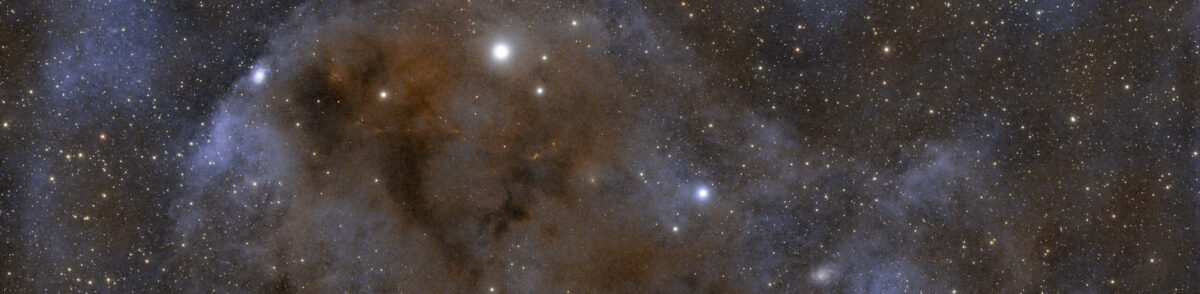
Hidden in the outskirts of the Orion constellation, close to the Witchhead Nebula (IC 2118), we can find an area rich in interstellar gas and dust around the reflection nebula NGC 1788. This bright deep sky object attracts our attention among all that faint dust and gas. It is flanked by the dark nebula known as Lynds 1616.
I began imaging NGC 1788 on January 1st and continued on the nights of Jan 4th, 7th, 10th and 11th. I acquired a touch over 200 5 minute exposures. I remember it was bloody cold! This was imaged with the Skywatcher Esprit 120ED telescope at 840mm focal length using a ZWO ASI2600MC camera.
NGC 1788 is about 2,000 light years away from Earth and is sometimes called the “Cosmic Bat” nebula. It is made up of blue reflection regions, lots of dust, and a glowing area of hydrogen gas. It is close to the celestial equator, so it is sometimes visible from both hemispheres at certain times of the year. The brightest star in the nebula is 10th magnitude and is in the northwest sector.
Although this ghostly cloud is rather isolated from Orion’s bright stars, their powerful winds and light have a strong impact on the nebula, forging its shape and making it a home to a multitude of newborn stars.
I’ve enjoyed imaging these reflection nebula showing something a little different in our night sky.
The first thing that struck me as I began to see this image unfold is the vast number of stars found in the illuminated sky. Varying temperatures are seen in the gases with hot Hydrogen gases glowing in reddish hues with cooler gases expanding outward.
IC 2177 is a region of nebulosity that lies along the border between the constellations Monoceros and Canis Major. The name Seagull Nebula is sometimes applied by astronomers to this emission region as it resembles a gull in flight, although it also includes the neighboring regions of star clusters, dust clouds and reflection nebulae.
Astronomers catalog the nebula as IC 2177. This cosmic cloud is one of many sites of star formation within the Milky Way galaxy. It is located 3,800 light-years away from Earth, inside the Orion spur — the same partial spiral arm of the Milky Way where our solar system is located. The nebula is nearly 240 light-years across.
NGC 2327 is located in IC 2177. It is also known as the Seagull’s Head, due to its larger presence in the Seagull nebula. Astronomers list the region near the seagull’s eye (or lizard’s hip) as NGC 2327, which contains a cluster of stars born about 1.5 million years ago. The eye is the brightest and hottest of the newborn stars in the entire nebula, and heats up the dust so that it glows in infrared light.
Dominated by the reddish glow of atomic hydrogen, the complex of gas and dust clouds with bright young stars spans over 100 light-years at an estimated 3,800 light-year distance.
This image consists of 11 hours of exposures with an ASI071MC pro OSC camera connected to a WO Z73 doublet refractor telescope riding a SW EQ6r Pro mount. Image acquisition with APT, processing in PixInsight.
The Monkey Head Nebula (also known as NGC 2174 and Sharpless Sh2-252) is a star-forming region located 6,400 light-years away in the constellation Orion in which bright, newborn stars near the center of the nebula illuminate the surrounding gas with energetic radiation. The nebula is mostly composed of hydrogen gas. The cloud is sculpted by ultraviolet light carving into the cool hydrogen gas and dust. As the interstellar dust particles are warmed from the radiation from the stars in the center of the nebula, they heat up and begin to glow at infrared wavelengths.
The prime source of energy in the nebula is the massive, hot star named HD 42088. This star has a mass 30 times that of our Sun and a surface temperature 6 times greater. Such stars emit extraordinary amounts of ultraviolet radiation. The high-energy particles in these stars’ outer atmospheres are being blown away in high-speed “stellar winds.”
The ultraviolet radiation causes the nebula to shine. In combination with the stellar wind, this radiation also causes the nebula to expand. Dust and gas are being evaporated and scattered by the energy from the hot star. Where there is a very dense condensation, a pillar is formed pointing toward the star, because the knot shields the material behind it.
If the knot is dense enough, rather than scattering, it may be pushed to collapse into a new star. Such an event is occurring in a pillar above center right of the image. This cannot be seen in visible light, because those wavelengths are blocked by the pillar’s dust. The new star will eventually shed its dusty cocoon and emerge to be seen in optical wavelengths.
This image was captured January 22nd and 23rd 2021 and is made up of 163 240s subs. It was taken with an ASI071MC Pro camera, with OPT Radian Quad Ultra filter, attached to a WO Z73 refractor telescope riding a SkyWatcher EQ6r Pro mount. Guding via a WO 50mm guidescope and ASI120mm mini camera. Pegasus PBA provides power distribution and USB connectivity. QHY Polemaster for precise polar alignment. Senso Sesto electronic focuser.
Flame and Horsehead Nebula in the Orion Molecular Cloud
The Orion Molecular Cloud Complex is situated close to the celestial equator and, as such, it is at least partly visible from both hemispheres in certain times of the year. This means that astrophotographers all over the world are able to share their images of the areas targets including this Flame, Horsehead, Orion, Running Man and De Marian’s Nebula among others. Here in the northern hemispehere its a winter target. Clear cold nights allow for stunning images.
This image captures several distinct items. The Flame Nebula, designated as NGC 2024 and Sh2-277, is an emission nebula situated just next to the very bright star Alnitak. It is about 900 to 1,500 light-years away. That bright star Alnitak (ζ Ori), the easternmost star in the Belt of Orion, shines energetic ultraviolet light into the Flame and this knocks electrons away from the great clouds of hydrogen gas that reside there. Much of the glow results when the electrons and ionized hydrogen recombine. Additional dark gas and dust lies in front of the bright part of the nebula and this is what causes the dark network that appears in the center of the glowing gas. In this center is a concentrated cluster of newly formed stars.
The Flame Nebula is part of the Orion Molecular Cloud Complex, a star-forming region that includes the famous Horsehead Nebula. The Horsehead Nebula (also known as Barnard 33) is a small dark nebula in the constellation Orion. The nebula is located just to the south of that bright star, Alnitak, the easternmost star of Orion’s Belt within the Orion Molecular Cloud Complex. It appears within the southern region of the dense dust cloud known as Lynds 1630, along the edge of the much larger, active star-forming H II region called IC 434, which is the backdrop of the Horsehead.
The Horsehead Nebula is approximately 422 parsecs or 1,375 light-years from Earth. It is one of the most identifiable nebulae because of its resemblance to a horse’s head. The nebula was first recorded in 1888 by Scottish astronomer Williamina Fleming on a photographic plate taken at the Harvard College Observatory. One of the first descriptions was made by E. E. Barnard, describing it as: “Dark mass, diam. 4′, on nebulous strip extending south from ζ Orionis”, cataloguing the dark nebula as Barnard 33 The dark cloud of dust and gas is a region in the Orion Molecular Cloud Complex where star formation is taking place.
Colour images reveal a deep-red colour that originates from ionised hydrogen gas (Hα) predominantly behind the nebula, and caused by the nearby bright star Sigma Orionis. Magnetic fields channel the gases, leaving the nebula into streams, shown as foreground streaks against the background glow. A glowing strip of hydrogen gas marks the edge of the enormous cloud, and the densities of nearby stars are noticeably different on either side.
Heavy concentrations of dust in the Horsehead Nebula region and neighbouring Orion Nebula are localized into interstellar clouds, resulting in alternating sections of nearly complete opacity and transparency. The darkness of the Horsehead is caused mostly by thick dust blocking the light of stars behind it. The lower part of the Horsehead’s neck casts a shadow to the left. The visible dark nebula emerging from the gaseous complex is an active site of the formation of “low-mass” stars. Bright spots in the Horsehead Nebula’s base are young stars just in the process of forming.
Orion Nebula (M42); De Mairan’s Nebula (M43); Running Man Nebula (Sh2-279)
The Orion Nebula (also known as Messier 42, M42, or NGC 1976) is a diffuse nebula situated in the Milky Way south of Orion’s Belt in the constellation of Orion. It is one of the brightest nebulae, and is visible to the naked eye in the night sky. M42 is located at a distance of 1,344 light years and is the closest region of massive star formation to Earth. The M42 nebula is estimated to be 24 light years across. It has a mass of about 2,000 times that of the Sun.
De Mairan’s Nebula (M43) is a star-forming nebula with a prominent H II region in the equatorial constellation of Orion. It was discovered by the French scientist Jean-Jacques Dortous de Mairan some time before 1731, then catalogued by French astronomer Charles Messier on March 4, 1769. The De Mairan’s Nebula is part of the Orion Nebula (M42), being separated from the main nebula by a dense lane of dust known as the northeast dark lane. It is part of the much larger Orion Molecular Cloud Complex.
The main ionizing star in this nebula is HD 37061, which is positioned near the center of the H II region and located 1,300ly from the Sun. This is a triple star system with the brighter component being a single-lined spectroscopic binary. The main component is a blue-white hued B-type main-sequence star with a stellar classification of B0.5V or B1V. It has 19 times the mass of the Sun and 5.7 times the Sun’s radius. The star is radiating over 26,000 times the Sun’s luminosity from its photosphere at an effective temperature of 31,000 K. It is spinning rapidly with a projected rotational velocity of around 200 km/s.
The H II region of M43 is a roundish volume of ionized hydrogen centered on HD 37061. There is a dark lane crossing in front of the region from north to south, known as the M43 dark lane.
Sh2-279 (Running Man Nebula) is an HII region and bright nebulae that includes a reflection nebula located in the constellation Orion. It is the northernmost part of the asterism known as Orion’s Sword, lying 0.6° north of the Orion Nebula. The reflection nebula embedded in Sh2-279 is popularly known as the Running Man Nebula. The Running Man Nebula is a popular target for amateur astrophotographers, as it lies close to the Orion Nebula and has many nearby guide stars. The outline of the running man shows up primarily in photographs; it is difficult to perceive visually through telescopes, though the reflection nebula itself is visible in small to medium apertures in dark skies.
The Orion Nebula is one of the most scrutinized and photographed objects in the night sky, and is among the most intensely studied celestial features. While that may be true, it was a very difficult target to photograph without blowing out the core and the large stars. It is surrounded by hydrogen gas as seen in the red hues thoughout. The dark nebula of M43 as well as the Running Man nebula add character to the image.
The nebula has revealed much about the process of how stars and planetary systems are formed from collapsing clouds of gas and dust. Astronomers have directly observed protoplanetary disks, brown dwarfs, intense and turbulent motions of the gas, and the photo-ionizing effects of massive nearby stars in the nebula.
The Nebula is visible with the naked eye even from areas affected by some light pollution. It is seen as the middle “star” in the “sword” of Orion, which are the three stars located south of Orion’s Belt. The star appears fuzzy to sharp-eyed observers, and the nebulosity is obvious through binoculars or a small telescope.
The Orion Nebula contains a very young open cluster, known as the Trapezium due to the asterism of its primary four stars. Two of these can be resolved into their component binary systems on nights with good seeing, giving a total of six stars. The stars of the Trapezium, along with many other stars, are still in their early years. The Trapezium is a component of the much larger Orion Nebula Cluster, an association of about 2,800 stars within a diameter of 20 light years. Two million years ago this cluster may have been the home of the runaway stars AE Aurigae, 53 Arietis, and Mu Columbae, which are currently moving away from the nebula at speeds greater than 100 km/s (62 mi/s).
There has been speculation that the Mayans of Central America may have described the nebula within their “Three Hearthstones” creation myth; if so, the three would correspond to two stars at the base of Orion, Rigel and Saiph, and another, Alnitak at the tip of the “belt” of the imagined hunter, the vertices of a nearly perfect equilateral triangle with Orion’s Sword (including the Orion Nebula) in the middle of the triangle seen as the smudge of smoke from copal incense in a modern myth, or, in an ancient one, the literal or figurative embers of a fiery creation.
I encourage you to have a read of the wikipedia information available. The observing and photographic history of this complex is very interesting. Who knew that in the 1600’s people made telescopes?
A sickle for cutting hay or some sort of weapon – that’s what I first saw.
Flaming Star Nebula
The Flaming Star nebula (IC405 or Caldwell 31) is fairly unique nebula in the constellation Auriga with obvious emission and reflection components.
At first when imaging this target it appears as an isolated piece of Nebula taking the shape of a sickle for cutting hay or long grass back in the day. (yeah, I’m old). But as the stretch began on this image and the Ha & OIII were rejoined the enormity of the nebulosity became apparent.
Specifically, there’s this faint wisp that is present in the center of the nebula. Both components are due, either directly or indirectly (via dust), to the illumination of the bluish runaway star AE Aurigae. It lies ~1500 light years away from Earth and is about five light years across. It is believed that the proper motion of the central star can be traced back to the Orion’s Belt area. This nebula is very close to the Tadpoles nebula (bottom left of the image).
This image is comprised of 248 subs collected in November 2020 – (81 @ 180s; 129 @ 240s; 38 @ 360s = 987 minutes of exposure or 16.45 hours)
Gear: EQ6r Pro Eq mount; WO Z73 scope; ZWO ASI071MC Pro OSC camera; WO 50mm guidescope; ZWO ASI120mm mini guide camera; Senso Sesto 2 Focuser; Pegasus PBA; Polemaster
Software: Stellarium for planning; APT for image capture; PHD2 guiding; Pixinsight for processing; PS for metadata update and jpg creation.
The Soul Nebula is an emission nebula located in the constellation Cassiopeia.
Soul Nebula in Cassiopeia
In astrophotography the key to a good image is integration time, especially if you image with a broadband color camera. This image now consists of 6 hours of exposure on this target. As a newbie in this hobby it takes me time to process an image so I try to wait until sufficient data has been collected before starting the process. Of course opportunities for imaging are sparse in the cloudy nights of summer here in the blue ridge. Fall is coming!
The Soul Nebula is an emission nebula located in the constellation Cassiopeia. It forms a famous pair known as the Heart and Soul with the neighbouring Heart Nebula (IC 1805). The Soul Nebula is sometimes also known as the Embryo Nebula or IC 1848, which is a designation used for the open star cluster embedded within the nebula.
The Heart and Soul Nebulae complex spans an area about 300 light years across and is a vast star-forming region illuminated by the light of the young stars surrounded by star-forming clouds of dust and gas. The two large clouds are separated by only 2.5 degrees and physically connected by a bridge of gas. The stars in the region are less than a few million years old and are only beginning their life. For comparison, our Sun has been around for almost 5 billion years.
Thanks for visiting and don’t foget to subscribe below.
NGC 6910 – Inchworm Cluster / Rocking Horse Cluster. It is a small open cluster located near Gamma Cygni (Sadr) in the constellation of Cygnus. It lies approximately 3700 light years away, near the galactic plane. It is embedded in IC 1316, a much larger emission nebula.
Sadr, Gamma Cygni (γ Cyg) is a yellow-white supergiant star. With an apparent magnitude of 2.23, it is the constellation’s second brightest star, after Deneb. Sadr lies at an approximate distance of 1,800 light years from Earth. It is the star that marks the intersection of the Northern Cross, a bright asterism that dominates the summer sky in the northern hemisphere. Sadr lies in a rich field of the Milky Way and is surrounded by the diffuse emission nebula IC 1318, also known as the Gamma Cygni Nebula or Sadr Region.
IC 1318 – Sadr is surrounded by the emission nebula IC 1318, one of the several nebulous regions at the centre of the Northern Cross. IC 1318 is known as the Gamma Cygni Nebula, Sadr Region or the Butterfly Nebula. It is not physically related to Sadr, but merely lies in the same line of sight. The nebula is located much farther away than the star, at a distance of 4,900 light years. The star that illuminates IC 1318 is a hot, blue O9-class star obscured by interstellar dust.
Sadr is the central star of the Northern Cross, also formed by the bright Deneb (Alpha Cygni), Albireo (Beta Cygni), Aljanah (Epsilon Cygni) and Fawaris (Delta Cygni). Deneb, Sadr and Albireo form the pole of the cross, while Aljanah and Fawaris mark the crossbeam.
The name Sadr (pronunciation: /ˈsædər/) comes from the Arabic ṣadr, meaning “chest.” It has the same etymology as the name of Alpha Cassiopeiae, Schedar. The name has also been spelled Sadir or Sador. It refers to the star’s position in the constellation, marking the Swan’s chest. The name was officially approved by the International Astronomical Union’s (IAU) Working Group on Star Names (WGSN) on August 21, 2016. It formally applies only to Gamma Cygni A.
Sadr is very easy to find because it lies at the intersection of the bright, large Northern Cross asterism. The Northern Cross is easy to spot on a clear night. It lies within the larger Summer Triangle, a brighter summer asterism formed by Deneb with Vega in the constellation Lyra and Altair in Aquila.
Sadr is located in the vicinity of several interesting deep sky objects. The Rocking Horse Cluster (NGC 6910) is an open cluster located only half a degree east and a little north of the star. It is at a similar distance as the Gamma Cygni Nebula and may be physically associated with it. The cluster has an apparent magnitude of 7.4 and occupies an area of 10’. The neighbouring open cluster Collinder 419 (Cr 419) is only slightly fainter, with a visual magnitude of 7.60.
Sadr is located in the constellation Cygnus. Representing the celestial Swan, Cygnus is one of the larger northern constellations, stretching across 804 square degrees of the apparent sky. It is known mainly for the Northern Cross and its bright stars Deneb, the 19th brightest star in the sky, and Albireo, a famous contrasting double.
The Sadr Region of Cygnus
The constellation contains a number of well-known deep sky objects, among others the bright open clusters Messier 29, Messier 39 and NGC 6910, the Fireworks Galaxy (NGC 6946), and several bright nebulae, including the North America Nebula (NGC 7000), the Pelican Nebula (IC 5070), the Veil Nebula (NGC 6960, 6962, 6979, 6992 and 6995), the blinking planetary nebula (NGC 6826), and the nebulae near Sadr: the Gamma Cygni Nebula (IC 1318) and the Crescent Nebula (NGC 6888).
The best time of year to see the stars and deep sky objects in the constellation is during the month of September.
Key Facts & Summary
Sadr is located at around 1,800 light-years / 560 parsecs away from the Sun.
Sadr is the second brightest star in the constellation of Cygnus, after Deneb. This star is also among the brightest stars in the night sky.
Its location marks the intersection of the Northern Cross, a bright asterism that dominates the summer sky in the northern hemisphere.
In comparison to our Sun, Sadr is around 33,023 times brighter, yet it is several times younger, having an estimated age of around 12 million years.
Sadr has around 12.11 solar masses and a radius of 150 times that of our Sun.
Sadr is a supergiant star of spectral type FB8 lab, appearing yellowish-white in color.
The star is surrounded by a diffuse nebula called IC 1318, or the Gamma Cygni region.
The star’s name, Sadr, is derived from Arabic and it translates to “chest.” The same word gave rise to the name of the star Schedar – Alpha Cassiopeiae.
Sadr formed at around 12 million years ago from an interstellar medium of gas and dust. Gravity pulled the swirling gas and dust together until it reached the critical temperature, giving birth to the second-brightest star in Cygnus, named Sadr.
It is quite a young star and the interstellar medium from which it was born was probably abundant in elements such as hydrogen, thus the reason for its short lifespan, as Sadr will eventually go supernova.
Sadr has reached the supergiant stage of its stellar evolution and thus its radius has expanded and it will probably continue to expand several times its former size.
Since Sadr is so massive, it will one day go supernova and illuminate a big portion of the night sky, despite being such a young star.
The Elephant’s Trunk Nebula is a concentration of interstellar gas and dust within the much larger ionized gas region IC 1396 located in the constellation Cepheus about 2,400 light years away from Earth. The piece of the nebula shown here is the dark, dense globule IC 1396A; it is commonly called the Elephant’s Trunk nebula because of its appearance at visible light wavelengths, where there is a dark patch with a bright, sinuous rim. The bright rim is the surface of the dense cloud that is being illuminated and ionized by a very bright, massive star (HD 206267) that is just to the east of IC 1396A.
Elephant’s Trunk Nebula
The Elephant’s Trunk Nebula is now thought to be a site of star formation, containing several very young (less than 100,000 yr) stars that were discovered in infrared images in 2003. Two older (but still young, a couple of million years, by the standards of stars, which live for billions of years) stars are present in a small, circular cavity in the head of the globule. Winds from these young stars may have emptied the cavity.
The combined action of the light from the massive star ionizing and compressing the rim of the cloud, and the wind from the young stars shifting gas from the center outward lead to very high compression in the Elephant’s Trunk Nebula. This pressure has triggered the current generation of protostars.
Very happy to have captured this piece of our night sky from Burke County, NC. A very peaceful night here in the hills of the blue Ridge. Any questions or comments, we’d love to hear from you.
North America Nebula (NGC 7000) – The portion of the nebula resembling Mexico and Central America is known as the Cygnus Wall. This region exhibits the most concentrated star formation.
The North America Nebula and the nearby Pelican Nebula (IC 5070) are parts of the same interstellar cloud of ionized hydrogen (H II region). Between the Earth and the nebula complex lies a band of interstellar dust that absorbs the light of stars and nebulae behind it, and thereby determines the nebula’s apparent shape.
My first target in Astrophotography was the North America Nebula framed with the Pelican Nebula. The name is obvious as this dust cloud really looks like the continent. There has been a lot of stuff to learn in photographing objects in our dark sky. The initial image is as you might expect – black with a few white dots! This version of the nebula is comprised of 48 images or 2 1/2 hours of exposure obtained over two nights of imaging. My first night was not very productive (learning curve is steep).
Once the images have been obtained they have to be debayered, aligned, registered and stacked. While PixInsight (PI) can do this, I prefer DeepSkyStacker (DSS) and feel it does a better job than my manual workings in PI. After stacking I do switch to PI for most of the processing and then Photoshop(PS) for the final tweaks.
All of this is run from my Acer Netbook, which I remotely manage from my home office (about 40 yards away). Image acquisition is totally performed with Astro Photography Tool (APT). Everything is intergrated via ASCOM drivers. It took over a month to understand all of the technology involved. I learned that capturing the photograph is only half the job! Truly looking forward to mastering this over the years.