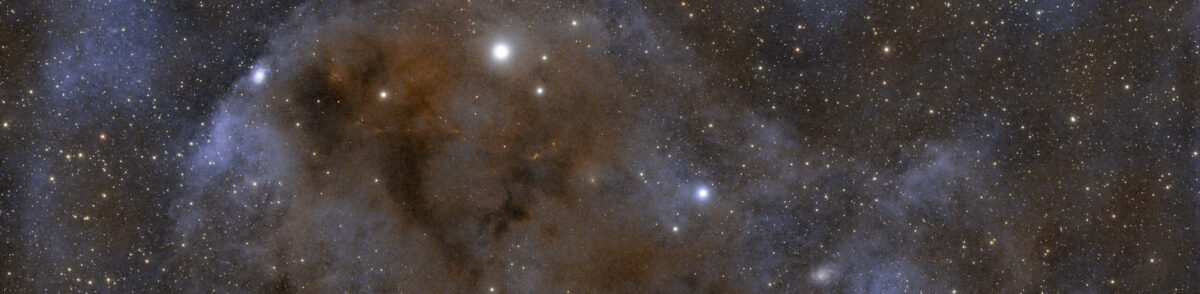
Sh2-280 is a faint, diffuse emission nebula situated in constellation Monoceros. It is mainly an ionized hydrogen cloud. There is also a little oxygen around the bow-shock of the ionizing star at the center – HD46573. Sh2-280 is approximately 5,500 light-years away and near the Rosette Nebula.
This target sits very low in my southern sky. I imaged this over 4 nights in March 2025 using a Skywatcher Esprit 120ED telescope and an ASI2600MC camera. APT 4.62 – image acquisition and session control. Image calibrated, aligned, integrated and processed manually in PixInsight.
A globular star Cluster (M 53) is located in Coma Berenices. It is one of the most distant globular clusters, situated 59k ly from earth. Globular star clusters are found in the galactic plane of our Milky Way Galaxy. They cause the massive glow of our core.
M 53 appears to be connected to the nearby globular cluster NGC 5053 by a tidal bridge-like structure. To the right is a low mass globular cluster cataloged as NGC 5053 – 56k ly from earth. This is a metal-poor cluster. This means the stars have a low abundance of elements other than hydrogen and helium. Astronomers term this “metallicity”. As recently as 1995, it was considered the most metal-poor globular cluster in the Milky Way.
The chemical abundances of the stars in NGC 5053 are similar to those in the dwarf galaxy. Specifically, they resemble the Sagittarius Dwarf Spheroidal Galaxy. They differ from those in the Milky Way halo. The kinematics of the globular cluster support this idea. This suggests that NGC 5053 may have been stripped from the dwarf galaxy.
This image centers on a three galaxies in the Leo Constellation.
They are NGC 3384, M 105, and NGC 3389. A lesser player to the left is IC 642, it’s tiny. Annotated astrobin link.
NGC 3384 is a lenticular galaxy in the constellation Leo, about 35 million light-years away.
Messier 105 or M 105, also known as NGC 3379, is an elliptical galaxy 36.6 million light-years away in the equatorial constellation of Leo. It is the biggest elliptical galaxy in the Messier catalogue that is not in the Virgo cluster.
NGC 3389, a spiral galaxy in Leo. While not large I did manage to get some detail of this galaxy.
Sh2-247 is a round diffused nebula positioned at the western edge of Gemini near a boundary on Orion. It is part of the Gemini OB1 molecular cloud complex and is located near the boundary with Orion. Admittedly, it’s not very exciting to look at.
It’s located near the Monkey Head Nebula as well as the Jellyfish Nebula.
Imaged over three nights, this image consists of 161 5-minute exposures. These were taken with a GSO RC8 telescope at 1625mm f/8. It is paired with a ZWO ASI071MC camera atop a Skywatcher Eq6r Pro mount. Acquisition session management with Astro Photography Tool (APT 4.60). Image calibration, alignment, integration and processing performed manually in PixInsight.
Sharpless 265 (LBN 869) is a faint Hii region located approximately 1,300 light-years away in Orion. This one is a couple of degrees from the bright star Bellatrix. This area of the Orion constellation is rich in emission nebula. However, it is a much fainter area as well. This image of SH2-265 shows massive clouds of ionized hydrogen surrounded by cooler gases and dust. Long exposures help expose the fainter areas of this nebula.
This image consists of 164 exposures. Each exposure is 300 seconds long. The image is captured using a Skywatcher Esprit 120ED camera. It is paired with a ZWO ASI2600MC camera and mounted atop a Skywatcher Eq6r Pro mount. Image acquisition session management via Astro Photography Tool (APT 4.60). Image calibrated, aligned, integrated and processed manually in PixInsight.
Messier 99 is a grand design spiral galaxy, completely unbarred and with two giant spiral arms. One of the spiral arms is normal and the other appears distorted. M99 is slightly asymmetric in shape. The nucleus is shifted from the galaxy’s center. This is likely due to interactions with other galaxies in the Virgo Cluster.
This galaxy seems to be known as both the Virgo Pinwheel Galaxy and St. Catherine’s Wheel. It is located in the northern constellation Coma Berenices, approximately 49,000,000 light-years from the Milky Way. That’s 49 million times 5.8 trillion miles away.
I imaged this over two nights from my driveway in January 2025. I used an RC8 with an ASI071MC camera atop a Skywatcher Eq6r Pro mount. It consists of 128 180″ exposures calibrated, integrated and processed manually using PixInsight.
Sh2-284 is a colorful emission nebula in the constellation Monoceros. It is the southernmost in a chain of nebulae below the Rosette Nebula. It is by far the most interesting of the three. It does not have a nickname, but is often mistakenly called the Little Rosette Nebula (which is in fact Sh2-270).
There is so much in this image I much prefer to look at the annotated version in Astrobin. I encourage you to have a look, no strings!
Sh2-284 can be found in Monoceros in the Winter sky. It is not far from the brightest star in the sky: Sirius, as well as Betelgeuse in Orion. Sh2-284 can be seen from a dark site using a telescope or a pair of binoculars. It looks similar to the Rosette Nebula, but slightly fainter and much smaller.
Sh2-284 is a star formation region, and at its center there is a cluster of young stars, dubbed Dolidze 25. The radiation from this cluster is powerful enough to ionize the hydrogen gas in the nebula’s cloud. It is this ionization that produces its bright orange and red colors.
This image consists of 231 exposures, each 300 seconds long. They were taken with a Skywatcher Esprit 120ED telescope and an ASI2600MC OSC camera at f/15. The setup was atop a Skywatcher Eq6r Pro mount. Astro Photography Tool (APT4.60) handled the acquisition session management and automation coordinating all of the gear used. These images were calibrated, aligned, integrated and processed manually in its natural colors using PixInsight.
Sh2-278 sits halfway between M 42 and the Witch’s Head Nebula in the Orion constellation, about 2.5° north of Rigel. It has a triangular structure that is prominent in H-alpha. This structure is surrounded by several faint reflection nebulae. These include LBN 964 to the east, LBN 945 to the northwest, and LBN 937/LBN 942 to the north. It is an incredibly pretty and unique object, but it is very faint. The combination of dim molecular cloud with ionized hydrogen makes it challenging both to capture and to process.
The glow here may be extended red emission. It sits just off the edge of the Orion A molecular cloud. This is the cloud containing M42. However, it is not clear if it is a remnant of that group or a distinct cloud.
Imaged from my driveway in the hills of WNC. Session management with Astro Photography Tool (APT 4.60), image processed manually with PixInsight processes.
It’s referred to as the Wolf Head Nebula, but I don’t see it.
A barred spiral galaxy about 50 million light-years away, and located in the constellation Ursa Major. I found this to be bright, small, and colorful. At 1625mm fl with the RC8 it still looks small. Session management with Astrophotography Tool (APT); processing in PixInsight.
This is Sh2-216. It is a planetary nebula in the constellation Perseus. Planetary nebulae get their name because they are generally spherical. In the crude telescopes of centuries past, they appeared similar to the much closer planets of our own solar system. The astronomers of old did not realize the scale of our galaxy. They assumed these nebulae might be similar to our planetary brothers. This led to their name.
These objects are remnants of a stage in the death of larger stars. During this stage, stars convulse and blow off their outer layers of material into space. In the case of Sh2-216, the stellar explosion occurred some half million years ago. It left behind the core of the progenitor star, a white dwarf. There is also a slowly expanding cloud of mostly ionized hydrogen.
This particular object is the closest planetary nebula to us at only 400 light years distance. It’s proximity also makes it the largest in apparent diameter at 1.6 degrees – over three times that of our Moon. But it is very FAINT! The expanding hydrogen gas is extremely thin, requiring long exposure photography to show it. It is completely invisible to the naked eye, and isn’t visible in a single five minute camera exposure. This is a stack of 222 5 minute exposures, or 18.5 hours.
It won’t fit in my 860 mm Fl Esprit 120ED due to its size. Therefore, I focused on a bright outer band of gas. Image acquisition using APT 4.60. Processed manually in PI.