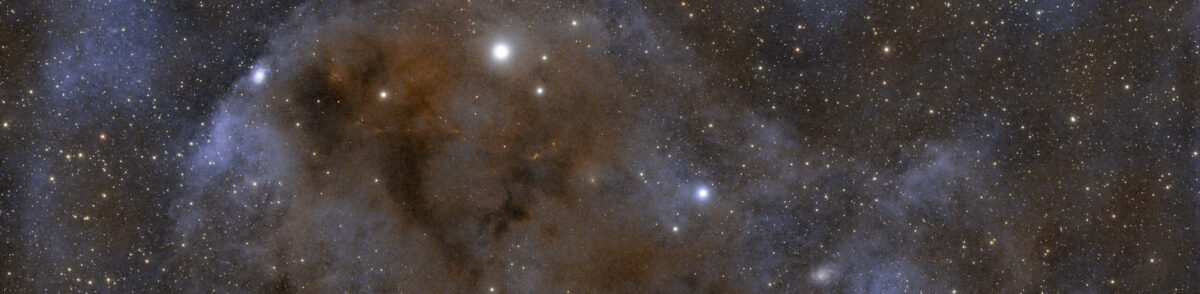
Astronomers like to name things, based upon resemblance if possible, to make them easier to remember. LDN 1622 is called the “Boogeyman Nebula”.
I chose to image it because of the dense dark molecular cloud structure against the hydrogen rich background. I chose the wider field of the SkyWatcher Esprit 120ED triplet refractor telescope to capture the space behind the huge Barnards Loop hydrogen cloud that is home for the Boogeyman. A cloud within a cloud within a cloud, if you will.
LDN 1622 is close to the plane of our Milky Way Galaxy, close to Barnard’s Loop, a large cloud surrounding the Belt and Sword of Orion. It is a fairly dim target, at 1,300 light-years away, requiring long exposure photography to illuminate its beauty. My image consists of 20.5 hours of exposure using an Antlia quadband light pollution filter with a ZWO 2600MC pro camera on a Skywatcher Eq6r Pro mount.
I hope you enjoy this unique image from the Orion Constellation.
The Silver Sliver Galaxy Caldwell 23, also known as NGC 891, is an edge-on unbarred spiral galaxy located in the constellation Andromeda.
It is about 30 million light-years away from Earth and is best viewed in our fall season. A spindle-shaped galaxy that is viewed almost edge-on, it is also known as the Silver Sliver Galaxy, the Outer Limits Galaxy, and the Silver Needle Galaxy.
C 23 is visible in small to moderate size telescopes as a faint elongated smear of light with a dust lane visible in larger apertures. Its outskirts are populated by multiple low-surface brightness, and vast substructures, like giant streams that loop around the parent galaxy. The bulge and the disk are surrounded by a flat and thick cocoon-like stellar structure.
In popular 1960’s culture, NGC 891 appears alongside M67, the Sombrero Galaxy, the Pinwheel Galaxy, NGC 5128, NGC 1300, M81, and the Andromeda Galaxy in the end credits of the Outer Limits TV series, which is why it is occasionally called the Outer Limits Galaxy.
This image was taken December 19th, 2023 and January 31st 2024 with a RC8 telescope at 1625mm and ASI071MC camera riding an EQ6r Pro mount. I hope you enjoy this galaxy image.
Hidden in the outskirts of the Orion constellation, close to the Witchhead Nebula (IC 2118), we can find an area rich in interstellar gas and dust around the reflection nebula NGC 1788. This bright deep sky object attracts our attention among all that faint dust and gas. It is flanked by the dark nebula known as Lynds 1616.
I began imaging NGC 1788 on January 1st and continued on the nights of Jan 4th, 7th, 10th and 11th. I acquired a touch over 200 5 minute exposures. I remember it was bloody cold! This was imaged with the Skywatcher Esprit 120ED telescope at 840mm focal length using a ZWO ASI2600MC camera.
NGC 1788 is about 2,000 light years away from Earth and is sometimes called the “Cosmic Bat” nebula. It is made up of blue reflection regions, lots of dust, and a glowing area of hydrogen gas. It is close to the celestial equator, so it is sometimes visible from both hemispheres at certain times of the year. The brightest star in the nebula is 10th magnitude and is in the northwest sector.
Although this ghostly cloud is rather isolated from Orion’s bright stars, their powerful winds and light have a strong impact on the nebula, forging its shape and making it a home to a multitude of newborn stars.
I’ve enjoyed imaging these reflection nebula showing something a little different in our night sky.
The Monkey Head Nebula (also known as NGC 2174 and Sharpless Sh2-252) is a star-forming region located 6,400 light-years away in the constellation Orion in which bright, newborn stars near the center of the nebula illuminate the surrounding gas with energetic radiation. The nebula is mostly composed of hydrogen gas. The cloud is sculpted by ultraviolet light carving into the cool hydrogen gas and dust. As the interstellar dust particles are warmed from the radiation from the stars in the center of the nebula, they heat up and begin to glow at infrared wavelengths.
The prime source of energy in the nebula is the massive, hot star named HD 42088. This star has a mass 30 times that of our Sun and a surface temperature 6 times greater. Such stars emit extraordinary amounts of ultraviolet radiation. The high-energy particles in these stars’ outer atmospheres are being blown away in high-speed “stellar winds.”
The ultraviolet radiation causes the nebula to shine. In combination with the stellar wind, this radiation also causes the nebula to expand. Dust and gas are being evaporated and scattered by the energy from the hot star. Where there is a very dense condensation, a pillar is formed pointing toward the star, because the knot shields the material behind it.
If the knot is dense enough, rather than scattering, it may be pushed to collapse into a new star. Such an event is occurring in a pillar above center right of the image. This cannot be seen in visible light, because those wavelengths are blocked by the pillar’s dust. The new star will eventually shed its dusty cocoon and emerge to be seen in optical wavelengths.
This image was captured January 22nd and 23rd 2021 and is made up of 163 240s subs. It was taken with an ASI071MC Pro camera, with OPT Radian Quad Ultra filter, attached to a WO Z73 refractor telescope riding a SkyWatcher EQ6r Pro mount. Guding via a WO 50mm guidescope and ASI120mm mini camera. Pegasus PBA provides power distribution and USB connectivity. QHY Polemaster for precise polar alignment. Senso Sesto electronic focuser.
Sharpless 2-132, the Lion Nebula, is a very faint emission type nebula on the Cepheus/Lacerta border.
Lion Nebula in Cepheus
It is estimated to be about 10,000 to 12,000 light years away, but this is no more than an estimate.
This image consists of 16 hours of exposure from a ZWO ASI071MC OSC camera at -6c. Z73 440mm telescope riding a Skywatcher EQ6r Pro mount. Processed in PixInsight, sharpened and converted to jpg in Photoshop.
Night after night I would shoot this for a few hours with only a faint hint of a bright spot on the screen. Once I had 20 hours of data I began the processing journey. All calibrated, cosmetic correction, debayered, subframe selector weeded out about 4 hours of data that just wasn’t up to par. Weightings assigned, top 20 images identified, all frames registered to the best weighted frame, master reference image created from best 20, all frames reregistered to master reference frame, L_Norm reference frame generated, L_norm ran against all frames, finally image integration was run using calibrated, corrected, debayered, registered, lights & L_norm.
I was very pleasantly surprised when I got my first glimpse of this image. Just a little post processing required.
As winter continues more targets will be available to shoot. Sign up below to be notified of additions. Cheers!