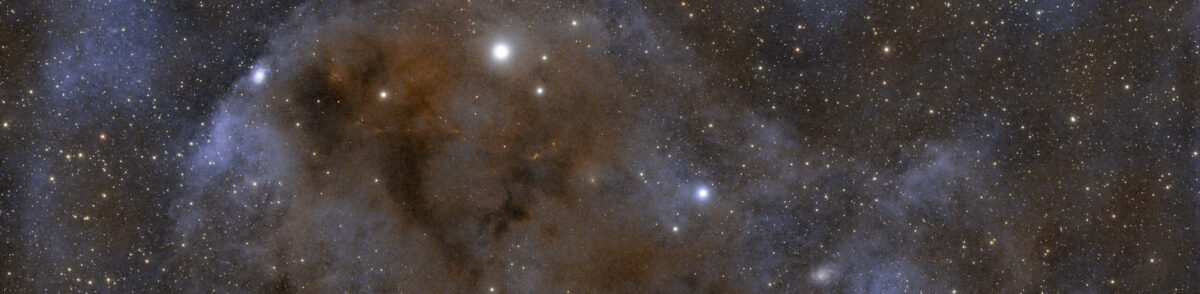
Imaging the Iris Nebula was a bit of a challenge for me. Dark nebula!
The Iris Nebula is a bright reflection nebula in the constellation Cepheus. The designation NGC 7023 refers to the open cluster within the larger reflection nebula designated LBN 487.
The bright blue reflection among the dark nebula is striking. A few very bright stars in the region add a bit of character.
This image is comprised of 92 light frames. No calibration frames. Dithered every image. I’ll try this target again once I have the Meade ETX-90 added to my mount.
North America Nebula (NGC 7000) – The portion of the nebula resembling Mexico and Central America is known as the Cygnus Wall. This region exhibits the most concentrated star formation.
The North America Nebula and the nearby Pelican Nebula (IC 5070) are parts of the same interstellar cloud of ionized hydrogen (H II region). Between the Earth and the nebula complex lies a band of interstellar dust that absorbs the light of stars and nebulae behind it, and thereby determines the nebula’s apparent shape.
My first target in Astrophotography was the North America Nebula framed with the Pelican Nebula. The name is obvious as this dust cloud really looks like the continent. There has been a lot of stuff to learn in photographing objects in our dark sky. The initial image is as you might expect – black with a few white dots! This version of the nebula is comprised of 48 images or 2 1/2 hours of exposure obtained over two nights of imaging. My first night was not very productive (learning curve is steep).
Once the images have been obtained they have to be debayered, aligned, registered and stacked. While PixInsight (PI) can do this, I prefer DeepSkyStacker (DSS) and feel it does a better job than my manual workings in PI. After stacking I do switch to PI for most of the processing and then Photoshop(PS) for the final tweaks.
All of this is run from my Acer Netbook, which I remotely manage from my home office (about 40 yards away). Image acquisition is totally performed with Astro Photography Tool (APT). Everything is intergrated via ASCOM drivers. It took over a month to understand all of the technology involved. I learned that capturing the photograph is only half the job! Truly looking forward to mastering this over the years.
As a result of the Covid-19 stuff I looked for an avenue of photography that did not involve travel or people. I had always wanted to photograph the moon or the Milky Way but lacked the equipment to to do it right and honestly didn’t think it achievable. I sought help on Youtube! Trevor Jones at Astrobackyard.com is awesome and his tutorials convinced me that I could photograph the night sky after all – and the investment is less than a single dive trip!
My equipment after a lengthy wait.
Stay tuned for images as clear night skies allow. As always my images are presented in the Semper Iuvenis Galleries. Cheers!