Messier 63 or M 63 is also known as NGC 5055. It is sometimes called the Sunflower Galaxy. This spiral galaxy is in the northern constellation of Canes Venatici. It contains approximately 400 billion stars. The galaxy is located roughly 27 million light-years from Earth.
This colorful image is composed of 157 2 minute exposures, or 5.2 hours of exposure. It was taken using a GSO RC8 at 1627mm fl and ASI071MC Pro camera riding an EQ6r Pro mount.
Messier 83 or M 83, also known as the Southern Pinwheel Galaxy and NGC 5236, is a barred spiral galaxy. It is approximately 15 million light-years away. It is located in the constellation borders of Hydra and Centaurus. At a declination of -29:52, it is the most southerly target I can image. There are many nebulae in the arms of this face-on galaxy. This makes it an appealing target for photography.
This image is 49 3 minute exposures from a SW Esprit 120ED & ZWO ASI2600MC Pro riding an EQ6r Pro. Captured using APT and processed in PixInsight.
I centered my sensor on this Elliptical Galaxy in the Virgo constellation so I could frame the “Face”. NGC 4387 is situated close to the celestial equator. It is partly visible from both hemispheres at certain times of the year.
It is the nose in the commonly viewed Galactic Face of Virgo. NGC 4388 is the mouth while the eyes are the elliptical galaxies, M 86 and M 84, of Markarians chain.
NGC 4402 is the galaxy to the left and NGC 4413 is to the bottom right.
Caldwell 3 is located just north of the Big Dipper. It is one of at least 34 gravitationally bound galaxies in the Ursa Major galaxy group. This barred spiral galaxy, also known as NGC 4236, sits 11.7 million light-years from Earth in the constellation Draco and has an apparent magnitude of 9.6. Although faint, Caldwell 3 can be spotted using a small telescope from a dark-sky site. The best views are seen through large telescopes. They show the galaxy as a large, diffuse glow that’s brighter toward the center. It appears highest during the spring in the Northern Hemisphere.
As far as galaxies go, this is by far the faintest I have tried to image. This image consists of 115 5 minute subframes, for a total of 9.5 hours of exposure. Colorful dust lanes did appear. Imaged the evenings of May 12th, 27th and 28th, 2024.
A barred spiral galaxy located in the constellation Coma Berenices, about 40 million light-years away. It is an intermediate galaxy. It has a prominent ring structure. It is roughly the size of the Milky Way at over 100,000 light-years across. NGC 4725 is unique in that it only has one spiral arm, while most spiral galaxies have two or more. The galaxy’s center has a bar of stars. It is surrounded by a ring of stars. Astronomers call this formation a ringed barred spiral galaxy.
In this sharp color composite image, the solo spira mirabilis seems to wind from a prominent ring of bluish, newborn star clusters. It appears to originate from a distinct ring. The ring consists of bluish, newborn star clusters. It also appears to wind from red tinted star forming regions. The odd galaxy also sports obscuring dust lanes a yellowish central bar structure composed of an older population of stars. Also included in the frame is NGC 4712. It sports a noticeably more traditional spiral galaxy look. NGC 4712 is a more distant background galaxy.
Imaged 5/1, 5/10 and 5/11. The night of 5/10 was our Aurora Borealis event. Imaged from 21:30 to 02:00 each of these evenings. 136 4 minute subs were included, or 9 hours of exposure. Gear includes an f8 GSO RC8 telescope at 1625mm, an ASI071MC astro camera cooled to 15f, and an EQ6r Pro mount.
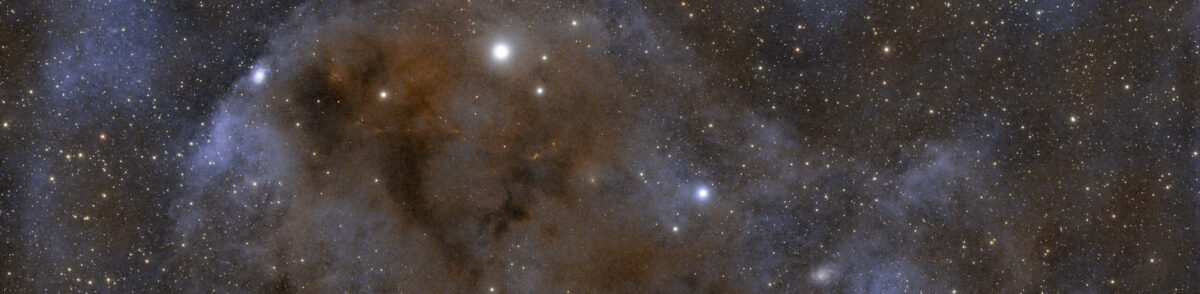
I continue my efforts in imaging reflection nebula from the vdB catalog. IC 4601, or vdB 103, is a bluish reflection nebula. It is located in the constellation Scorpius, about 420 light-years away from Earth.
It’s part of a larger area called the Blue Horsehead. Reflection nebulae are clouds of gas and dust. They shine by reflecting light from nearby stars. They do not create their own light. vdB 103’s blue color comes from the blue light reflected by the nebula’s gas and dust. This light is from two bright blue giant stars on the right. A double star on the left also contributes. The nebula’s brightness depends on the density and size of the reflecting grains. It also depends on the color and brightness of nearby stars.
Messier 15 (M15) is a globular cluster of stars in the constellation Pegasus, located about 32,620 light-years from Earth. It is one of the oldest known globular clusters, estimated to be around 12.5 billion years old. M15 is also one of the densest globular clusters, with most of its mass concentrated at its core.
M15 is part of a halo of nearly 150 globular clusters that surround the Milky Way galaxy. Each cluster is a spherical group of hundreds of thousands of ancient stars, with M15 containing both hot blue stars and cooler golden stars. The brightest stars in M15 have an apparent magnitude of 12.6, an absolute magnitude of -2.8, and a luminosity that is 1,000 times that of the Sun.
M101 – The Pinwheel Galaxy – is a face-on spiral galaxy 21 million light-years away from Earth in the constellation Ursa Major (Big Dipper). Located just west of the last star in the handle.
M101 is a large galaxy containing approx 1 trillion stars, with a diameter of 170,000 light-years. By comparison, the Milky Way has a diameter of between 100,000 and 120,000 light-years.
M101 has a high population of H II regions, many of which are very large and bright. H II regions usually accompany the enormous clouds of high density molecular hydrogen gas contracting under their own gravitational force where stars form. H II regions are ionized by large numbers of extremely bright and hot young stars; those in M101 are capable of creating hot superbubbles. In a 1990 study, 1,264 H II regions were cataloged in the galaxy. Three are prominent enough to receive New General Catalogue numbers—NGC 5461, NGC 5462, and NGC 5471.
There are at least 4 different galaxies resolved within this image. M101 is the largest and closest. NGC5474 is at the lower left. NGC5477 is above the bottom arm of M101 and appears equally distant between the two yellow stars. NGC5473 is at the far left of the image in the middle.
Image acquisition via APT using a SW Esprit120ED, ASI2600MC Pro, OPT L-Pro filter, & EQ6r Pro mount from my backyard in the hills of western NC.
Messier 104, also known as the Sombrero Galaxy, is an edge-on spiral galaxy in the Virgo constellation. It’s 28 million light-years away, 50,000 light-years across, and has a mass of 800 billion suns. It’s the brightest galaxy within a 32.6 million light-year radius of the Milky Way.
The Sombrero Galaxy is named for its resemblance to a Mexican hat, with a broad rim and high top. It’s best seen with small telescopes during the months of March, April, and May.
The galaxy has a supermassive black hole at its center. Hubble observations also reveal that the Sombrero Galaxy has nearly 2,000 globular clusters, which is 10 times more than in our galaxy. French astronomer Pierre Méchain discovered the Sombrero Galaxy in 1781, but it wasn’t included in Messier’s original catalog.
Stars The Sombrero Galaxy contains several hundred billion stars, about 100 times as many stars as there are people today on Earth.
Globular clusters The Sombrero Galaxy has an estimated 2,000 globular clusters, 10 times as many as orbit our Milky Way galaxy.
Dust lane The Sombrero Galaxy’s most striking feature is the dust lane that crosses in front of the bulge of the galaxy. This dust lane is actually a symmetrical ring that encloses the bulge of the galaxy.
Sh2-274, also known as the Medusa Nebula or Abell 21, is a planetary nebula in the constellation Gemini.
It is located 1,500 light-years away and has an estimated diameter of 4 light-years. The nebula is around 8,800 years old and was discovered in 1955 by UCLA astronomer George O. Abell
A planetary nebula is a region of cosmic gas and dust formed from the cast-off outer layers of a dying star. Despite their name, planetary nebulae have nothing to do with planets.
When stars with an intermediate mass (greater than 80% of the Sun’s mass, but less than eight times its mass) die, they expand to form red giants. The dying star will continue to expel gas, whilst simultaneously the remaining core of the star contracts and temporarily begins to radiate energy again. This energy causes the expelled gas to ionise, meaning that the atoms and molecules in the gas become charged and begin to emit light. The cast-off glowing gas is known as a planetary nebula. Therefore, planetary nebulae are classified as emission nebulae, and are entirely unrelated to planets.
The misnomer came about because of a historical misclassification. 250 years ago, astronomers thought they were looking at gas planets when they observed the colourful spectacle of planetary nebulae through their less powerful telescopes. Planetary nebulae only last for about 20 000 years, making them a very short-lived part of the stellar life cycle.