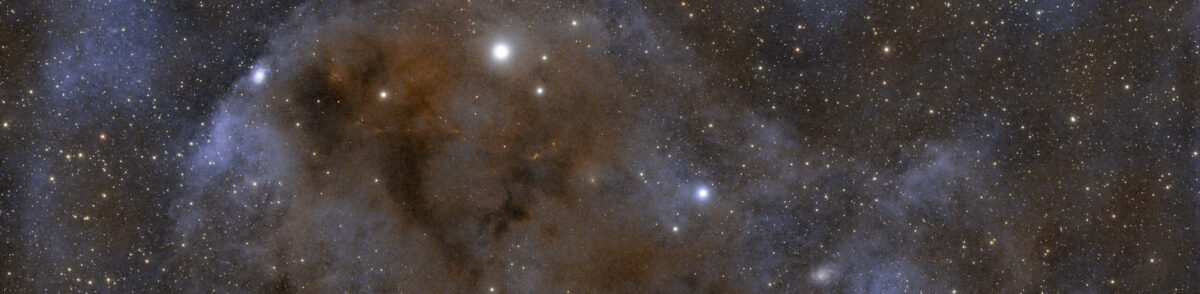
Sh2-114 Flying Dragon Nebula

Sh2-114 - Flying Dragon

SH2-114, better known as the “Flying Dragon Nebula,” is a VERY faint Hii emission nebula in the constellation of Cygnus. Also cataloged as LBN 347, it is part of a larger complex that includes SH2-113.

This large curving filamentary structure seems to be part of a supernova. However, no supernova remnant has been identified as the source. The shape of the nebula is most often seen as a winged dragon or bat. A combination of intense stellar winds emitted by massive, hot, O and B stars forms this structure. These winds interact with magnetic fields within the interstellar medium.

Other than this – not much more is known about this object. It is certainly not a common target for Astrophotography and is too faint for visual observation.

Directly above the right wing, halfway between the wing and the edge of the frame, is a planetary nebula. This is cataloged as Kronberger (Kn) 26, and it is a bipolar emission nebula.

I chose to image this with my RC8 and 071MC OSC camera. As it is a very dim target, I spent multiple nights gathering data, in a bright moon no less. More data to be acquired in coming years.

Sh2-261 – Lower’s Nebula

SH2-261 / Lower's Nebula

Lower’s nebula (Sh2-261) is found on the outermost edge of our Milky Way between the Orion and Perseus arm. Sh2-261 is a large faint region of predominantly ionized hydrogen. The nebula is named after Harold and Charles Lower who discovered this nebula in 1939.

I took 300 4 minute exposures over the course of 5 nights in October 2024. I used APT, Astro Photography Tool, from my driveway here in the hills of western North Carolina.

As a predominantly ionized hydrogen (Hii) gas cloud, Lower’s Nebula takes on a distinct reddish hue in long exposure astrophotography. I applied an HOO color map to the final image to help highlight structures and dark nebula within.

IC 434 – The Horsehead Nebula

The Horsehead Nebula (B33) is a small dark nebula in the constellation Orion. It is perhaps the most recognizable nebula because of its resemblance to a horse’s head. The Nebula is located just to the south of Alnitak, the easternmost star of Orion’s Belt.

IC 434 is an active star forming H II region located at a distance of approx. 1,260 ly from the Sun. This is an H II region that is being ionized by ultraviolet radiation from the nearby Sigma Orionis multi-star system. The Horsehead Nebula is a dark nebula that is silhouetted against the diffuse background of IC 434.

The photograph consists of 300 180s subs. They were acquired from my driveway using the APT session control software. I used a RC8 telescope and an ASI071MC Pro camera. The camera was riding an Eq6r pro german equatorial mount.

Sh 2-185 Ghost of Cassiopeia

IC 63 - Ghost of Cassiopeia

Sh2-185 is a H II region. It is centered on the massive star system Gamma Cassiopeiae (y Cas). This star system is in the northern constellation of Cassiopeia. Sh2-185 is located at a distance of approx. 10,500 Ly from the sun. The region is encapsulated in a giant hydrogen dust shell.

This H II region includes the reflection and emission nebulae IC 59 and IC 63. Both nebulae have a cometary shape, with IC 63 being the brighter of the two. The difference in appearance between the two nebulae is a consequence of their physical distance from γ Cas. IC 63 displays a well-defined ionization front, while this is lacking in IC 59. IC 63 is sometimes dubbed the Ghost Nebula, or the Ghost of Cassiopeia.

I framed this image so y Cas would not be in the frame as it is massively bright. It is located just outside the top of the frame. The direction of the massive energy is apparent in the distribution of the dust. I wanted to focus on the nebulae and the dust surrounding them.

Sh2-54

NGC 6604 within Sh2-54

NGC 6604 is a young open cluster of stars in the equatorial constellation of Serpens, positioned about 1.5° north of the Eagle Nebula (M 16) low in our southern sky. It is located at a distance of 4,580 light years from the Sun. This cluster is embedded in an HII nebula which bears the designation Sharpless 54. The older stellar population in this region has an average age of 4-5 million years. They are grouped in the open cluster NGC 6604.

Astro photographers often overlook the cluster. They favor its more prominent neighbor, the Eagle Nebula (also known as Messier 16). The nebula lies a mere wingspan away. The framing of this picture shows a beautiful object, NGC 6604. It places the star cluster in a landscape of surrounding gas and dust clouds.

Sh2-54 belongs to an extended region of nebulae that includes the Eagle Nebula and the Omega Nebula.

Elephant’s Trunk Nebula – IC 1396

Elephant's Trunk Nebula

The Elephant’s Trunk Nebula in the constellation Cepheus is a popular object for Astro photographers. It is ideal for imaging during late summer and early fall. The trunk itself is a dark, dense, and elongated globule cloud. It consists of interstellar gas and dust within the much larger ionized gas region IC 1396.

This globule is commonly called the Elephant’s Trunk nebula. The name comes from its appearance at visible light wavelengths. It is the dark, dense globule IC 1396A. This globule features a dark patch with a bright, sinuous rim. The bright rim is the surface of the dense cloud. A very bright, massive star (HD 206267) just to the east of IC 1396A illuminates and ionizes it.

The massive blue star is in the center of the image. This star ionizes the entire IC 1396 region. Dense globules can protect themselves from the star’s harsh ultraviolet rays.

I chose to photograph this with the Skywatcher Esprit 120 telescope. I used an ASI2600MC Pro Astro camera. Additionally, I used a Radian Ultra Quad-band Narrow band filter. My session management software is APT 4.56. Running on a mini-pc mounted on the telescope it controls everything, coordinating the activities of several pieces of technology. This photograph contains 248 subs for a total exposure of 13.88 hours. Two entire nights, Sept 8 & 9, 2024.

I’m presenting the image in two color palettes. The first is its natural color, with no color mapping applied. IC 1396 is a large cloud of faintly glowing gas, composed mainly of hydrogen which appears very red in long exposure photography. The second palette is known as the Hubble palette, HOO. In this the Ha and Oiii channels are blended to achieve a more pleasing optical presentation of the image. Very common approach.

I hope you enjoy!

M 27 – Dumbbell Nebula

Dumbbell Nebula

M27 – The Dumbbell Planetary Nebula

A little over 4 years into this hobby I have finally imaged M 27. The RC8, at 1625mm of focal length, allows me to capture the details without cropping the image.

The Dumbbell Nebula is a planetary nebula. It is a nebulosity surrounding a white dwarf in the constellation Vulpecula, at a distance of about 1360 light-years. Messier 27 is bright and, at first, appears a little small. However, large expansions of gas are visible around the nebula in long exposure photos.

The first exposure I took was 120 seconds. It was far too bright and I could see that the core would be overexposed after stacking a lot of images. I’m only using a broadband light pollution filter so I went with 60 second exposures for this project. In all I used 344 exposures captured using APT 4.56.

Like many nearby planetary nebulae, the Dumbbell contains knots. Its central region is marked by a pattern of dark and bright cusped knots and their associated dark tails. The knots vary in appearance from symmetric objects with tails to rather irregular tail-less objects. Similarly to the Helix Nebula, the heads of the knots have bright cusps which are local photoionization fronts.

The stars in the image stand out for me. There are many yellow and red stars, along with a few blues that jump out. Such an interesting part of our sky.

M 17 – The Omega Nebula

Omega Nebula - Messier 17

M 17

The Omega Nebula is also known as Messier 17 (M17). It is one of several brilliant deep-sky astrophotography targets located in the constellation Sagittarius. It is also known as the Swan Nebula, Checkmark Nebula, Lobster Nebula, and the Horseshoe Nebula.

The Omega Nebula is one of the largest star-forming regions in our galaxy. It is located between 5,000 and 6,000 light-years from Earth. It contains more gas than the Orion Nebula. This makes it one of the best places to study how stars form.

The Omega Nebula is located just to the south of the Eagle Nebula (M 16). It is also north of the Trifid Nebula (M 20) and the Lagoon Nebula (M 8). These southern targets are visible during May – Aug.

The name is derived from the resemblance to the Greek letter, omega.

This image is 8 hours of exposure gathered in 2023 and 2024. All image acquisition was performed using APT. Processed manually with PixInsight.

M 8 – Lagoon Nebula

The Lagoon in Sagittarius

NGC 6530 / Messier 8 – Lagoon Nebula

I used the star cluster as the central focus for this image. 112 3 minute exposures with an 840mm Skywatcher Esprit 120ED refractor telescope paired with a ZWO ASI2600MC astro camera.

NGC6530 is a young, open cluster of stars. It is in the southern constellation of Sagittarius. It is located some 4,300 light years from the Sun. The cluster exists within the H II region known as the Lagoon Nebula, or Messier 8. More than two dozen stars are visible.

Like many nebulae, M8 appears reddish in time-exposure color photos. However, it looks gray to the eye peering through binoculars or a telescope. This is because human vision has poor color sensitivity at low light levels.

The nebula contains a number of Bok globules. These are dark, collapsing clouds of protostellar material. The most prominent globules have been catalogued. The platesolved and annotated version in this astrobin link shows everything within the frame. https://astrob.in/y6m8f5/0/

The Lagoon Nebula also contains at its centre a structure known as the Hourglass Nebula.

M 2 – Globular Cluster in Aquarius

Messier 2 - Globular Cluster in Aquarius

Messier 2 or M2 (also designated NGC 7089) is a globular cluster in the constellation Aquarius. It is located five degrees north of the star Beta Aquarii. M2 contains about 150,000 stars, including 21 known variable stars. Its brightest stars are red and yellow giant stars. Messier 2 is located within our Milky Way galaxy. It is one of the oldest clusters of stars designated to the Milky Way. Like most globular clusters, M2 is found within the galactic halo, specifically in the southern galactic cap. This places it right below the southern pole of the Milky Way.

M2 was the first globular cluster added to the Messier catalog. It is located roughly 55,000 light-years from Earth in the constellation Aquarius. A globular cluster is a spherical group of stars that are bound together by their mutual gravitational attraction. M2 has a diameter of over 175 light-years and is one of the largest clusters of its kind. The cluster is rich, compact, and significantly elliptical. It is 12.5 billion years old and one of the older globular clusters associated with the Milky Way galaxy. It was discovered in 1746 by the French astronomer Jean-Dominique Maraldi while he was observing a comet.

This image consists of 66 120 second subs for a total exposure of 2.2 hours. Imaged with an RC8 and ASI071MC camera riding an EQ6r Pro mount from my driveway in the hills of western North Carolina, USA. All controlled using APT 4.50 with guiding by PHD2. Processed manually with PixInsight.

Verified by MonsterInsights