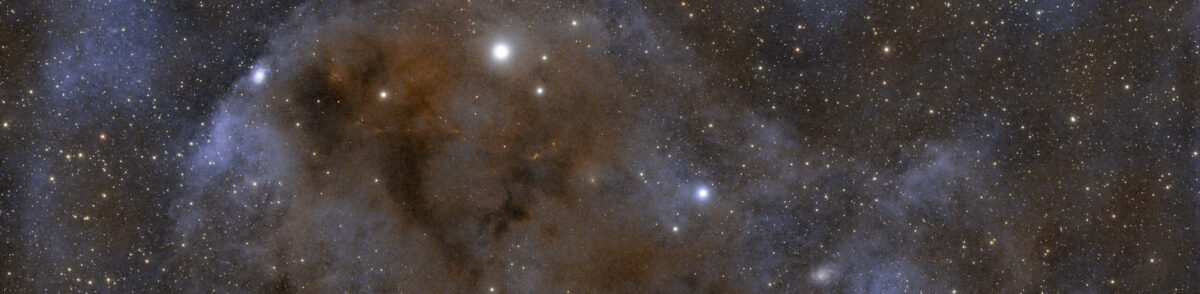

I choose to image this pair of Nebula while perusing images of the Sharpless Catalog online. I didn’t realize how faint and small they are at the time. This image integrates 7 hours of exposure. It uses a GSO RC8 at 1627mm fl and a ZWO ASI071MC camera atop a Skywatcher EQ6r Pro mount. All are controlled and integrated by APT, Astro Photography Tool.
Sharpless 2-207 is a star-forming region, similar to a miniature version of the Rosette Nebula. Despite its appearance, this is an HII region ionised by an O9.5 IV star and not a planetary nebula. The star cluster in the western part of the nebula is about 2-3 million years old. Its kinetic distance is about 4 kpc. The smaller H-II region Sharpless 2-208 is at about the same distance.
The nebulae Sh 2-207 and Sh 2-208 are located on the border of the constellation Camelopardalis to Perseus. The best viewing time is September to March, when the circumpolar constellation is at its highest. These are very dim and require long exposure and adequate focal length. They are surrounded by the Perseus hydrogen cloud but that would require much more integration time to bring out. Perhaps another year.
There’s not much else to say about a couple of balls of ionized hydrogen in space.