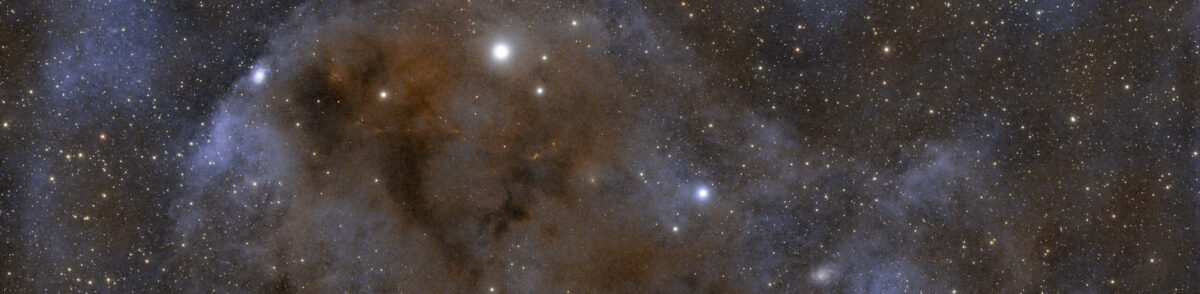
Exploring Sh2-223: The Faint Emission Nebula in Auriga

Sh2-223 - Faint Nebula in Auriga

Sh2-223 is a faint emission nebula (H II region) located in a dense starfield in the constellation Auriga. It is a huge H II region, a large cloud of partially ionized gas where star formation can occur. It appears as a large, faint red arc or “wing” in deep-sky images. Its red glow comes from ionized hydrogen-alpha (Hα) emissions. The nebula is believed to be ionized by the star BD +41 1144 (an O7.5 V star) or possibly LS V +40 46.

In addition to the predominant Hii, there is also a significant amount of Oiii in the area. This leads to a bluish tinge or a slight purplish hue in parts of the image.

It is considered a difficult target for astrophotographers because of its extreme faintness. It often requires long total integration times, such as 25+ hours, to resolve clearly. Separating the IFN from the Hii nebula requires data. This photograph is only 11.4 hours. More to come in the future if the opportunity presents itself.

Image acquisition using Astro Photography Tool (APT). Subframe calibration, alignment, integration, and processing using PixInsight. Astrobin link for acquisition details and an annotated image.

Discovering The Broken Heart Cluster in Auriga: NGC 2281

NGC 2281 - The Broken Heart Cluster of Auriga

NGC 2281 is popularly known as the Broken Heart Cluster. It is a bright open star cluster. It is located in the northern constellation of Auriga. Located in the eastern part of Auriga. It is southeast of the star Menkalinan and about halfway between Castor, Pollux, and Capella.

Estimated to be between 435 and 660 million years old. Recent 2023 studies suggest an age of 435 ± 50 million years. This makes it similar in age to clusters like M37 and M48.

NGC 2281 is often described as having a sparse but pleasing arrangement of stars. Notable visual features include:

Central Rhombus: A prominent group of four stars forming a parallelogram or diamond shape at its center.

Member Stars: Contains more than 400 cataloged members. The brightest stars are mostly white A-type stars, with a few evolved red and yellow giants.

Besides the “Broken Heart,” some observers describe the arrangement as resembling a “floppy fish” or the Greek letter lambda (λ).

This image contains 114 60s subs captured using APT for acquisition and session automation. Telescope – Skywatcher Esprit 120ED; Camera – ZWO ASI2600MC Pro; Filter – Antlia Quad light pollution filter; Mount Skywatcher Eq6r Pro

Astrobin link for all of the details

Flaming Star Nebula: A Deep Dive

Sh2-229 - Flaming Star Nebula in Auriga

The object listed as Sh2-229 in the Sharpless catalog is the Flaming Star Nebula. It is also known as IC 405 or Caldwell 31. It is a combination emission and reflection nebula located in the constellation Auriga. The nebula surrounds the hot, bluish, irregular variable star AE Aurigae. This massive O-type star (about 23 solar masses) is responsible for illuminating the surrounding gas and dust.

Sh2-229 displays both emission (reddish glow from ionized hydrogen gas) and reflection (bluish cast from dust scattering starlight) properties. The “flaming” appearance is largely due to the bright red hydrogen emission.

I captured 166 240s subframes from my driveway. I used a Skywatcher Eq6r Pro mount, a Skywatcher Esprit 120ED telescope, and an ASI2600MC Pro camera cooled to 15f. APT was used for session management and automation. PixInsight was used to calibrate, align, integrate and process the image.

Astrobin link for acquisition details and image annotation.

Sh2-227 – Hii in Auriga

Sh2-227 - Hii in Auriga

You don’t see a lot of images of Sh2-227. It’s really faint, and it is outshone by nearby IC405 (Flaming Star Nebula) and IC410 (The Tadpoles). I initially wanted to capture it to see what structure I could reveal. After 8 hours, I felt like I’d got a fair image of the regions. However, I wanted less noise. So, I spent another 7.5 hours on it.

Sh2-227 is an emission nebula visible in the constellation Auriga. It is located within the large pentagon that constitutes the constellation. It is a short distance from the open cluster NGC 1857, seen at the bottom of this image. The best period for its observation in the evening sky falls between the months of October and March. Observers find it considerably easier to observe in the regions of the Earth’s northern hemisphere.

Verified by MonsterInsights