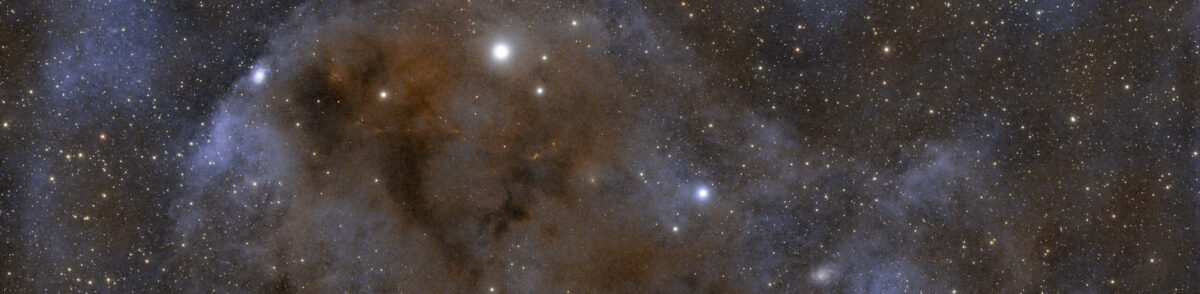
IC 1848 – Soul Nebula, part II

The Soul Nebula is an emission nebula located in the constellation Cassiopeia.

Soul Nebula in Cassiopeia

In astrophotography the key to a good image is integration time, especially if you image with a broadband color camera. This image now consists of 6 hours of exposure on this target. As a newbie in this hobby it takes me time to process an image so I try to wait until sufficient data has been collected before starting the process. Of course opportunities for imaging are sparse in the cloudy nights of summer here in the blue ridge. Fall is coming!

The Soul Nebula is an emission nebula located in the constellation Cassiopeia. It forms a famous pair known as the Heart and Soul with the neighbouring Heart Nebula (IC 1805). The Soul Nebula is sometimes also known as the Embryo Nebula or IC 1848, which is a designation used for the open star cluster embedded within the nebula.

The Heart and Soul Nebulae complex spans an area about 300 light years across and is a vast star-forming region illuminated by the light of the young stars surrounded by star-forming clouds of dust and gas. The two large clouds are separated by only 2.5 degrees and physically connected by a bridge of gas. The stars in the region are less than a few million years old and are only beginning their life. For comparison, our Sun has been around for almost 5 billion years.

Thanks for visiting and don’t foget to subscribe below.

Cheers!

NGC 6910 – Inchworm Cluster

NGC 6910 – Inchworm Cluster in Cygnus

NGC 6910 is an open cluster in the constellation Cygnus and is located half a degree east-north east of Gamma Cygni, also known as Sadr.

This image is a stack of 23 4 min light frames at 20f, 30 darks, flats and dark-flats. Taken Aug 2, 2020 in below-average seeing & transparency during a full moon (99% illuminated, age 14 days). Was impossible to achieve good focus in a hazy sky with 99% humidity.

This night was a test of guiding under PHD2 as I added a guide scope and camera to my configuration as well as automated scripts for the evenings shooting plan (limited success) Hopefully guiding will allow me to extend the exposure times in these Nebula images to 10 minutes. Do to learning issues, 7 frames of the 30 taken had to be tossed into the junk bin.

Gear: EQ6R mount; WO Z73 w/flat73a; ZWO ASI071MC Pro camera, WO 50mm guide scope; ZWO ASI120mm mini guide scope; Senso Sesto focuser; Pegasus PBA; OPT L-enhance filter; Acer Netbook

Software: APT for acquisition; PHD2 guiding; DSS stacking; PI processing with final touches in PS.

My imaging rig being set up in the afternoon.

Much more time on a clear night is desirable. Subscribe below to receive update notifications for future images and posts. Cheers!

IC 1805: The Heart Nebula

IC 1805 - Heart Nebula
The Heart Nebula

The Heart Nebula lies some 7500 light years away from Earth and is located in the Perseus Arm of the Galaxy in the constellation Cassiopeia. It was discovered by William Herschel on 3 November 1787. It is an emission nebula showing glowing ionized hydrogen gas and darker dust lanes.

The brightest part of the nebula (a knot at its western edge) is separately classified as NGC 896 and known as the Fish Head Nebula, because it was the first part of the nebula to be discovered.

The nebula’s intense red output and its morphology are driven by the radiation emanating from a small group of stars near the nebula’s center. This open cluster of stars at the Heart’s heart, known as Melotte 15, contains a few bright stars nearly 50 times the mass of our Sun, and many more dim stars that are only a fraction of our Sun’s mass.

This image is comprised of 40 images of 4 min exposures each for a total integration of 2hrs 40mins. Each image was shot at 100 gain & 20 offset in a ZWO ASI071MC Pro camera cooled to 20f. 20 darks, 20 flats, 20 bias frames as calibration frames.

This nebula is in a late rising constellation in our summer months. I was able to begin imaging at 2AM and photographed continuously until a few minutes past 5AM. Do you see the heart? How about the fishhead? There’s also a soul nebula located just outside of this images frame. I’ll image that in the future. The FOV of my Z73 is just a touch to narrow to get them both in the same shot.

Post a comment if you have questions or an observation. Subscribe to be notified when updates are made if you wish.

Cheers!

Elephant’s Trunk Nebula

The Elephant’s Trunk Nebula is a concentration of interstellar gas and dust within the much larger ionized gas region IC 1396 located in the constellation Cepheus about 2,400 light years away from Earth. The piece of the nebula shown here is the dark, dense globule IC 1396A; it is commonly called the Elephant’s Trunk nebula because of its appearance at visible light wavelengths, where there is a dark patch with a bright, sinuous rim. The bright rim is the surface of the dense cloud that is being illuminated and ionized by a very bright, massive star (HD 206267) that is just to the east of IC 1396A.

Elephant’s Trunk Nebula

The Elephant’s Trunk Nebula is now thought to be a site of star formation, containing several very young (less than 100,000 yr) stars that were discovered in infrared images in 2003. Two older (but still young, a couple of million years, by the standards of stars, which live for billions of years) stars are present in a small, circular cavity in the head of the globule. Winds from these young stars may have emptied the cavity.

The combined action of the light from the massive star ionizing and compressing the rim of the cloud, and the wind from the young stars shifting gas from the center outward lead to very high compression in the Elephant’s Trunk Nebula. This pressure has triggered the current generation of protostars.

Very happy to have captured this piece of our night sky from Burke County, NC. A very peaceful night here in the hills of the blue Ridge. Any questions or comments, we’d love to hear from you.

North America Nebula

NGC 1499
North America Nebula - Cygnus Constellation
North America Nebula (NGC 7000) – The portion of the nebula resembling Mexico and Central America is known as the Cygnus Wall. This region exhibits the most concentrated star formation. The North America Nebula and the nearby Pelican Nebula (IC 5070) are parts of the same interstellar cloud of ionized hydrogen (H II region). Between the Earth and the nebula complex lies a band of interstellar dust that absorbs the light of stars and nebulae behind it, and thereby determines the nebula’s apparent shape.

My first target in Astrophotography was the North America Nebula framed with the Pelican Nebula. The name is obvious as this dust cloud really looks like the continent. There has been a lot of stuff to learn in photographing objects in our dark sky. The initial image is as you might expect – black with a few white dots! This version of the nebula is comprised of 48 images or 2 1/2 hours of exposure obtained over two nights of imaging. My first night was not very productive (learning curve is steep).

Once the images have been obtained they have to be debayered, aligned, registered and stacked. While PixInsight (PI) can do this, I prefer DeepSkyStacker (DSS) and feel it does a better job than my manual workings in PI. After stacking I do switch to PI for most of the processing and then Photoshop(PS) for the final tweaks.

All of this is run from my Acer Netbook, which I remotely manage from my home office (about 40 yards away). Image acquisition is totally performed with Astro Photography Tool (APT). Everything is intergrated via ASCOM drivers. It took over a month to understand all of the technology involved. I learned that capturing the photograph is only half the job! Truly looking forward to mastering this over the years.

As always my images can be seen in the Semper Iuvenis Galleries.

Astrophotography

Lagoon Nebula in Sagittarius

As a result of the Covid-19 stuff I looked for an avenue of photography that did not involve travel or people. I had always wanted to photograph the moon or the Milky Way but lacked the equipment to to do it right and honestly didn’t think it achievable. I sought help on Youtube! Trevor Jones at Astrobackyard.com is awesome and his tutorials convinced me that I could photograph the night sky after all – and the investment is less than a single dive trip!

My equipment after a lengthy wait.

Stay tuned for images as clear night skies allow. As always my images are presented in the Semper Iuvenis Galleries. Cheers!

Verified by MonsterInsights