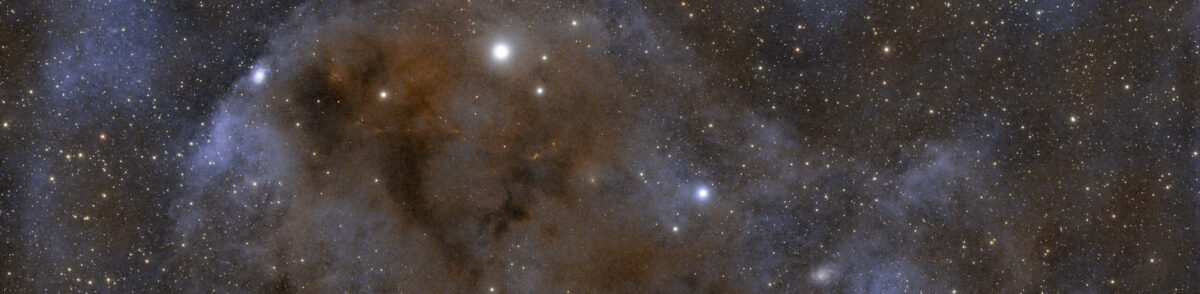

This is round two for me on this target. The first experienced significant reflections from the Antlia Quad Broadband LP filter. So, I’m back at it during the full moon using the Radian Ultra Quad-Band narrow band filter.
This beautiful but faint planetary nebula was imaged from my driveway at home. It was discovered in 1983 by the astronomers Herbert Hartl, Johann Dengel, and Ronald Weinberger. In 1987, further narrowband observations detected a large faint outer halo extending further than the central shell. However, it wasn’t confirmed to be a true genuine planetary nebula until 2017.
It has been given the name of Bear Claw Nebula for the imprint found on the central shell. Looks a lot like a bears print. This could be the faintest object I’ve ever attempted to image. After many hours of integration the Nebula began to appear. Individual subs showed absolutely nothing but stars and it is an impressive starfield! This is 15 hours of exposure using 156 6 minute subs.
Imaging sessions controlled and automated by Astro Photography Tool (APT 4.65.2). Two nights from 11/3/2025 using 360″ exposures on a RC8 telescope and ASI071MC camera atop an Eq6r Pro mount. 15 hours of exposure. Processed manually in Pixinsight.