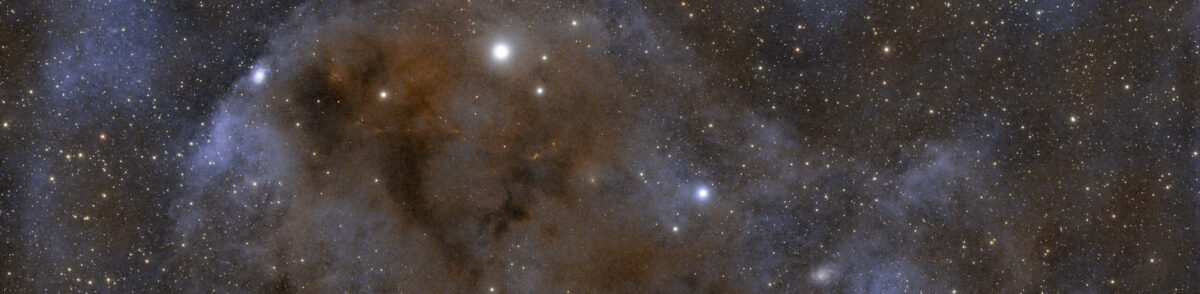

This is Sh2-216. It is a planetary nebula in the constellation Perseus. Planetary nebulae get their name because they are generally spherical. In the crude telescopes of centuries past, they appeared similar to the much closer planets of our own solar system. The astronomers of old did not realize the scale of our galaxy. They assumed these nebulae might be similar to our planetary brothers. This led to their name.
These objects are remnants of a stage in the death of larger stars. During this stage, stars convulse and blow off their outer layers of material into space. In the case of Sh2-216, the stellar explosion occurred some half million years ago. It left behind the core of the progenitor star, a white dwarf. There is also a slowly expanding cloud of mostly ionized hydrogen.
This particular object is the closest planetary nebula to us at only 400 light years distance. It’s proximity also makes it the largest in apparent diameter at 1.6 degrees – over three times that of our Moon. But it is very FAINT! The expanding hydrogen gas is extremely thin, requiring long exposure photography to show it. It is completely invisible to the naked eye, and isn’t visible in a single five minute camera exposure. This is a stack of 222 5 minute exposures, or 18.5 hours.
It won’t fit in my 860 mm Fl Esprit 120ED due to its size. Therefore, I focused on a bright outer band of gas. Image acquisition using APT 4.60. Processed manually in PI.
Astrobin – https://astrob.in/qwvo2i/0