Exploring M81 and M82: A Guide for Amateur Astronomers

M81 and M82 are a famous pair of interacting galaxies. They are located approximately 12 million light-years away in the constellation Ursa Major.

They are popular targets for amateur astronomers. They are bright enough to be seen with binoculars. They often fit within the same telescopic field of view as they do in this 5″ refractor.

As the pair are circumpolar, I chose to end my nightly winter sessions with this pair. I’ll add more data if the opportunity arises. This will happen over the remainder of our winter as we head into galaxy season. Imaged from my driveway with a wide-field Esprit 120ED refractor telescope and ZWO ASI2600MC camera atop an Eq6r Pro mount.

M 81 is commonly known as Bode’s Galaxy. It is a “grand design” spiral galaxy discovered by Johann Bode in 1774. It features a bright nucleus and well-defined spiral arms filled with blue star clusters and pinkish hydrogen gas clouds.

M 82 is known as the Cigar Galaxy due to its elongated, edge-on appearance, M82 is a prototypical starburst galaxy. It is undergoing an intense period of star formation, creating new stars 10 times faster than the entire Milky Way. It is famous for its bright red filaments of ionized hydrogen gas. These filaments blast out from its central regions, driven by strong galactic winds from supernova explosions.

Astrobin link with all the capture details and an annotated image. There are actually a lot of galaxies in this photo.

NGC 5982 Group: A Stunning Galaxy Trio in Draco

NGC 5982 and the Draco Trio

The NGC 5982 group is also known as the Draco Triplet or Draco Group. It is a striking trio of galaxies located approximately 100 to 140 million light-years away in the constellation Draco. The group is a favorite for Astro photographers. This is because it features three distinct types of galaxies in a single field of view. The view spans about the width of a full moon. There are 10 galaxies in this photograph total.

The “triplet” is composed of the following galaxies, typically seen in a line:

NGC 5982 (Center): A bright elliptical galaxy (type E3). It features a “decoupled nucleus.” This is a core that rotates perpendicular to the rest of the galaxy. It also has faint shells. Both are strong evidence of past galactic mergers.

NGC 5985 (Top): A large, nearly face-on barred spiral galaxy. It is classified as a Seyfert galaxy. This classification means it has an extremely bright and active nucleus. This is powered by a supermassive black hole.

NGC 5981 (Bottom): A faint spiral galaxy seen almost edge-on. Its thin profile shows a prominent dust lane similar to the famous “Needle Galaxy”.

This photograph was captured from my driveway in the hills of western North Carolina. I set up my RC8 with an ASI071MC camera atop an Eq6r Pro mount. I use Astro Photography Tool (APT 4.70.1) for session management and acquisition automation. The 96 3 minute subframes were calibrated, aligned, integrated, and processed manually with Pix Insight 1.9.3. Astrobin link for acquisition details and annotated image.

Discovering NGC 3384: The Lenticular Galaxy in Leo

NGC 3384

NGC 3384 (also known as NGC 3371) is a lenticular galaxy. It is located approximately 35 million light-years away. This galaxy is in the constellation Leo. It is a prominent member of the M 96 Group. This group is also called the Leo I Group. It includes the well-known Messier objects M 95, M 96, and M 105.

NGC 3384 and its neighbor M 105 are surrounded by a massive ring of neutral hydrogen. This ring is 650,000 light-years wide. Sparse star formation still occurs there. In the night sky, NGC 3384 forms a visual trio with the elliptical galaxy M 105. It forms this trio with (NGC 3379) and the spiral galaxy NGC 3389.

While M 105 and NGC 3384 are physical companions, NGC 3389 is a background galaxy located significantly further away. The galaxy hosts a supermassive black hole at its core. It has an estimated mass of 16 million times that of the Sun. This black hole is considered “quiet,” producing very little radio energy.

Image acquisition details in Astrobin. APT used for image acquisition and session automation. PixInsight used for subframe processing.

Messier 88: Characteristics of a Unique Galaxy

M 88 - A Virgo Cluster Galaxy

Messier 88 (M88 or NGC 4501) is a bright, multi-arm spiral galaxy located in the constellation Coma Berenices. As a prominent member of the Virgo Cluster, it is roughly 47 to 60 million light-years from Earth. M88 is one of the fifteen Messier objects that belong to the nearby Virgo Cluster of galaxies. It is galaxy number 1401 in the Virgo Cluster Catalogue (VCC). The catalogue includes 2096 galaxies that are candidate members of the cluster.

The galaxy is inclined at about 30 to 64 degrees to our line of sight. This inclination gives it an elongated, elliptical appearance through telescopes. It spans about 100,000 to 130,000 light-years in diameter, making it comparable in size to our Milky Way. It contains about 400 billion stars.

With an apparent magnitude of 9.6, it is visible in large binoculars as a blurry patch and reveals its spiral structure in larger amateur telescopes. The galaxy is best observed during the spring months, particularly in May.

Image acquisition using APT. Image processing using PixInsight. Astrobin link for acquisition details and an annotated image.

Antennae Galaxies – NGC 4038 & 4039

Antennae Galaxies in Corvus

NGC 4038 and NGC 4039 are known as the Antennae Galaxies. They are a famous pair of interacting spiral galaxies. They are located in the constellation Corvus. They are currently undergoing a violent galactic collision that began approximately 900 million years ago.

Key Characteristics
Nicknames: Commonly known as the Antennae Galaxies or the Ringtail Galaxy. They are also cataloged as Caldwell 60/61 and Arp 244.

Distance: Estimates of their distance from Earth range between 45 million and 65 million light-years.

Appearance: Their name comes from two long “tidal tails” of ejected stars, gas, and dust that resemble an insect’s antennae. These tails span over 500,000 light-years.

Starburst Activity: The collision has led to a massive “starburst” phase. In this phase, clouds of gas and dust are being compressed. This compression forms billions of new stars and super star clusters.

Astrobin link for acquisition details and annotated image

Coma Berenices Galaxy Cluster

The Coma Galaxy Cluster

Abell 1656

I generally like to image open star clusters, globular clusters, and galaxies. However, it is fairly rare for a “starfield” to actually be a galaxy cluster. Hundreds of galaxies within my single field of view at 840mm fl. Challenges the mind.

Abell 1656, also known as the Coma Galaxy Cluster, is a massive and dense collection of galaxies. It contains more than 1,000 identified galaxies. These galaxies are located in the constellation Coma Berenices. It is situated approximately 321 million light-years from Earth. The cluster has a diameter of about 20 million light-years.

The central region is dominated by two supergiant elliptical galaxies: NGC 4874 and NGC 4889. Most central members are ellipticals, while spiral galaxies like NGC 4921 are typically found on the outskirts. Important to look at the astrobin platesolve for this image to see what’s actually in there.

Capturing the Faint Beauty of vdB 30

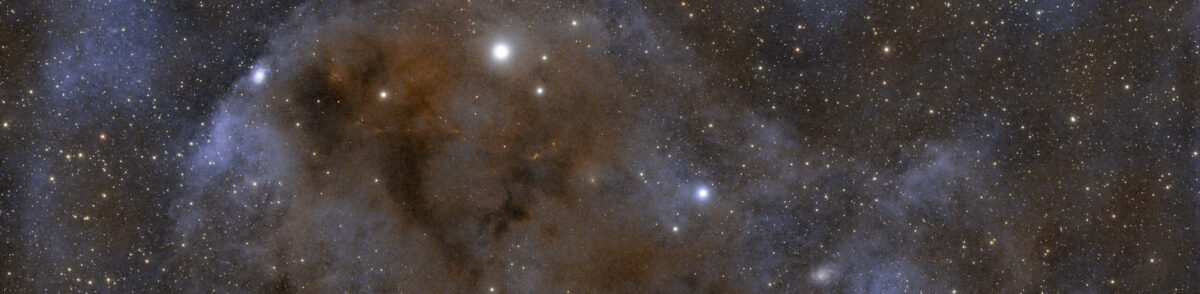
vdB 30 - bow shock in Camelopardalis

vdB 30 is a very faint reflection nebula located in the northern constellation Camelopardalis. This nebula is part of the van den Bergh (vdB) catalog of reflection nebulae. Astronomer Sidney van den Bergh originally published the catalog in 1966.

It is primarily a reflection nebula, meaning it consists of interstellar dust that reflects the light of nearby stars. The nebula surrounds the bright star Alpha Camelopardalis. Because this star is quite brilliant (magnitude ~4.3), the faint nebulosity can be difficult to capture and is often overwhelmed by the star’s glare. While categorized as a reflection nebula, it is rich in ionized hydrogen (HII) and some sulfur.

Modern narrowband imaging often reveals a bow shock in the gas. These are visible as curved structures in hydrogen-alpha (Ha) light. This phenomenon is caused by the star moving through the interstellar medium. It is estimated to be approximately 5,000 light-years away from Earth.

vdB 30 is considered a very faint and challenging target for amateur astronomers. It requires long exposure times (often 5 to 10+ hours) to detect the subtle dust and gas structures. Its coordinates place it at a high northern declination (+66 degrees), making it a circumpolar object for many observers in the Northern Hemisphere.

VdB 30 is a reflection nebula in the constellation Camelopardalis. It is a very extensive gas cloud. Observing it is difficult due to the low amount of light reflected and its relatively low temperature. It appears to surround the star α Camelopardalis. This star is located in the centre of the image. It is a blue supergiant from apparent magnitude 4.26 and spectral class O9Ia. The cloud extends for about 29 parsecs. It is composed of cold dust. The dust emits infrared radiation due to the weak heating received from the supergiant. The emissions from the supergiant are especially ultraviolet because of its surface temperature equal to 30,000 Kelvin.

The nebula has a ring shape. It is impressed by the strong stellar wind of the supergiant. This wind is responsible for creating a bubble in the interstellar medium surrounding it. As a result, it disperses the cloud itself.

I photographed this difficult target from my driveway in the foothills of the Blue Ridge Mountains in Burke County, NC. I use APT for image acquisition and session automation to capture 159 5 minute exposures across 4 nights. Subframes calibrated, debayered, aligned, integrated, and processed in PixInsight 1.9.3

Astrobin link for acquisition details and annotated image

Exploring NGC 3521 – The Bubble Galaxy in Leo

The Bubble Galaxy in Leo

NGC 3521 is popularly known as the Bubble Galaxy. It is an intermediate spiral galaxy. It is located approximately 35 million light-years away in the constellation Leo. The galaxy earns its nickname from the gigantic, very faint bubble-like shells and tidal remnants that surround it.

Astronomers believe these shells are tidal debris. They consist of streams of stars and gas. These materials were torn from smaller satellite galaxies. NGC 3521 absorbed them in the distant past. These outer structures are very faint and typically only appear in deep, long-exposure astrophotography. In smaller backyard telescopes, the galaxy often appears as a simple glowing object. It is rounded in shape. This appearance also contributes to the “bubble” moniker.

I photographed this galaxy from my driveway here in Burke County, NC. I used APT for session management and automation. Over two nights, I gathered 105 3 minute exposures. I used a GSO RC8 telescope at 1625mm fl paired with a ZWO ASI071MC Pro cooled to 14f. These ride a Skywatcher EQ6r Pro Equatorial mount. The subframes are manually calibrated, debayered, aligned, integrated, and processed in PixInsight 1.9.3.

Astrobin link for acquisition details and annotated image

NGC 2355 Insights: Chemical Evolution and Star Formation

An Open Cluster in Gemini - NGC 2355

NGC 2355, also known as NGC 2356, is an old open star cluster in the constellation Gemini. It is approximately a billion years old. The cluster is located about 5,400 light-years from the Solar System. It is 1,100 light-years above the Milky Way galaxy’s plane.

NGC 2355 is useful for studying the chemical and dynamical evolution of the Galactic disk. Recent studies using Gaia DR3 data have identified over 400 member stars within the cluster. They have also discovered dozens of variable stars. These include eclipsing binaries and pulsating stars.

NGC 2355 is located in the outer disk and elevated above the plane. This position makes it an important probe for understanding the evolution and structure of the Milky Way’s galactic disk. It is particularly valuable for studying star formation and dynamical processes in less dense regions.

NGC 2355 lies near the celestial equator. It is observable from both the Northern and Southern Hemispheres. It favors northern latitudes where Gemini rises higher in the sky. In the Northern Hemisphere, it is best viewed during winter months from December to March. During this time, the constellation is prominent in the evening sky. From mid-northern latitudes such as 40°N, the cluster culminates at an altitude of approximately 63° above the horizon. This provides favorable viewing conditions away from atmospheric distortion.

I photographed this cluster from my driveway in the foothills of the Blue Ridge Mountains. I use APT for session management, image acquisition, and automation. 71 60sec subframes for just a touch over an hour of integration. Calibrated, aligned, integrated, and processed manually using PixInsight.

Astrobin link for acquisition details and annotated image.

Exploring the Beauty of Reflection Nebulae: IC 2169

Dreyer's Nebula - Reflections in Monoceros

Perhaps among the most beautiful targets to image in our night sky. There are no less than five reflection nebulae in the photograph. They are contrasted by large areas of ionized hydrogen showing as red in the image.

IC 2169, popularly known as Dreyer’s Nebula, is a large blue reflection nebula located in the constellation Monoceros (the Unicorn). It is a primary feature of the Monoceros R1 complex. This is a region of active star formation situated approximately 2,500 to 2,700 light-years away from Earth. It’s in a massive starfield!

The nebula has a distinctive blue hue. This color occurs as interstellar dust particles scatter blue light from nearby hot, young stars. It is primarily illuminated by the massive B-type stars of the young open cluster Collinder 95. Some sources also associate its glow with the variable star T Orionis or the star HD 45677.

The Nebula is often referred to as Dreyer’s Nebula. This name honors John Dreyer, who compiled the NGC and IC catalogs. However, it was actually discovered by Barnard. The nebula is also designated as IC 447. This duplication exists because it was recorded twice in the Index Catalogue (IC) due to separate observations by Edward Barnard. It is located about 2 degrees west of the more famous Cone Nebula and the Christmas Tree Cluster (NGC 2264). It is often imaged alongside smaller reflection nebulae such as IC 446, NGC 2245, and NGC 2247.

I took this photograph from my driveway in the foothills of the Blue Ridge Mountains in western North Carolina. Here, I enjoy a bortle 4/5 sky. Continued development pushes it ever closer to a 5. Imaged with a Skywatcher Esprit 120ED telescope at 840mm focal length and a ZWO ASI2600MC camera cooled to 14f. These are mounted on a Skywatcher Eq6r Pro equatorial mount. It runs EQMOD and guides via PHD2. This is done through a ZWO OAG and an ASI290mm mini guide camera.

Component control is done by APT. Session automation and image acquisition are also managed by APT. These are the magic dust in getting the 143 5 minute subframes. The subframes were manually calibrated, debayered, aligned, integrated, and processed to the targets natural colors using PixInsight.

Astrobin link for acquisition details and annotated image.

Verified by MonsterInsights