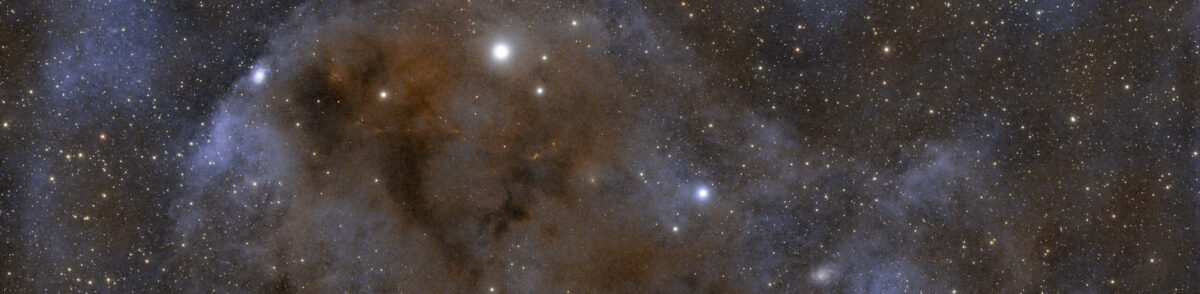

Sh2-284 is a colorful emission nebula in the constellation Monoceros. It is the southernmost in a chain of nebulae below the Rosette Nebula. It is by far the most interesting of the three. It does not have a nickname, but is often mistakenly called the Little Rosette Nebula (which is in fact Sh2-270).
There is so much in this image I much prefer to look at the annotated version in Astrobin. I encourage you to have a look, no strings!
Sh2-284 can be found in Monoceros in the Winter sky. It is not far from the brightest star in the sky: Sirius, as well as Betelgeuse in Orion. Sh2-284 can be seen from a dark site using a telescope or a pair of binoculars. It looks similar to the Rosette Nebula, but slightly fainter and much smaller.
Sh2-284 is a star formation region, and at its center there is a cluster of young stars, dubbed Dolidze 25. The radiation from this cluster is powerful enough to ionize the hydrogen gas in the nebula’s cloud. It is this ionization that produces its bright orange and red colors.
This image consists of 231 exposures, each 300 seconds long. They were taken with a Skywatcher Esprit 120ED telescope and an ASI2600MC OSC camera at f/15. The setup was atop a Skywatcher Eq6r Pro mount. Astro Photography Tool (APT4.60) handled the acquisition session management and automation coordinating all of the gear used. These images were calibrated, aligned, integrated and processed manually in its natural colors using PixInsight.