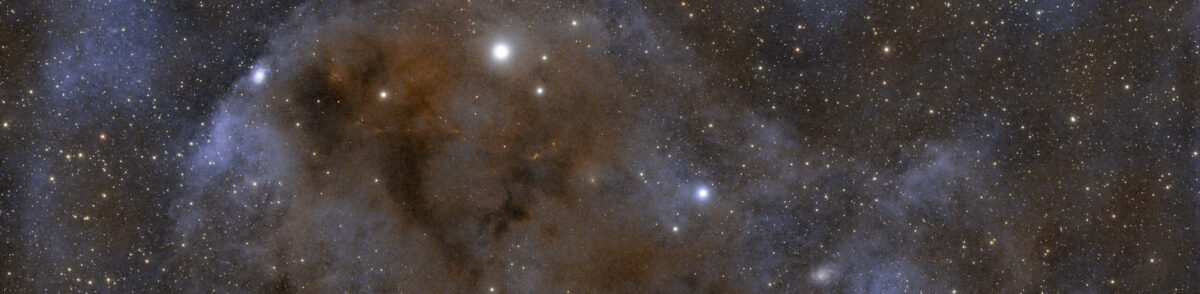
Capturing the Faint Beauty of vdB 30

vdB 30 - bow shock in Camelopardalis

vdB 30 is a very faint reflection nebula located in the northern constellation Camelopardalis. This nebula is part of the van den Bergh (vdB) catalog of reflection nebulae. Astronomer Sidney van den Bergh originally published the catalog in 1966.

It is primarily a reflection nebula, meaning it consists of interstellar dust that reflects the light of nearby stars. The nebula surrounds the bright star Alpha Camelopardalis. Because this star is quite brilliant (magnitude ~4.3), the faint nebulosity can be difficult to capture and is often overwhelmed by the star’s glare. While categorized as a reflection nebula, it is rich in ionized hydrogen (HII) and some sulfur.

Modern narrowband imaging often reveals a bow shock in the gas. These are visible as curved structures in hydrogen-alpha (Ha) light. This phenomenon is caused by the star moving through the interstellar medium. It is estimated to be approximately 5,000 light-years away from Earth.

vdB 30 is considered a very faint and challenging target for amateur astronomers. It requires long exposure times (often 5 to 10+ hours) to detect the subtle dust and gas structures. Its coordinates place it at a high northern declination (+66 degrees), making it a circumpolar object for many observers in the Northern Hemisphere.

VdB 30 is a reflection nebula in the constellation Camelopardalis. It is a very extensive gas cloud. Observing it is difficult due to the low amount of light reflected and its relatively low temperature. It appears to surround the star α Camelopardalis. This star is located in the centre of the image. It is a blue supergiant from apparent magnitude 4.26 and spectral class O9Ia. The cloud extends for about 29 parsecs. It is composed of cold dust. The dust emits infrared radiation due to the weak heating received from the supergiant. The emissions from the supergiant are especially ultraviolet because of its surface temperature equal to 30,000 Kelvin.

The nebula has a ring shape. It is impressed by the strong stellar wind of the supergiant. This wind is responsible for creating a bubble in the interstellar medium surrounding it. As a result, it disperses the cloud itself.

I photographed this difficult target from my driveway in the foothills of the Blue Ridge Mountains in Burke County, NC. I use APT for image acquisition and session automation to capture 159 5 minute exposures across 4 nights. Subframes calibrated, debayered, aligned, integrated, and processed in PixInsight 1.9.3

Astrobin link for acquisition details and annotated image

Exploring the Beauty of Reflection Nebulae: IC 2169

Dreyer's Nebula - Reflections in Monoceros

Perhaps among the most beautiful targets to image in our night sky. There are no less than five reflection nebulae in the photograph. They are contrasted by large areas of ionized hydrogen showing as red in the image.

IC 2169, popularly known as Dreyer’s Nebula, is a large blue reflection nebula located in the constellation Monoceros (the Unicorn). It is a primary feature of the Monoceros R1 complex. This is a region of active star formation situated approximately 2,500 to 2,700 light-years away from Earth. It’s in a massive starfield!

The nebula has a distinctive blue hue. This color occurs as interstellar dust particles scatter blue light from nearby hot, young stars. It is primarily illuminated by the massive B-type stars of the young open cluster Collinder 95. Some sources also associate its glow with the variable star T Orionis or the star HD 45677.

The Nebula is often referred to as Dreyer’s Nebula. This name honors John Dreyer, who compiled the NGC and IC catalogs. However, it was actually discovered by Barnard. The nebula is also designated as IC 447. This duplication exists because it was recorded twice in the Index Catalogue (IC) due to separate observations by Edward Barnard. It is located about 2 degrees west of the more famous Cone Nebula and the Christmas Tree Cluster (NGC 2264). It is often imaged alongside smaller reflection nebulae such as IC 446, NGC 2245, and NGC 2247.

I took this photograph from my driveway in the foothills of the Blue Ridge Mountains in western North Carolina. Here, I enjoy a bortle 4/5 sky. Continued development pushes it ever closer to a 5. Imaged with a Skywatcher Esprit 120ED telescope at 840mm focal length and a ZWO ASI2600MC camera cooled to 14f. These are mounted on a Skywatcher Eq6r Pro equatorial mount. It runs EQMOD and guides via PHD2. This is done through a ZWO OAG and an ASI290mm mini guide camera.

Component control is done by APT. Session automation and image acquisition are also managed by APT. These are the magic dust in getting the 143 5 minute subframes. The subframes were manually calibrated, debayered, aligned, integrated, and processed to the targets natural colors using PixInsight.

Astrobin link for acquisition details and annotated image.

What Makes vdB 13 a Captivating Celestial Object?

vdB 13 - Reflection in Aries

vdB 13 is a bluish reflection nebula cataloged in Sydney van den Bergh’s 1966 VdB Catalogue of 159 reflection nebulae.

Situated approximately 1,000 light-years away in the constellation Aries (at the northeast corner). It is part of the western edge of the Perseus Molecular Cloud.

The nebula is illuminated by the star HIP 15984, a blue star of spectral type B8. It has an apparent magnitude of approximately 8.25.

VDB 13 is surrounded by dust and a dark nebula structure. The dusty blue reflection nebula shines prominently through the darkness. It is these dark lanes that provide the contrast and thus the eerie beauty within the image.

Astrobin link for acquisition details and an annotated image.

vdB 16 a Reflection in Aires

vdB 16 - a Reflection in Aries

LBN 746 is a reflection nebula located approximately 947 light-years away in the constellation Aries. It is part of the Lynds’ Catalogue of Bright Nebulae. It is often identified as a portion of the larger vdB 16 (van den Bergh 16) nebulosity.

LBN 746 is embedded within a dense region of cosmic dust. It is surrounded by dark nebulae. These include LDN 1452 and several Barnard objects such as Barnard 202, 203, 204, and 206.

LBN 746 is situated near the border of Aries and Taurus. It lies about 7 degrees northwest of the Pleiades star cluster.
For Astro photographers, this region is known for its complex mix of “light and dust.” Capturing the subtle interactions between the blue reflection light of vdB 16 is a detailed process. Observing the surrounding dark molecular clouds requires time. Long exposure photography is necessary.

Image acquisition and session automation using APT. This image consists of approximately 12 hours of exposure. The equipment used included an RC8 telescope and an ASI071MC Pro camera. They were mounted on a skywatcher Eq6r Pro Mount. Subframe calibration, alignment, integration, and processing performed manually in PixInsight. Astrobin link for all the details.

Verified by MonsterInsights