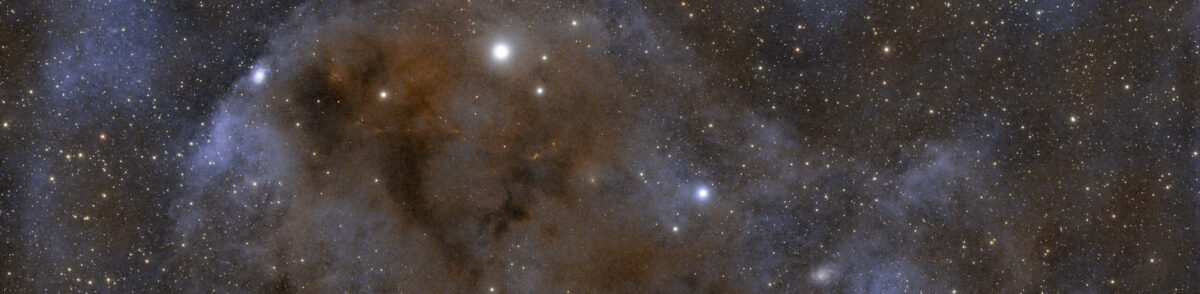

The first thing that struck me was the vast number of stars. I noticed them as I began to see this image unfold in the illuminated sky. Varying temperatures are seen in the gases with hot Hydrogen gases glowing in reddish hues with cooler gases expanding outward.
IC 2177 is a region of nebulosity that lies along the border between the constellations Monoceros and Canis Major. The name Seagull Nebula is sometimes applied by astronomers to this emission region. It resembles a gull in flight. It also includes the neighboring regions of star clusters, dust clouds, and reflection nebulae.
Astronomers catalog the nebula as IC 2177. This cosmic cloud is one of many sites of star formation within the Milky Way galaxy. It is located 3,800 light-years away from Earth. It resides inside the Orion spur. This is the same partial spiral arm of the Milky Way where our solar system is located. The nebula is nearly 240 light-years across.
NGC 2327 is located in IC 2177. It is also known as the Seagull’s Head, due to its larger presence in the Seagull nebula. The region near the seagull’s eye (or lizard’s hip) is listed as NGC 2327 by astronomers. It contains a cluster of stars born about 1.5 million years ago. The eye is the brightest and hottest of the newborn stars in the entire nebula. It heats up the dust. Consequently, the dust glows in infrared light.
The complex of gas and dust clouds is dominated by the reddish glow of atomic hydrogen. It spans over 100 light-years. Bright young stars are within it at an estimated distance of 3,800 light-years.