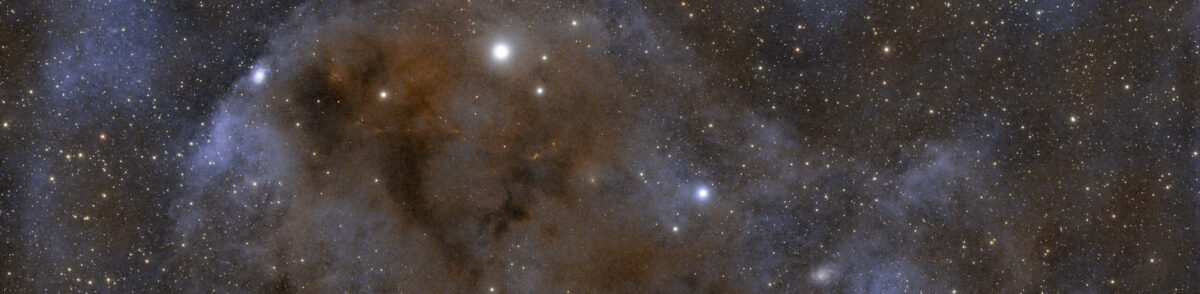
LBN 406 – Laughing Skull molecular cloud

LBN 406 - Laughing Skull molecular cloud - Draco

The Laughing Skull Nebula in Draco

Beverly Lynds Bright Nebula (LBN) 406 is a very faint molecular cloud of dust. It reflects nearby star shine in the constellation Draco. On her brightness scale of 1 to 6, Lynds classified this nebula as a barely visible, 1. The stellar winds have created some interesting shapes. This area is often called The Laughing Skull Nebula, focus on the center of the image.

At the very bottom center is the small galaxy, UGC 10548, that looks like the planet Saturn. A Higher resolution telescope reveals two distinct arms and not a ring.

This image is 125 8 minute exposures, or 16.5 hours, over several early mornings in March 2025. Imaged with a Skywatcher Esprit 120ED and Antlia Quad LP filter. Imaging camera is an ASI2600MC. Both riding n EQ6r Pro mount. Imaging session control and acquisition by APT 4.62. Image calibration, alignment, integration and processing done manually in PixInsight.

Cheers!

A deep look into Sh2-280

Sh2-280 Hii nebula cloud in Monoceros

Sh2-280 is a faint, diffuse emission nebula situated in constellation Monoceros. It is mainly an ionized hydrogen cloud. There is also a little oxygen around the bow-shock of the ionizing star at the center – HD46573. Sh2-280 is approximately 5,500 light-years away and near the Rosette Nebula.

This target sits very low in my southern sky. I imaged this over 4 nights in March 2025 using a Skywatcher Esprit 120ED telescope and an ASI2600MC camera. APT 4.62 – image acquisition and session control. Image calibrated, aligned, integrated and processed manually in PixInsight.

Acquisition details and annotated image here.

Peering into Sh2-308, the Dolphin Head Nebula

Sh2-308 - Dolphin Head Nebula

Sh 2-308 is commonly known as the Dolphin-Head Nebula. It is an H II region located near the center of the constellation Canis Major. The region is composed of ionized hydrogen. It is about 8 degrees south of Sirius, the brightest star in the night sky.

The nebula is bubble-like and surrounds a Wolf–Rayet star named EZ Canis Majoris. This star is in the brief, pre-supernova phase of its stellar evolution.

Sh2-308 sits at a declination of -23 degrees, which means it’s just above my tree tops to the south. Unobstructed for a couple of hours per night it takes a while to gather significant data. With weather, life and the moon impacts this will be all I get of it this year.

Astrobin view of all objects in this photo.

The image consists of 67 5 minute exposures captured using APT 4.60 over 3 nights in Feb ’25.

Calibration, registration, integration and processing manually in PixInsight.

Sh2-247 – A dust ball in Gemini

Sh2-247 - A dustball in Gemini

Sh2-247 is a round diffused nebula positioned at the western edge of Gemini near a boundary on Orion. It is part of the Gemini OB1 molecular cloud complex and is located near the boundary with Orion. Admittedly, it’s not very exciting to look at.

It’s located near the Monkey Head Nebula as well as the Jellyfish Nebula.

Imaged over three nights, this image consists of 161 5-minute exposures. These were taken with a GSO RC8 telescope at 1625mm f/8. It is paired with a ZWO ASI071MC camera atop a Skywatcher Eq6r Pro mount. Acquisition session management with Astro Photography Tool (APT 4.60). Image calibration, alignment, integration and processing performed manually in PixInsight.

Exploring Sharpless 265: A Deep Dive into Nebula Images

Sh2-265 - Ionized Hydrogen in Orion

Sharpless 265 (LBN 869) is a faint Hii region located approximately 1,300 light-years away in Orion. This one is a couple of degrees from the bright star Bellatrix. This area of the Orion constellation is rich in emission nebula. However, it is a much fainter area as well. This image of SH2-265 shows massive clouds of ionized hydrogen surrounded by cooler gases and dust. Long exposures help expose the fainter areas of this nebula.

Astrobin link

This image consists of 164 exposures. Each exposure is 300 seconds long. The image is captured using a Skywatcher Esprit 120ED camera. It is paired with a ZWO ASI2600MC camera and mounted atop a Skywatcher Eq6r Pro mount. Image acquisition session management via Astro Photography Tool (APT 4.60). Image calibrated, aligned, integrated and processed manually in PixInsight.

Capturing Nebula Sh2-239: A Challenge in Astrophotography

Sh2-239 - a dark cloud in Taurus

I’ll start by sharing that this may very well be the most difficult target I have ever imaged. It is shrouded in dark nebula. So much dust that there was at most two guide stars for the OAG on the RC8 to guide on. Processing wasn’t much easier. A slight reflection in the dust off my Antlia Quad-band light pollution filter has caused me to stop it’s use. Going back to the LPro. This target truly needs to be shot with a mono camera.

Cataloged as Sh2-239 and LDN 1551, the region lies near the southern end of the Taurus molecular cloud complex. It is some 450 light-years distant. The region stretches for nearly 3 light-years. It abounds with signs of embedded young stellar objects. These objects drive dynamic outflows into the surrounding medium.

Near the center of the frame is a compact, tell-tale red jet of shocked hydrogen gas. It is close to the position of infrared source IRS5. IRS5 is known to be a system of protostars surrounded by dust disks. Just below it are the wings of HH 102. They are broader and brighter. HH 102 is one of the region’s many Herbig-Haro objects. These are nebulosity’s linked to newly born stars. Estimates suggest that the star forming LDN 1551 region contains a large amount of material. This amount is equivalent to about 50 times the mass of the Sun.

The image was captured with a RC8 f/8 telescope. The focal length was 1625mm. An ASI071MC camera was used atop a Skywatcher Eq6r Pro mount. Imaged from my driveway in the hills of western North Carolina. Session management by Astro Photography Tool (APT 4.60). Image calibrated, aligned, integrated, and processed in a natural colors manually in PixInsight.

Exploring Sh2-284: The Colorful Emission Nebula

Sh2-284 & LBN 984 - space dust in Monoceros

Sh2-284 is a colorful emission nebula in the constellation Monoceros. It is the southernmost in a chain of nebulae below the Rosette Nebula. It is by far the most interesting of the three. It does not have a nickname, but is often mistakenly called the Little Rosette Nebula (which is in fact Sh2-270).

There is so much in this image I much prefer to look at the annotated version in Astrobin. I encourage you to have a look, no strings!

Sh2-284 can be found in Monoceros in the Winter sky. It is not far from the brightest star in the sky: Sirius, as well as Betelgeuse in Orion. Sh2-284 can be seen from a dark site using a telescope or a pair of binoculars. It looks similar to the Rosette Nebula, but slightly fainter and much smaller.

Sh2-284 is a star formation region, and at its center there is a cluster of young stars, dubbed Dolidze 25. The radiation from this cluster is powerful enough to ionize the hydrogen gas in the nebula’s cloud. It is this ionization that produces its bright orange and red colors.

This image consists of 231 exposures, each 300 seconds long. They were taken with a Skywatcher Esprit 120ED telescope and an ASI2600MC OSC camera at f/15. The setup was atop a Skywatcher Eq6r Pro mount. Astro Photography Tool (APT4.60) handled the acquisition session management and automation coordinating all of the gear used. These images were calibrated, aligned, integrated and processed manually in its natural colors using PixInsight.

Exploring Sh2-290: The Ancient Planetary Nebula

Sh2-290 Planetary Nebula in Cancer

Sh2-290 (also known as Abell 31 or PK 219+31.1) is an ancient planetary nebula in the constellation of Cancer. It is estimated to be about 2,000 light years away.

Although it is one of the largest planetary nebulae in the sky, it is not very bright. The central star of the planetary nebula is a white dwarf with a spectral type of DAO. A planetary nebula is created when a low-mass star blows off its outer layers at the end of its life. The white dwarf is the dead remains of a star that existed but had died leaving behind Sh2-290. This is exactly what is expected of our star when it runs out of fuel in about 5 billion years.

Sh2-290 is made mostly of hydrogen and oxygen gas. The red gas signifies hydrogen gas, and the greenish hues signify the oxygen gas. The nebula has a bright central region being most of the nebula and a red ring around this blue/green region. The nebula, due to its ancient age, has its gas being dispersed into the interstellar medium.

This image was captured over five nights in January 2025. The image consists of 192 exposures, each lasting 5 minutes. These were taken with an f/8 RC8 telescope at 1626mm fl. An asi071MC color camera, cooled to 15f, was used atop a Skywatcher Eq6r pro mount. Image acquisition using Astro Photography Tool (APT) and processed manually in PixInsight.

Astrobin Link

Sh2-278 Nebula in Orion

Sh2-278 in Orion

Sh2-278 sits halfway between M 42 and the Witch’s Head Nebula in the Orion constellation, about 2.5° north of Rigel. It has a triangular structure that is prominent in H-alpha. This structure is surrounded by several faint reflection nebulae. These include LBN 964 to the east, LBN 945 to the northwest, and LBN 937/LBN 942 to the north. It is an incredibly pretty and unique object, but it is very faint. The combination of dim molecular cloud with ionized hydrogen makes it challenging both to capture and to process.

The glow here may be extended red emission. It sits just off the edge of the Orion A molecular cloud. This is the cloud containing M42. However, it is not clear if it is a remnant of that group or a distinct cloud.

Imaged from my driveway in the hills of WNC. Session management with Astro Photography Tool (APT 4.60), image processed manually with PixInsight processes.

It’s referred to as the Wolf Head Nebula, but I don’t see it.

Astrobin Link ==> https://astrob.in/6j0jyd/0/

Verified by MonsterInsights