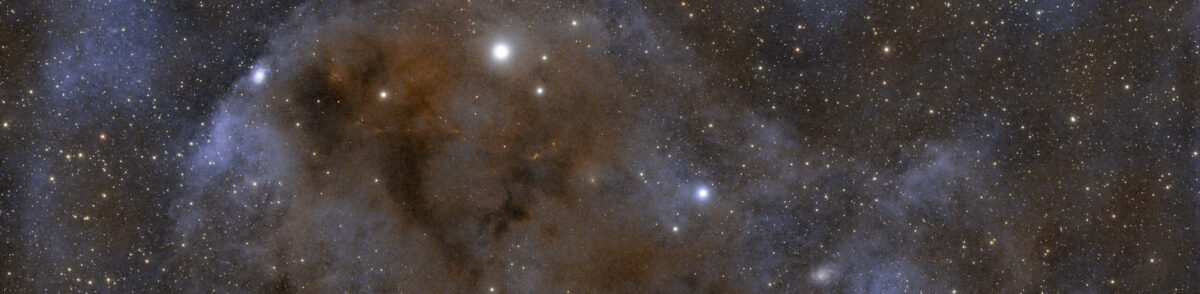
Exploring the Beauty of Reflection Nebulae: IC 2169

Dreyer's Nebula - Reflections in Monoceros

Perhaps among the most beautiful targets to image in our night sky. There are no less than five reflection nebulae in the photograph. They are contrasted by large areas of ionized hydrogen showing as red in the image.

IC 2169, popularly known as Dreyer’s Nebula, is a large blue reflection nebula located in the constellation Monoceros (the Unicorn). It is a primary feature of the Monoceros R1 complex. This is a region of active star formation situated approximately 2,500 to 2,700 light-years away from Earth. It’s in a massive starfield!

The nebula has a distinctive blue hue. This color occurs as interstellar dust particles scatter blue light from nearby hot, young stars. It is primarily illuminated by the massive B-type stars of the young open cluster Collinder 95. Some sources also associate its glow with the variable star T Orionis or the star HD 45677.

The Nebula is often referred to as Dreyer’s Nebula. This name honors John Dreyer, who compiled the NGC and IC catalogs. However, it was actually discovered by Barnard. The nebula is also designated as IC 447. This duplication exists because it was recorded twice in the Index Catalogue (IC) due to separate observations by Edward Barnard. It is located about 2 degrees west of the more famous Cone Nebula and the Christmas Tree Cluster (NGC 2264). It is often imaged alongside smaller reflection nebulae such as IC 446, NGC 2245, and NGC 2247.

I took this photograph from my driveway in the foothills of the Blue Ridge Mountains in western North Carolina. Here, I enjoy a bortle 4/5 sky. Continued development pushes it ever closer to a 5. Imaged with a Skywatcher Esprit 120ED telescope at 840mm focal length and a ZWO ASI2600MC camera cooled to 14f. These are mounted on a Skywatcher Eq6r Pro equatorial mount. It runs EQMOD and guides via PHD2. This is done through a ZWO OAG and an ASI290mm mini guide camera.

Component control is done by APT. Session automation and image acquisition are also managed by APT. These are the magic dust in getting the 143 5 minute subframes. The subframes were manually calibrated, debayered, aligned, integrated, and processed to the targets natural colors using PixInsight.

Astrobin link for acquisition details and annotated image.

A deep look into Sh2-280

Sh2-280 Hii nebula cloud in Monoceros

Sh2-280 is a faint, diffuse emission nebula situated in constellation Monoceros. It is mainly an ionized hydrogen cloud. There is also a little oxygen around the bow-shock of the ionizing star at the center – HD46573. Sh2-280 is approximately 5,500 light-years away and near the Rosette Nebula.

This target sits very low in my southern sky. I imaged this over 4 nights in March 2025 using a Skywatcher Esprit 120ED telescope and an ASI2600MC camera. APT 4.62 – image acquisition and session control. Image calibrated, aligned, integrated and processed manually in PixInsight.

Acquisition details and annotated image here.

IC 2177 – Seagull Nebula

Seagull Nebula
Seagull Nebula

The first thing that struck me as I began to see this image unfold is the vast number of stars found in the illuminated sky. Varying temperatures are seen in the gases with hot Hydrogen gases glowing in reddish hues with cooler gases expanding outward.

IC 2177 is a region of nebulosity that lies along the border between the constellations Monoceros and Canis Major. The name Seagull Nebula is sometimes applied by astronomers to this emission region as it resembles a gull in flight, although it also includes the neighboring regions of star clusters, dust clouds and reflection nebulae.

Astronomers catalog the nebula as IC 2177. This cosmic cloud is one of many sites of star formation within the Milky Way galaxy. It is located 3,800 light-years away from Earth, inside the Orion spur — the same partial spiral arm of the Milky Way where our solar system is located. The nebula is nearly 240 light-years across.

NGC 2327 is located in IC 2177. It is also known as the Seagull’s Head, due to its larger presence in the Seagull nebula. Astronomers list the region near the seagull’s eye (or lizard’s hip) as NGC 2327, which contains a cluster of stars born about 1.5 million years ago. The eye is the brightest and hottest of the newborn stars in the entire nebula, and heats up the dust so that it glows in infrared light.

Dominated by the reddish glow of atomic hydrogen, the complex of gas and dust clouds with bright young stars spans over 100 light-years at an estimated 3,800 light-year distance.

This image consists of 11 hours of exposures with an ASI071MC pro OSC camera connected to a WO Z73 doublet refractor telescope riding a SW EQ6r Pro mount. Image acquisition with APT, processing in PixInsight.

New projects underway!

Verified by MonsterInsights