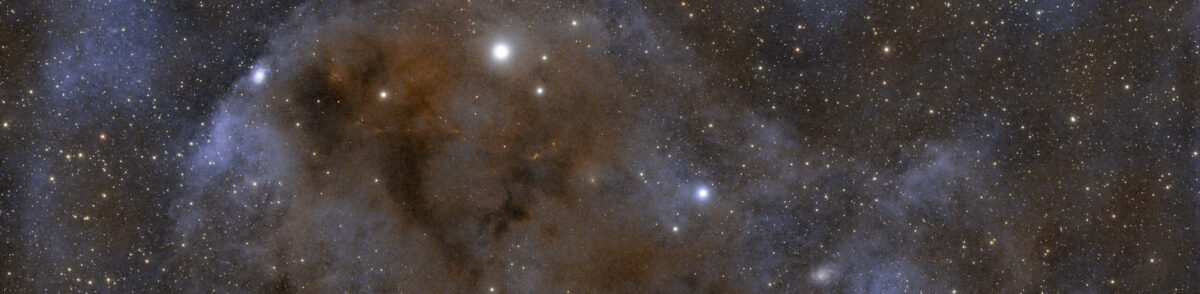

Messier 41 (also known as M 41 or NGC 2287) is an open star cluster in the constellation Canis Major. It is sometimes called the Little Beehive Cluster. It slightly resembles a smaller version of the regular Beehive Cluster, M 44. It was discovered by Giovanni Batista Hodierna before 1654 and was perhaps known to Aristotle about 325 BC. It lies about four degrees almost exactly south of Sirius (the brightest star in the sky). Together, it forms a roughly equilateral triangle with Nu2 Canis Majoris to the west. All three figure in the same field in binoculars.
The cluster covers an area about the size of the full moon. It contains about 100 stars, including several red giants the brightest of which has spectral type K3, apparent magnitude 6.3 and is near the center, and some white dwarfs. The cluster is estimated to be moving away from us at 23.3 km/s. The diameter of the cluster is 25–26 light-years. It is estimated to be 190 million years old. Cluster properties and dynamics suggest a total life expectancy of 500 million years for this cluster. It will have disintegrated by then.
The primary yellow stars are annotated in the astrobin version here.