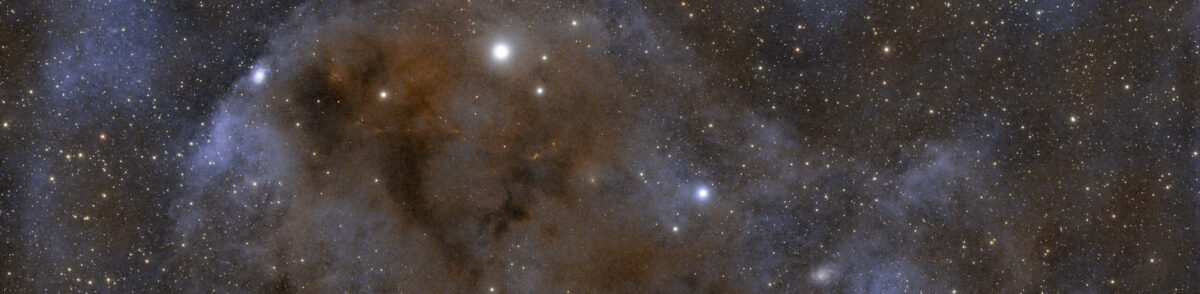

The main object in this image is LBN 878. It is the red and brown nebula dominating the field. The full nebula complex is a combination of emission and dark nebulae. The complex blends emission nebulae. They glow with ionized gas. Dark nebulae obscure background starlight. Together, they create a striking celestial portrait.
Included in this overall object structure is LBN 879 which is in association with the variable star FU Ori. LBN 879 is the small bright nebula in the center and is also known as CED 59. The dark nebula Barnard 35 encompasses the LBN 879 structure. The very dark portion of the red part of LBN 878 is the dark nebula LDN 1594. Here’s the annotated astrobin image. It has all the acquisition detail and identifies every object in the photograph.
Barnard 35 and its illuminated rim (LBN 878) are part of the larger Sharpless 264 (Sh2-264) region. This area is commonly called the Lambda Orionis Ring.
This colossal star-forming complex combines a giant molecular cloud. It also features an expansive H II region. These elements are centered around the massive star Lambda Orionis. The yellow-tinged Cederblad 59 nebula (LBN 879) envelops FU Orionis. It serves as a visual anchor within Barnard 35’s dark clouds. This nebula illustrates the dynamic processes of stellar birth and evolution in this active Orion neighborhood.
I took this photograph during a full moon from my driveway in the hills of the Blue Ridge Mountains. I used a skywatcher Esprit 120ED scope. I paired it with an ASI 2600MC camera cooled to 15f and an Antlia Quad Broadband light pollution filter. The kit sits atop a skywatcher Eq6r Pro mount. APT controls the image acquisition and automation. Pixinsight used for image calibration, alignment, integration, and processing.