NGC 2355 Insights: Chemical Evolution and Star Formation

An Open Cluster in Gemini - NGC 2355

NGC 2355, also known as NGC 2356, is an old open star cluster in the constellation Gemini. It is approximately a billion years old. The cluster is located about 5,400 light-years from the Solar System. It is 1,100 light-years above the Milky Way galaxy’s plane.

NGC 2355 is useful for studying the chemical and dynamical evolution of the Galactic disk. Recent studies using Gaia DR3 data have identified over 400 member stars within the cluster. They have also discovered dozens of variable stars. These include eclipsing binaries and pulsating stars.

NGC 2355 is located in the outer disk and elevated above the plane. This position makes it an important probe for understanding the evolution and structure of the Milky Way’s galactic disk. It is particularly valuable for studying star formation and dynamical processes in less dense regions.

NGC 2355 lies near the celestial equator. It is observable from both the Northern and Southern Hemispheres. It favors northern latitudes where Gemini rises higher in the sky. In the Northern Hemisphere, it is best viewed during winter months from December to March. During this time, the constellation is prominent in the evening sky. From mid-northern latitudes such as 40°N, the cluster culminates at an altitude of approximately 63° above the horizon. This provides favorable viewing conditions away from atmospheric distortion.

I photographed this cluster from my driveway in the foothills of the Blue Ridge Mountains. I use APT for session management, image acquisition, and automation. 71 60sec subframes for just a touch over an hour of integration. Calibrated, aligned, integrated, and processed manually using PixInsight.

Astrobin link for acquisition details and annotated image.

Sh2-247 – A dust ball in Gemini

Sh2-247 - A dustball in Gemini

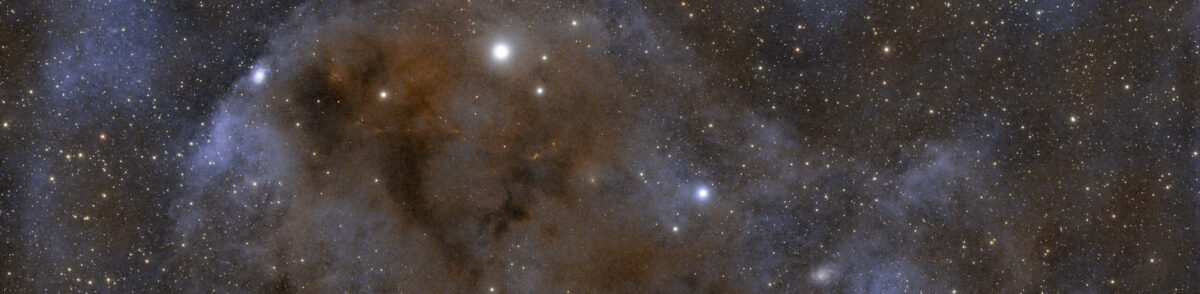
Sh2-247 is a round diffused nebula positioned at the western edge of Gemini near a boundary on Orion. It is part of the Gemini OB1 molecular cloud complex and is located near the boundary with Orion. Admittedly, it’s not very exciting to look at.

It’s located near the Monkey Head Nebula as well as the Jellyfish Nebula.

Imaged over three nights, this image consists of 161 5-minute exposures. These were taken with a GSO RC8 telescope at 1625mm f/8. It is paired with a ZWO ASI071MC camera atop a Skywatcher Eq6r Pro mount. Acquisition session management with Astro Photography Tool (APT 4.60). Image calibration, alignment, integration and processing performed manually in PixInsight.

The Jellyfish Nebula

Jellyfish
The Jellyfish

IC 443 (also known as the Jellyfish Nebula and Sharpless 248 (Sh2-248)) is a galactic supernova remnant in the constellation Gemini. It lies adjacent to the emission nebula Sharpless 249, a star forming region, in the left half of this image. Some really smart folk who’ve been studying this believe that IC 443 may be the remains of a supernova (Star Explosion) that occurred 3,000 – 30,000 years ago. The same supernova event likely created the neutron star CXOU J061705, the collapsed remnant of the stellar core. The shock wave from the explosion produced the particularly intricate lacework of nebulosity that makes up the Jellyfish. The nebula, which is about 5,000 light years away, is adjacent to a rich region of star formation called Sharpless 249. IC 443 is one of the best-studied cases of supernova remnants interacting with surrounding molecular clouds.

The region is bordered by two very bright stars – Propus to the right and Tejat on the left. I find these two by lining up Alnitak (bottom star in Orions Belt) with the bright red star Betelgeuse and continuing about as far again. The two little stars are visible to the naked eye.

Eta Geminorum is the star’s Bayer designation. The traditional names Tejat Prior, Propus (from the Greek, meaning forward foot) and Praepes and Pish Pai (from the Persian Pīshpāy, پیش‌پای, meaning foreleg). In 2016, the International Astronomical Union organized a Working Group on Star Names (WGSN) to catalog and standardize proper names for stars. The WGSN’s first bulletin of July 2016 included a table of the first two batches of names approved by the WGSN; which included Propus for this star. Between the Propus and Tejat are several faint areas of nebulosity. IC 443, the jellyfish while further east around μ Gem is the emission nebula Sh 249 (left side of image). In between is the small faint emission nebula IC 444 (the bridge between the jellyfish and Sh 249).

Image captured with a ASI071MC Pro camera attached to a WO Z73 refractor telescope riding a SkyWatcher EQ6r Pro equitorial mount. Image acquisition with APT and processed manually in PixInsight. Exposures of 240s(28), 360s(94), 600s(32) – totaling 996 minutes, or 16.6 hours. All at unity gain and cooled to 20f. Calibration masters utilized.

Clear skies!

Verified by MonsterInsights