A bright Starburst galaxy located in the constellation Ursa Major, about 12 million light-years away. It’s also known as the Cigar Galaxy because of its elliptical shape.
M 82 is generally photographed with M 81, Bode’s Galaxy. I pointed the 8″ RC telescope at it to get as much detail as I could on just this galaxy.
M82 is a spiral galaxy that’s undergoing a starburst, a massive burst of star formation in its core. It has a gravitatioonal interaction with its nearby galaxy, M81, which causes it to have an extremely high rate of star formation.
M82 is a prototype starburst galaxy and the second-largest member of the M81 group. It’s bright at infrared wavelength and has over 30 billion stars.
M82 can be found in the northern skies in the direction of Ursa Major, also known as the Great Bear.
The Silver Sliver Galaxy Caldwell 23, also known as NGC 891, is an edge-on unbarred spiral galaxy located in the constellation Andromeda.
It is about 30 million light-years away from Earth and is best viewed in our fall season. A spindle-shaped galaxy that is viewed almost edge-on, it is also known as the Silver Sliver Galaxy, the Outer Limits Galaxy, and the Silver Needle Galaxy.
C 23 is visible in small to moderate size telescopes as a faint elongated smear of light with a dust lane visible in larger apertures. Its outskirts are populated by multiple low-surface brightness, and vast substructures, like giant streams that loop around the parent galaxy. The bulge and the disk are surrounded by a flat and thick cocoon-like stellar structure.
In popular 1960’s culture, NGC 891 appears alongside M67, the Sombrero Galaxy, the Pinwheel Galaxy, NGC 5128, NGC 1300, M81, and the Andromeda Galaxy in the end credits of the Outer Limits TV series, which is why it is occasionally called the Outer Limits Galaxy.
This image was taken December 19th, 2023 and January 31st 2024 with a RC8 telescope at 1625mm and ASI071MC camera riding an EQ6r Pro mount. I hope you enjoy this galaxy image.
IC 2574, also known as Coddington’s Nebula, is a dwarf spiral galaxy in the Ursa Major constellation in our northern sky. It’s located 12 million light-years away and is about 50,000 light-years across.
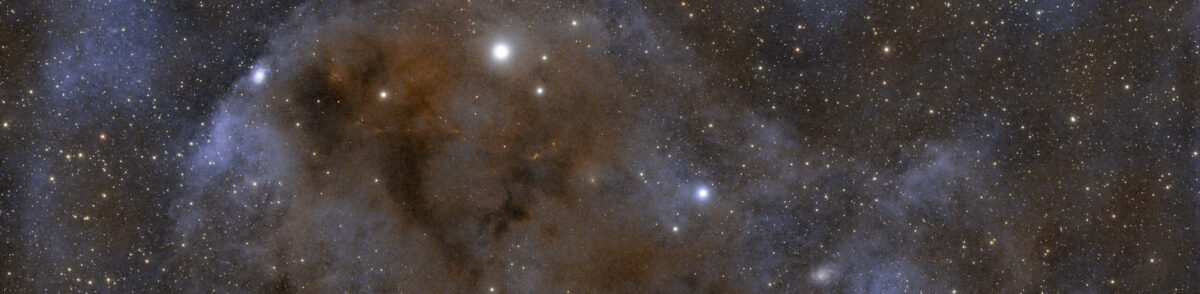
Looking up towards the North in my bortle 4 sky reveals bright stars which are somewhat recognizable like Cygnus, Cassiopeia, The Big Dipper, and the rectangle of the big bear (Ursa Major). There doesn’t appear to be much else this time of year, especially with a bright moon, but looks can be deceiving.
When imaging this target with 5 minute exposures (071mc) at a 1625mm focal length (RC8), a faint smudge appears where the galaxy is supposed to be. This is not one of those big bright galaxies we so often see photographed. This image is an integration of 11 hours of exposure. Even then it’s a fairly faint target. A plate-solved version is available here on my Astrobin collection including all of the imaging technical details.
American astronomer Edwin Foster Coddington discovered IC 2574 in 1898. It’s classified as a dwarf irregular galaxy because of its small size and lack of structure. IC 2574 is a member of the M81 group of galaxies (Bode’s, Cigar, Garland galaxies), which is one of the closest groups to our local group. It contains active star-forming regions that show strong H-alpha emissions, especially in the lower left part of the galaxy in my image.
Astronomers consider IC 2574 an irregular dwarf galaxy because it’s small, lacks structure, and is forming stars. Dwarf galaxies are small galaxies made up of a few billion stars. In 1898 it looked like a smear and therefore was called a nebula by Edwin Coddington. Improved resolution of telescopes over time revealed it to be a galaxy. Of course now with the Hubble Telescope, a population census is possible. Cheers!
The Andromeda Galaxy is one of the most distant objects that can be seen with the naked eye. The galaxy is commonly located in the sky in reference to the constellations Cassiopeia and Pegasus.
The Andromeda Galaxy, also known as Messier 31, M31, or NGC 224 and originally the Andromeda Nebula, is a barred spiral galaxy approximately 2.5 million light-years (770 kiloparsecs) from Earth and the nearest major galaxy to the Milky Way. The galaxy’s name stems from the area of Earth’s sky in which it appears, the constellation of Andromeda, which itself is named after the Ethiopian (or Phoenician) princess who was the wife of Perseus in Greek mythology.
Andromeda is best seen during autumn nights in the Northern Hemisphere when it passes high overhead, reaching its highest point around midnight in October, and two hours later each successive month. The 27 subs for this image were captured in Nov 2020 and Jan 2021.
In early evening, it rises in the east in September and sets in the west in February. From the Southern Hemisphere the Andromeda Galaxy is visible between October and December, best viewed from as far north as possible. Binoculars can reveal some larger structures of the galaxy and its two brightest satellite galaxies, M32 and M110.
An amateur telescope can reveal Andromeda’s disk, some of its brightest globular clusters, dark dust lanes and the large star cloud NGC 206.
This image was captured using the ASI071MC camera; WO Z73 telescope; SW EQ6r Pro mount and other bits and pieces. Capture software is APT. Image processed in PixInsight. Jpeg creation/save in Photoshop.
The first thing that struck me as I began to see this image unfold is the vast number of stars found in the illuminated sky. Varying temperatures are seen in the gases with hot Hydrogen gases glowing in reddish hues with cooler gases expanding outward.
IC 2177 is a region of nebulosity that lies along the border between the constellations Monoceros and Canis Major. The name Seagull Nebula is sometimes applied by astronomers to this emission region as it resembles a gull in flight, although it also includes the neighboring regions of star clusters, dust clouds and reflection nebulae.
Astronomers catalog the nebula as IC 2177. This cosmic cloud is one of many sites of star formation within the Milky Way galaxy. It is located 3,800 light-years away from Earth, inside the Orion spur — the same partial spiral arm of the Milky Way where our solar system is located. The nebula is nearly 240 light-years across.
NGC 2327 is located in IC 2177. It is also known as the Seagull’s Head, due to its larger presence in the Seagull nebula. Astronomers list the region near the seagull’s eye (or lizard’s hip) as NGC 2327, which contains a cluster of stars born about 1.5 million years ago. The eye is the brightest and hottest of the newborn stars in the entire nebula, and heats up the dust so that it glows in infrared light.
Dominated by the reddish glow of atomic hydrogen, the complex of gas and dust clouds with bright young stars spans over 100 light-years at an estimated 3,800 light-year distance.
This image consists of 11 hours of exposures with an ASI071MC pro OSC camera connected to a WO Z73 doublet refractor telescope riding a SW EQ6r Pro mount. Image acquisition with APT, processing in PixInsight.