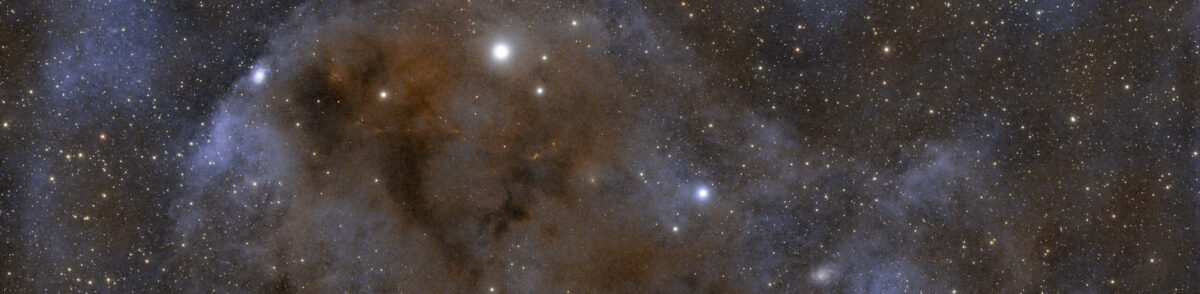
C 9 – Cave Nebula

The Cave Nebula is 2,400 Light-years from earth in the constellation Cepheus.

Cave Nebula
Cave Nebula in Cepheus

Sh2-155 (also designated Caldwell 9) is a very faint diffuse nebula located 2,400 light-years away in the constellation Cepheus. It is widely known as the Cave Nebula.

The image consists of subs taken from the hills of Burke County, NC from Nov & Dec ’20 along with subs from Jan, May, June & July of ’21 – 220 subs totaling 19.5 hours of exposure.

Acquisition hardware: EQ6r Pro, WO Z73, ASI071MC Pro, Radian Quad Ultra, Polemaster, Senso Sesto 2, WO 50-200mm guidescope, ASI 120mm, and NUC.

Acquisition software: APT, PHD2, EQMOD, W10 pro.

Processed manually in Pixinsight.

Roughly 2,400 light-years away and lying in the plane of our Milky Way galaxy, the Cave Nebula is a diffuse emission nebula, within a larger nebula complex that includes a reflection nebula, and dark nebula. It is formed of gases that emit their own light. The bright arc that forms the mouth of the cave is an active birthplace for stars, known as an H II region, where hot clouds of atomic hydrogen have become ionized.

Having a magnitude of about 8 and a span of roughly 40 light-years, Caldwell 9 is a diffuse and low-contrast object, so it can still be difficult to find in the sky. Caldwell 9 is tantalizing to researchers because, according to radio and near-infrared studies of this nebula, the area is bursting with young, hot stars popping into existence.

The amazing wonders of nature.

IC 1805: The Heart Nebula

IC 1805 - Heart Nebula
The Heart Nebula

The Heart Nebula lies some 7500 light years away from Earth and is located in the Perseus Arm of the Galaxy in the constellation Cassiopeia. It was discovered by William Herschel on 3 November 1787. It is an emission nebula showing glowing ionized hydrogen gas and darker dust lanes.

The brightest part of the nebula (a knot at its western edge) is separately classified as NGC 896 and known as the Fish Head Nebula, because it was the first part of the nebula to be discovered.

The nebula’s intense red output and its morphology are driven by the radiation emanating from a small group of stars near the nebula’s center. This open cluster of stars at the Heart’s heart, known as Melotte 15, contains a few bright stars nearly 50 times the mass of our Sun, and many more dim stars that are only a fraction of our Sun’s mass.

This image is comprised of 40 images of 4 min exposures each for a total integration of 2hrs 40mins. Each image was shot at 100 gain & 20 offset in a ZWO ASI071MC Pro camera cooled to 20f. 20 darks, 20 flats, 20 bias frames as calibration frames.

This nebula is in a late rising constellation in our summer months. I was able to begin imaging at 2AM and photographed continuously until a few minutes past 5AM. Do you see the heart? How about the fishhead? There’s also a soul nebula located just outside of this images frame. I’ll image that in the future. The FOV of my Z73 is just a touch to narrow to get them both in the same shot.

Post a comment if you have questions or an observation. Subscribe to be notified when updates are made if you wish.

Cheers!

Verified by MonsterInsights