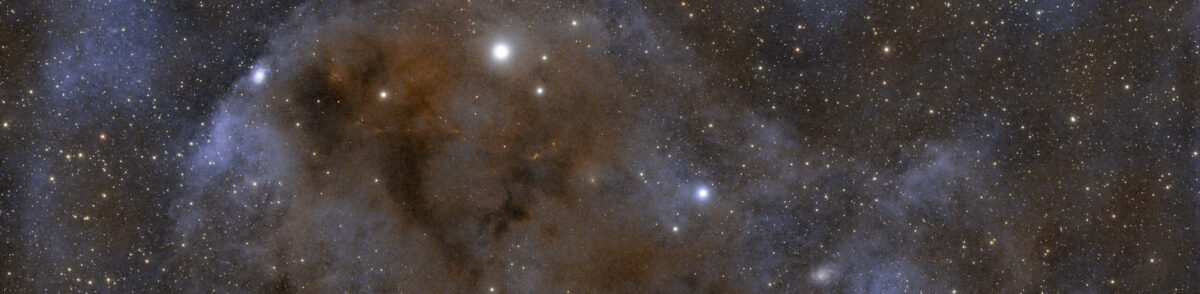
The Rosette Nebula – C 50

Rosette Nebula
Rosette Nebula

The Rosette Nebula is an H II region located near one end of a giant molecular cloud in the Monoceros region of the Milky Way Galaxy. The open cluster NGC 2244 is closely associated with the nebulosity, the stars of the cluster having been formed from the nebula’s matter.

The Rosette Nebula is a cloud of dust containing enough material to make about 10,000 stars like our Sun. In the center of the nebula, and off to the right hand side of this image, is a cluster of hot, bright young stars. These are warming up the surrounding gas and dust, making it appear blue.

The Rosette is a very busy area! A survey of the nebula with the Chandra X-ray Observatory has revealed the presence of numerous new-born stars inside optical Rosette Nebula and studded within a dense molecular cloud. Altogether, approximately 2500 young stars lie in this star-forming complex, including the massive O-type stars HD 46223 and HD 46150, which are primarily responsible for blowing the ionized bubble. Most of the ongoing star-formation activity is occurring in the dense molecular cloud to the south east of the bubble.

Another interesting tidbit of knowledge – On April 16, 2019 the Oklahoma Legislature passed HB1292, making the Rosette Nebula the official state astronomical object. Oklahoma Governor Kevin Stitt signed it into law April 22, 2019.

This photograph is comprised of 318 images totaling ~20 hours of exposure taken with a ZWO ASI071MC Pro camera and a WO Z73 scope w/flat7a riding a Skywatcher EQ6r Pro equitorial mount from my driveway parking area. Captured remotely on my laptop running APT & PHD2. Processed manually in PixInsight with PS doing the jpeg conversion.

There are 2 Caldwell designations as well a 5 New General Catalog (NGC) items within this cluster. They can be read about in Wikipedia via a google search. I dare ya!

Don’t forget to sign up below!

Cheers!

The Lion Nebula

Sharpless 2-132, the Lion Nebula, is a very faint emission type nebula on the Cepheus/Lacerta border.

The Lion Nebula
Lion Nebula in Cepheus

It is estimated to be about 10,000 to 12,000 light years away, but this is no more than an estimate.

This image consists of 16 hours of exposure from a ZWO ASI071MC OSC camera at -6c. Z73 440mm telescope riding a Skywatcher EQ6r Pro mount. Processed in PixInsight, sharpened and converted to jpg in Photoshop.

Night after night I would shoot this for a few hours with only a faint hint of a bright spot on the screen. Once I had 20 hours of data I began the processing journey. All calibrated, cosmetic correction, debayered, subframe selector weeded out about 4 hours of data that just wasn’t up to par. Weightings assigned, top 20 images identified, all frames registered to the best weighted frame, master reference image created from best 20, all frames reregistered to master reference frame, L_Norm reference frame generated, L_norm ran against all frames, finally image integration was run using calibrated, corrected, debayered, registered, lights & L_norm.

I was very pleasantly surprised when I got my first glimpse of this image. Just a little post processing required.

As winter continues more targets will be available to shoot. Sign up below to be notified of additions. Cheers!

Flaming Star Nebula

A sickle for cutting hay or some sort of weapon – that’s what I first saw.

Flaming Star Nebula
Flaming Star Nebula

The Flaming Star nebula (IC405 or Caldwell 31) is fairly unique nebula in the constellation Auriga with obvious emission and reflection components.

At first when imaging this target it appears as an isolated piece of Nebula taking the shape of a sickle for cutting hay or long grass back in the day. (yeah, I’m old). But as the stretch began on this image and the Ha & OIII were rejoined the enormity of the nebulosity became apparent.

Specifically, there’s this faint wisp that is present in the center of the nebula. Both components are due, either directly or indirectly (via dust), to the illumination of the bluish runaway star AE Aurigae. It lies ~1500 light years away from Earth and is about five light years across. It is believed that the proper motion of the central star can be traced back to the Orion’s Belt area. This nebula is very close to the Tadpoles nebula (bottom left of the image).

This image is comprised of 248 subs collected in November 2020 – (81 @ 180s; 129 @ 240s; 38 @ 360s = 987 minutes of exposure or 16.45 hours)

Gear: EQ6r Pro Eq mount; WO Z73 scope; ZWO ASI071MC Pro OSC camera; WO 50mm guidescope; ZWO ASI120mm mini guide camera; Senso Sesto 2 Focuser; Pegasus PBA; Polemaster

Software: Stellarium for planning; APT for image capture; PHD2 guiding; Pixinsight for processing; PS for metadata update and jpg creation.

North America Nebula – Pelican Nebula

North America & Pelican Nebulae
North America / Pelican

The North America Nebula (NGC 7000 or Caldwell 20) is an emission nebula in the constellation Cygnus, close to Deneb (the tail of the swan and its brightest star). The apparent shape of the nebula resembles that of the continent of North America, complete with a prominent Gulf of Mexico.

There’s much more to this image than what you initially think you see. Layers upon layers of gases in space create illusions. There’s A massively bright star illuminating all of the gases you see. It’s all the same gas field. There’s a huge Dark Nebula so thick that the light from that massively bright star cannot penetrate it – creating the illusion of a gulf of Mexico and a divide between the “two” nebula. Another layer nature added for contrast I’m sure is the Cygnus wall lining the left edge of the nebula. Cygnus’s Wall is a term for the “Mexico and Central America part” of the North America Nebula and exhibits the most concentrated star formations in the nebula. It too is so dense light from behind it does not pass through.

The North America Nebula is part of the same interstellar cloud of ionized hydrogen (H II region) as the Pelican Nebula, separated by a dark band of dust, and listed the two nebulae together as Sh2-117. American astronomer Beverly T. Lynds catalogued the obscuring dust cloud as L935 in her 1962 compilation of dark nebulae. The distinctive dark nebula known as LDN 935 (it should perhaps be called the Hudson Bay nebula). This dark nebula lies at the front of the North America nebula and it blocks the light behind it.

Seeing it: The North America Nebula covers a region more than ten times the area of the full moon, but its surface brightness is low, so normally it cannot be seen with the unaided eye. Binoculars and telescopes with large fields of view (approximately 3°) will show it as a foggy patch of light under sufficiently dark skies. However, using a UHC filter, which filters out some unwanted wavelengths of light, it can be seen without magnification under dark skies. Its shape and reddish color (from the hydrogen Hα emission line) show up only in photographs of the area.

Size: The North America and Pelican nebulae lie 2,590 light years away (795±25 parsecs). The whole HII region Sh2-117 is then 140 light years across, and the North America Nebula stretches 90 light years north to south.

What lights it?: In 2004, European astronomers Fernando Comerón and Anna Pasquali searched for the ionizing star behind L935 at infrared wavelengths, using data from the 2MASS survey, and then made detailed observations of likely suspects with the 2.2 m telescope at the Calar Alto Observatory in Spain. One star, catalogued J205551.3+435225, fulfilled all the criteria. Lying right in the centre of Sh2-117, with a temperature of over 40,000° K, it is almost certainly the ionising star for the North America and Pelican Nebulae.

Later observations have revealed J205551.3+435225 is a spectral type O3.5 star, with another hot star (type O8) in orbit. J205551.3+435225 lies just off the “Florida coast” of the North America Nebula, so it has been more conveniently nicknamed the Bajamar Star (“Islas de Bajamar,” meaning “low-tide islands” in Spanish, was the original name of the Bahamas because many of them are only easily seen from a ship during low tide).

Although the light from the Bajamar Star is dimmed by 9.6 magnitudes (almost 10,000 times) by the dark cloud L935, it is faintly visible at optical wavelengths, at magnitude 13.2. If we saw this star undimmed, it would shine at magnitude 3.6, almost as bright as Albireo, the star marking the swan’s head.

I hope you find this photo as interesting as I do. So much to see.

Cheers!

Verified by MonsterInsights