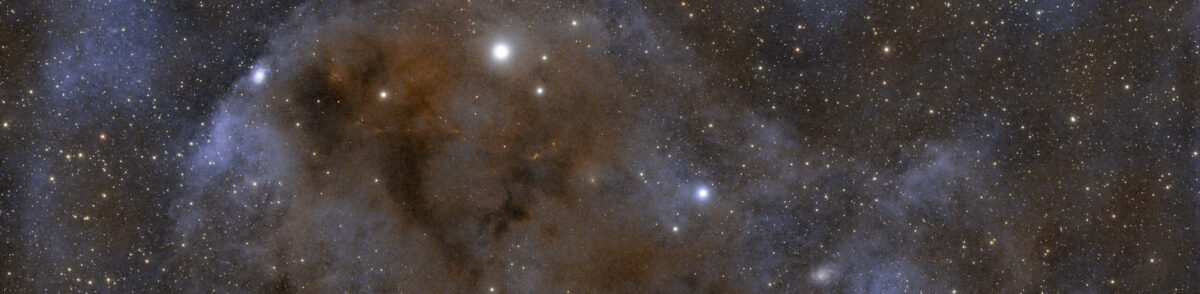
Sh2-155 The Cave Nebula

Sh2-155 / C  9 - The Cave Nebula

Sh 2-155 (also designated Caldwell 9) lies in the plane of our Milky Way galaxy. It is a diffuse nebula in the constellation Cepheus. It resides within a larger nebula complex containing emission, reflection, and dark nebulosity. It is widely known as the Cave Nebula. Sh 2-155 is an ionized H II region. There is ongoing star formation activity. It is at an estimated distance of 2400 light-years from Earth.

Patrick Moore coined the name “Cave Nebula” for this object. The name was presumably derived from photographic images showing a curved arc of emission nebulosity. This arc corresponds to a cave mouth. The “Caldwell Cave” is a bright H II emission nebula. It curves around in an arc and resembles the mouth of a cave. The nebula is part of a much larger Cepheus B molecular cloud. It contains hot, young stars that illuminate and ionize hydrogen gas.

This image is presented in the HOO “hubble palette”.

C 9 – Cave Nebula

The Cave Nebula is 2,400 Light-years from earth in the constellation Cepheus.

Cave Nebula
Cave Nebula in Cepheus

Sh2-155 (also designated Caldwell 9) is a very faint diffuse nebula located 2,400 light-years away in the constellation Cepheus. It is widely known as the Cave Nebula.

The image consists of subs taken from the hills of Burke County, NC from Nov & Dec ’20 along with subs from Jan, May, June & July of ’21 – 220 subs totaling 19.5 hours of exposure.

Acquisition hardware: EQ6r Pro, WO Z73, ASI071MC Pro, Radian Quad Ultra, Polemaster, Senso Sesto 2, WO 50-200mm guidescope, ASI 120mm, and NUC.

Acquisition software: APT, PHD2, EQMOD, W10 pro.

Processed manually in Pixinsight.

Roughly 2,400 light-years away and lying in the plane of our Milky Way galaxy, the Cave Nebula is a diffuse emission nebula, within a larger nebula complex that includes a reflection nebula, and dark nebula. It is formed of gases that emit their own light. The bright arc that forms the mouth of the cave is an active birthplace for stars, known as an H II region, where hot clouds of atomic hydrogen have become ionized.

Having a magnitude of about 8 and a span of roughly 40 light-years, Caldwell 9 is a diffuse and low-contrast object, so it can still be difficult to find in the sky. Caldwell 9 is tantalizing to researchers because, according to radio and near-infrared studies of this nebula, the area is bursting with young, hot stars popping into existence.

The amazing wonders of nature.

Verified by MonsterInsights