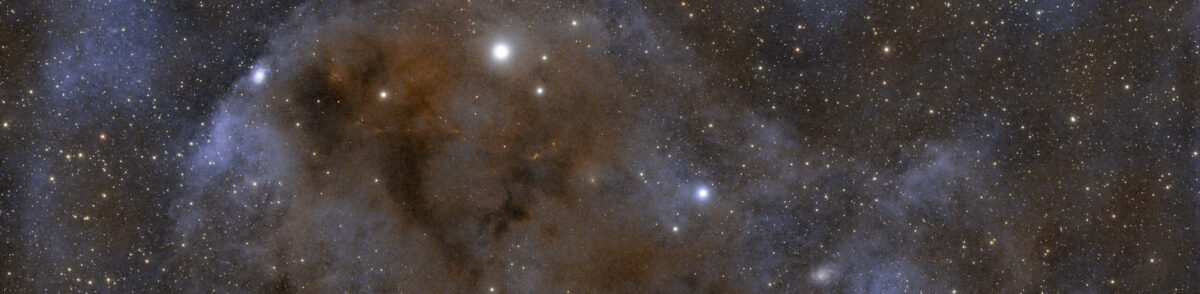
M 8 – Lagoon Nebula

The Lagoon in Sagittarius

NGC 6530 / Messier 8 – Lagoon Nebula

I used the star cluster as the central focus for this image. 112 3 minute exposures with an 840mm Skywatcher Esprit 120ED refractor telescope paired with a ZWO ASI2600MC astro camera.

NGC6530 is a young, open cluster of stars. It is in the southern constellation of Sagittarius. It is located some 4,300 light years from the Sun. The cluster exists within the H II region known as the Lagoon Nebula, or Messier 8. More than two dozen stars are visible.

Like many nebulae, M8 appears reddish in time-exposure color photos. However, it looks gray to the eye peering through binoculars or a telescope. This is because human vision has poor color sensitivity at low light levels.

The nebula contains a number of Bok globules. These are dark, collapsing clouds of protostellar material. The most prominent globules have been catalogued. The platesolved and annotated version in this astrobin link shows everything within the frame. https://astrob.in/y6m8f5/0/

The Lagoon Nebula also contains at its centre a structure known as the Hourglass Nebula.

M 2 – Globular Cluster in Aquarius

Messier 2 - Globular Cluster in Aquarius

Messier 2 or M2 (also designated NGC 7089) is a globular cluster in the constellation Aquarius. It is located five degrees north of the star Beta Aquarii. M2 contains about 150,000 stars, including 21 known variable stars. Its brightest stars are red and yellow giant stars. Messier 2 is located within our Milky Way galaxy. It is one of the oldest clusters of stars designated to the Milky Way. Like most globular clusters, M2 is found within the galactic halo, specifically in the southern galactic cap. This places it right below the southern pole of the Milky Way.

M2 was the first globular cluster added to the Messier catalog. It is located roughly 55,000 light-years from Earth in the constellation Aquarius. A globular cluster is a spherical group of stars that are bound together by their mutual gravitational attraction. M2 has a diameter of over 175 light-years and is one of the largest clusters of its kind. The cluster is rich, compact, and significantly elliptical. It is 12.5 billion years old and one of the older globular clusters associated with the Milky Way galaxy. It was discovered in 1746 by the French astronomer Jean-Dominique Maraldi while he was observing a comet.

This image consists of 66 120 second subs for a total exposure of 2.2 hours. Imaged with an RC8 and ASI071MC camera riding an EQ6r Pro mount from my driveway in the hills of western North Carolina, USA. All controlled using APT 4.50 with guiding by PHD2. Processed manually with PixInsight.

M 63 – Sunflower Galaxy

Sunflower in Canes Venatici

M 63

Messier 63 or M 63 is also known as NGC 5055. It is sometimes called the Sunflower Galaxy. This spiral galaxy is in the northern constellation of Canes Venatici. It contains approximately 400 billion stars. The galaxy is located roughly 27 million light-years from Earth.

This colorful image is composed of 157 2 minute exposures, or 5.2 hours of exposure. It was taken using a GSO RC8 at 1627mm fl and ASI071MC Pro camera riding an EQ6r Pro mount.

M 83 – Southern Pinwheel Galaxy

Southern Pinwheel as seen from the North

Messier 83 or M 83, also known as the Southern Pinwheel Galaxy and NGC 5236, is a barred spiral galaxy. It is approximately 15 million light-years away. It is located in the constellation borders of Hydra and Centaurus. At a declination of -29:52, it is the most southerly target I can image. There are many nebulae in the arms of this face-on galaxy. This makes it an appealing target for photography.

This image is 49 3 minute exposures from a SW Esprit 120ED & ZWO ASI2600MC Pro riding an EQ6r Pro. Captured using APT and processed in PixInsight.

The Galactic Face in Virgo

The Galactic Face of Virgo

NGC 4387

I centered my sensor on this Elliptical Galaxy in the Virgo constellation so I could frame the “Face”. NGC 4387 is situated close to the celestial equator. It is partly visible from both hemispheres at certain times of the year.

It is the nose in the commonly viewed Galactic Face of Virgo. NGC 4388 is the mouth while the eyes are the elliptical galaxies, M 86 and M 84, of Markarians chain.

NGC 4402 is the galaxy to the left and NGC 4413 is to the bottom right.

Caldwell 3 – Faint Galaxy in Draco

Caldwell 3 - A faint galaxy in Draco

NGC 4236 – C 3

Caldwell 3 is located just north of the Big Dipper. It is one of at least 34 gravitationally bound galaxies in the Ursa Major galaxy group. This barred spiral galaxy, also known as NGC 4236, sits 11.7 million light-years from Earth in the constellation Draco and has an apparent magnitude of 9.6. Although faint, Caldwell 3 can be spotted using a small telescope from a dark-sky site. The best views are seen through large telescopes. They show the galaxy as a large, diffuse glow that’s brighter toward the center. It appears highest during the spring in the Northern Hemisphere.

As far as galaxies go, this is by far the faintest I have tried to image. This image consists of 115 5 minute subframes, for a total of 9.5 hours of exposure. Colorful dust lanes did appear. Imaged the evenings of May 12th, 27th and 28th, 2024.

M 16 – The Eagle Nebula

Eagle Nebula

Messier 16 is also known as the Eagle Nebula or the Star Queen Nebula. It is considered an emission nebula in the constellation Serpens. It contains the Pillars of Creation. It’s located in the Milky Way’s Sagittarius Arm, about 7,000 light-years away from Earth. Parts of the Eagle Nebula are emission nebulas. The clouds of gas and dust are so hot they produce their own light. Other parts are dark nebulas. They are made of cold gas. These parts are only visible because of the silhouettes they create against the nebula’s glowing backdrop.

The Pillars of Creation are wispy columns of gas and dust in the nebula’s southern region that hide newborn stars. The Hubble Space Telescope’s 1995 image of the Pillars of Creation made them famous. The nebula’s dark silhouette near its center, which includes the Pillars of Creation, inspired the names “Eagle” and “Star Queen”.

The Eagle Nebula also contains the young star cluster NGC 6611. The nebula has several active star-forming regions. One of these is the Pillars of Creation. Here, gravity pulls gas clumps together to form stars. The wavy lines at the edges of some pillars are ejections from forming stars that collide with clouds of material. These collisions can also create bow shocks, which can form wavy patterns. The crimson glow comes from energetic hydrogen molecules that result from these jets and shocks.

This image was created from 117 240″ exposures captured using APT and calibrated/integrated using PixInsight. APT coordinates all of the technology used in imaging. This includes the cooled astro camera (ASI2600MC). It also includes the Telescope and its focusing (SW Esprit 120ED). Additionally, it includes the Eq6r Pro Mount that tracks with the stars.

NGC 4725 – Spiral Galaxy

Colorful single spiral galaxy

A barred spiral galaxy located in the constellation Coma Berenices, about 40 million light-years away. It is an intermediate galaxy. It has a prominent ring structure. It is roughly the size of the Milky Way at over 100,000 light-years across. NGC 4725 is unique in that it only has one spiral arm, while most spiral galaxies have two or more. The galaxy’s center has a bar of stars. It is surrounded by a ring of stars. Astronomers call this formation a ringed barred spiral galaxy.

In this sharp color composite image, the solo spira mirabilis seems to wind from a prominent ring of bluish, newborn star clusters. It appears to originate from a distinct ring. The ring consists of bluish, newborn star clusters. It also appears to wind from red tinted star forming regions. The odd galaxy also sports obscuring dust lanes a yellowish central bar structure composed of an older population of stars. Also included in the frame is NGC 4712. It sports a noticeably more traditional spiral galaxy look. NGC 4712 is a more distant background galaxy.

Imaged 5/1, 5/10 and 5/11. The night of 5/10 was our Aurora Borealis event. Imaged from 21:30 to 02:00 each of these evenings. 136 4 minute subs were included, or 9 hours of exposure. Gear includes an f8 GSO RC8 telescope at 1625mm, an ASI071MC astro camera cooled to 15f, and an EQ6r Pro mount.

vdB 103 – Blue Reflection in Scorpius

Blue Reflection Nebula

I continue my efforts in imaging reflection nebula from the vdB catalog. IC 4601, or vdB 103, is a bluish reflection nebula. It is located in the constellation Scorpius, about 420 light-years away from Earth.

It’s part of a larger area called the Blue Horsehead. Reflection nebulae are clouds of gas and dust. They shine by reflecting light from nearby stars. They do not create their own light. vdB 103’s blue color comes from the blue light reflected by the nebula’s gas and dust. This light is from two bright blue giant stars on the right. A double star on the left also contributes. The nebula’s brightness depends on the density and size of the reflecting grains. It also depends on the color and brightness of nearby stars.

Platesolved Astrobin link-

https://astrob.in/lqj9k8/0

M 12 – Gumball Cluster in Ophiuchus

M 12 - Gumball Cluster in Ophiuchus

Another of the globular cluster targets on my list, M12 is bright and colorful. This image consists of 137 60 second subs taken with a GSO RC8 and a ZWO ASI071MC Pro camera cooled to 15f, riding an EQ6r Pro munt. Certainly a challenging night for imaging as we experienced a very rare Aurora this night here in the hills of NC. Seeing and transparency were poor and the wind was present so guiding was not the best. Still, I’m happy with it!

Messier 12 (M12), also known as the Gumball Cluster, is a globular cluster of stars in the constellation Ophiuchus. It’s located about 15,700–23,000 light-years from Earth and has a diameter of 75 light-years. M12 is one of the brightest of the seven Messier globulars in Ophiuchus, and it’s approaching our solar system at a speed of 16 kilometers per second.

M12 has fewer low-mass stars than expected, and astronomers believe that gravity has stripped many of them from the cluster as it passed through denser areas of the Milky Way. It’s thought that M12 may have lost up to one million stars in this way.

Verified by MonsterInsights