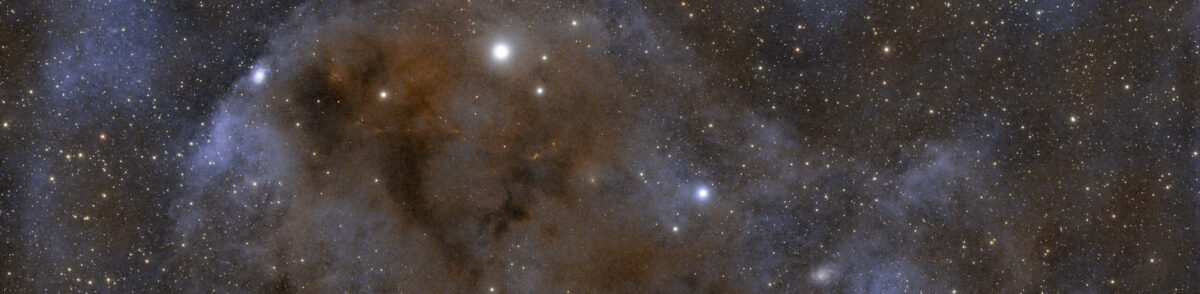

SH2-168 is a striking nebula in the constellation Cassiopeia, about 5,200 light-years from Earth. It’s a part of the Sharpless catalog, a collection of bright nebulae that emit light due to ionized hydrogen. SH2-168 is often nicknamed a “star nursery.” It is a stellar birthplace where young, hot stars ignite. They light up the surrounding gas.
In this image we get two targets in one. Sh2-168 is centered and bright. Sh2-169 is the very faint nebula just to the left in this image resembling a shadow or mirror reflection. I spent two nights photographing this target in Nov ’25. This was during the full moon. I used an Antlia Quad broadband LP filter. APT controlled the hardware, imaging, and automation. Hardware includes a Skywatcher Esprit 120ED scope, ASI2600MC camera, atop a Skywatcher Eq6r Pro mount. Pixinsight was used to calibrate, debayer, align, and integrate the 159 subs.
This nebula is a region filled with hydrogen gas. It glows in red and pink hues when it’s ionized by radiation from young, massive stars. This radiation strips electrons from hydrogen atoms, which later recombine, releasing energy in the form of colorful light. The main source of this illumination is thought to be an energetic B-type star, known for its intense ultraviolet radiation. This radiation “excites” the nebula, leading to the glowing effect that astronomers observe.
SH2-168 lies near the more prominent Heart and Soul Nebulae. It is part of the Perseus Arm of the Milky Way. This arm is one of the galaxy’s spiral arms rich in star-forming regions. Studying SH2-168 and similar nebulae helps scientists understand star formation. They also learn about the life cycle of gas clouds and the influence of massive stars on their surroundings. As these young stars evolve, they sculpt and disperse the gas, often leading to the formation of new stars. This ongoing cycle of creation within SH2-168 offers a small glimpse into the dynamic processes. These processes shape galaxies over millions of years.
Astrobin link for image acquisition details.