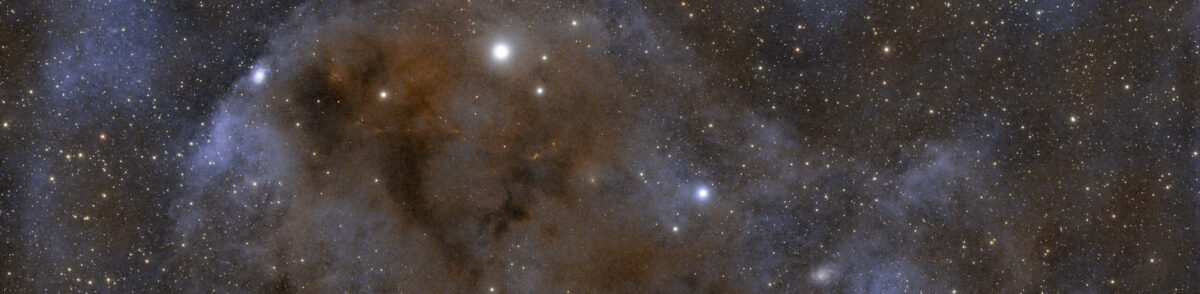

NGC 1999 is a bright reflection nebula in the Orion constellation, located about 1,500 light-years away near the Orion Nebula. Illuminated by the variable star V380 Orionis, it features a distinctive, T-shaped dark void in its center. Once thought to be a dust cloud, this “cosmic keyhole” is actually a hole in the nebula. Energetic stellar winds likely caused this hole. It is also called the “Rubber Stamp” nebula. This name is for those familiar with the use of stamps for marking items.
The nebula is part of the remnants of star formation, surrounded by a network of dusty filaments. It is often observed alongside Herbig-Haro objects, which are small, glowing patches of gas associated with newly formed stars.
The “Keyhole” Void: The most distinctive feature is a dark, T-shaped patch at its center. The region was long thought to be a dense Bok globule. A Bok globule is a cold cloud of dust and gas that blocks light. However, 2010 observations from the Herschel Space Observatory revealed it is actually an empty region of space. It is a literal hole in the nebula.
It is part of the Orion Molecular Cloud Complex and is located just south of the famous Orion Nebula (M42). The region is rich in Herbig-Haro (HH) objects, which are luminous shock waves created by jets from newborn stars. The entire field of view is but a tiny portion of the massive Orion molecular cloud (the Orion A Cloud). A surprise for me is the amount of Oiii in the region. The blue hues highlight its presence.
Session management and automation with APT. I Captured 262 subframes with 180s exposure each. This amounts to about 13 hours of exposure from my driveway. I used an RC8 telescope and an ASI071MC Pro camera cooled to 14f.