NGC 4725 – Spiral Galaxy

Colorful single spiral galaxy

A barred spiral galaxy located in the constellation Coma Berenices, about 40 million light-years away. It is an intermediate galaxy. It has a prominent ring structure. It is roughly the size of the Milky Way at over 100,000 light-years across. NGC 4725 is unique in that it only has one spiral arm, while most spiral galaxies have two or more. The galaxy’s center has a bar of stars. It is surrounded by a ring of stars. Astronomers call this formation a ringed barred spiral galaxy.

In this sharp color composite image, the solo spira mirabilis seems to wind from a prominent ring of bluish, newborn star clusters. It appears to originate from a distinct ring. The ring consists of bluish, newborn star clusters. It also appears to wind from red tinted star forming regions. The odd galaxy also sports obscuring dust lanes a yellowish central bar structure composed of an older population of stars. Also included in the frame is NGC 4712. It sports a noticeably more traditional spiral galaxy look. NGC 4712 is a more distant background galaxy.

Imaged 5/1, 5/10 and 5/11. The night of 5/10 was our Aurora Borealis event. Imaged from 21:30 to 02:00 each of these evenings. 136 4 minute subs were included, or 9 hours of exposure. Gear includes an f8 GSO RC8 telescope at 1625mm, an ASI071MC astro camera cooled to 15f, and an EQ6r Pro mount.

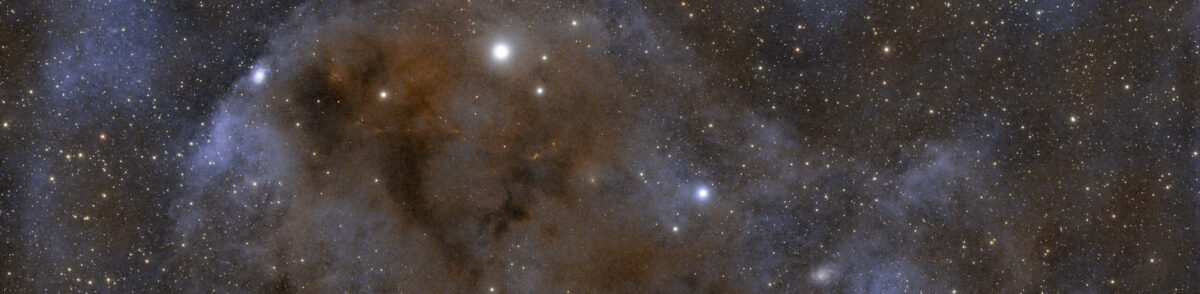
vdB 103 – Blue Reflection in Scorpius

Blue Reflection Nebula

I continue my efforts in imaging reflection nebula from the vdB catalog. IC 4601, or vdB 103, is a bluish reflection nebula. It is located in the constellation Scorpius, about 420 light-years away from Earth.

It’s part of a larger area called the Blue Horsehead. Reflection nebulae are clouds of gas and dust. They shine by reflecting light from nearby stars. They do not create their own light. vdB 103’s blue color comes from the blue light reflected by the nebula’s gas and dust. This light is from two bright blue giant stars on the right. A double star on the left also contributes. The nebula’s brightness depends on the density and size of the reflecting grains. It also depends on the color and brightness of nearby stars.

Platesolved Astrobin link-

https://astrob.in/lqj9k8/0

M 12 – Gumball Cluster in Ophiuchus

M 12 - Gumball Cluster in Ophiuchus

Another of the globular cluster targets on my list, M12 is bright and colorful. This image consists of 137 60 second subs taken with a GSO RC8 and a ZWO ASI071MC Pro camera cooled to 15f, riding an EQ6r Pro munt. Certainly a challenging night for imaging as we experienced a very rare Aurora this night here in the hills of NC. Seeing and transparency were poor and the wind was present so guiding was not the best. Still, I’m happy with it!

Messier 12 (M12), also known as the Gumball Cluster, is a globular cluster of stars in the constellation Ophiuchus. It’s located about 15,700–23,000 light-years from Earth and has a diameter of 75 light-years. M12 is one of the brightest of the seven Messier globulars in Ophiuchus, and it’s approaching our solar system at a speed of 16 kilometers per second.

M12 has fewer low-mass stars than expected, and astronomers believe that gravity has stripped many of them from the cluster as it passed through denser areas of the Milky Way. It’s thought that M12 may have lost up to one million stars in this way.

M 15 – Globular Cluster in Pegasus

M 15 - Globular Cluster in Pegasus

Messier 15 (M15) is a globular cluster of stars in the constellation Pegasus, located about 32,620 light-years from Earth. It is one of the oldest known globular clusters, estimated to be around 12.5 billion years old. M15 is also one of the densest globular clusters, with most of its mass concentrated at its core.

M15 is part of a halo of nearly 150 globular clusters that surround the Milky Way galaxy. Each cluster is a spherical group of hundreds of thousands of ancient stars, with M15 containing both hot blue stars and cooler golden stars. The brightest stars in M15 have an apparent magnitude of 12.6, an absolute magnitude of -2.8, and a luminosity that is 1,000 times that of the Sun.

M 92 – Globular Cluster in Hercules

Messier 92 (M 92) is a globular cluster of stars in the constellation Hercules, about 26,740 light years from Earth.

Messier 92 (M 92) is a globular cluster of stars in the constellation Hercules, about 26,740 light years from Earth. It’s one of the brightest globular clusters in the Milky Way. These ancient, giant clusters can contain tens of thousands to millions of stars, packed tightly together in dense clumps. They can survive for billions of years and can be found throughout the halo of our Milky Way galaxy.

M 92 is a very tightly packed cluster, containing roughly 330,000 stars in total.  M92 is visible in the summer sky for observers at mid-northern latitudes. It can be seen with 10 × 50 binoculars, and a small telescope can resolve the outlying stars in the cluster.  This image was created using a f8 GSO 8 inch Ritchie Creighton telescope and a ZWO ASI071MC pro astrophotography camera.  157 60s subs imaged May 1st, 2024.  Image capture by APT Astro Photography Tool.  Image processing with PixInsight.

During our spring season here in NC I like to image galaxies and globular star clusters.  There are so many to choose from I generally am only able to spend a single night on a cluster. This one is nice.  I particularly like the Red and Yellow stars found within the image in contrast to the hot blue stars.

M 5 – Globular Cluster

M 5 – Globular Cluster in Serpens

Messier 5 (M5) (also known as NGC 5904 or the Rose Cluster) is a globular star cluster in the constellation Serpens Caput (the Serpent’s Head) that’s visible from the Northern Hemisphere. It’s one of the largest and oldest globular clusters in the Milky Way galaxy, containing over 100,000 stars in a region about 165 light-years in diameter. M5 is located 24,500 light-years away from Earth and has an apparent magnitude of 6.7. It appears as a patch of light with binoculars and is best viewed during July.

M5 is a good target for beginner astro-photographers and is well known among visual astronomers as one of the best clusters to observe in the night sky. A 150–200mm (six- to eight-inch) telescope can provide a memorable view, allowing you to see individual stars across a roughly 10 arcminute-sized sphere and more or less all the way down to M5’s core. M5 makes an epic imaging target, especially for long focal length telescopes. This image was taken with an 8 inch Ritchie-Creighton telescope and a ZWO ASI071MC Pro astrophotography camera. – 61 120″ images combined.

Also in this image is IC 4537, a lenticular galaxy of type S0-a in the Serpens constellation, located 736 million light-years from the solar system. It has a surface brightness of magnitude 23.9, a Right Ascension of (15 hours: 17.5 minutes) and Declination (+0.2 degrees : 02 minutes). IC 4537 is located near the celestial equator and a few miles away from the globular cluster, Messier 5. (Top enter of this image)

M 101 – Pinwheel Galaxy

M101 – The Pinwheel Galaxy

M101 – The Pinwheel Galaxy – is a face-on spiral galaxy 21 million light-years away from Earth in the constellation Ursa Major (Big Dipper). Located just west of the last star in the handle.

M101 is a large galaxy containing approx 1 trillion stars, with a diameter of 170,000 light-years. By comparison, the Milky Way has a diameter of between 100,000 and 120,000 light-years.

M101 has a high population of H II regions, many of which are very large and bright. H II regions usually accompany the enormous clouds of high density molecular hydrogen gas contracting under their own gravitational force where stars form. H II regions are ionized by large numbers of extremely bright and hot young stars; those in M101 are capable of creating hot superbubbles. In a 1990 study, 1,264 H II regions were cataloged in the galaxy. Three are prominent enough to receive New General Catalogue numbers—NGC 5461, NGC 5462, and NGC 5471.

There are at least 4 different galaxies resolved within this image. M101 is the largest and closest. NGC5474 is at the lower left. NGC5477 is above the bottom arm of M101 and appears equally distant between the two yellow stars. NGC5473 is at the far left of the image in the middle.

Image acquisition via APT using a SW Esprit120ED, ASI2600MC Pro, OPT L-Pro filter, & EQ6r Pro mount from my backyard in the hills of western NC.

397 300s subs for an exposure of 33 hours.

NGC 4567/8 – Siamese Twin Galaxies

The focus of this image are NGC 4567 and NGC 4568, a pair of unbarred spiral galaxies in the constellation Virgo, about 60 million light-years away. They are known as “The Siamese Twins” or “The Butterfly Galaxies”.

While there are four galaxies in this photo, the focus of this image are NGC 4567 and NGC 4568, a pair of unbarred spiral galaxies in the constellation Virgo, about 60 million light-years away. They are known as “The Siamese Twins” or “The Butterfly Galaxies”. Both galaxies have small bright nuclei, many knotty arms, and arm segments, and a hint of an inner ring.

I find these “interacting” galaxies to be most interesting. They both have nearly the same red shift so they may well be very close or in actual contact. However, other than a dim general x-ray glow involving both galaxies there is no indication of interaction. Neither galaxy is distorted nor are there any tidal tails. NGC4568 has hosted two recent supernova, 1990B and 2004cc.

NGC 4564, the galaxy to the right, is an elliptical galaxy in the Virgo constellation, about 57 million light-years away.

This image was taken from my driveway in the hills of western North Carolina over two nights in April 2024 and consists of 209 3 minute subs from an RC8 scope at 1627mm. An ASI071MC camera cooled to 20f using an ANTLIA quad-band light pollution filter riding an EQ6r Pro mount collected the photons. Image acquisition was done using APT and processed manually using PixInsight.

M 13 – Great Star Cluster in Hercules

Messier 13 (M13) is a globular cluster of over 100,000 stars in the constellation Hercules.

It’s located about 22,180 light years from Earth, and is 11.66 billion years old. M13 is one of the brightest star clusters visible from the Northern Hemisphere.

This image consists of 291 60s subs taken with a ZWO ASI071MC Pro camera and Antlia Quad-band light pollution filter. Telescope is a GSO RC8 at 1627mm FL, EQ6r Pro GEM mount. APT is my image capture software. PixInsight is my image processing software.

Link to the annotated astrobin version.

M 104 – The Sombrero Galaxy

M 104

Messier 104, also known as the Sombrero Galaxy, is an edge-on spiral galaxy in the Virgo constellation. It’s 28 million light-years away, 50,000 light-years across, and has a mass of 800 billion suns. It’s the brightest galaxy within a 32.6 million light-year radius of the Milky Way.

The Sombrero Galaxy is named for its resemblance to a Mexican hat, with a broad rim and high top. It’s best seen with small telescopes during the months of March, April, and May.

The galaxy has a supermassive black hole at its center. Hubble observations also reveal that the Sombrero Galaxy has nearly 2,000 globular clusters, which is 10 times more than in our galaxy. French astronomer Pierre Méchain discovered the Sombrero Galaxy in 1781, but it wasn’t included in Messier’s original catalog.

Here are some facts about the Sombrero Galaxy:

Stars
The Sombrero Galaxy contains several hundred billion stars, about 100 times as many stars as there are people today on Earth.

Globular clusters
The Sombrero Galaxy has an estimated 2,000 globular clusters, 10 times as many as orbit our Milky Way galaxy.

Dust lane
The Sombrero Galaxy’s most striking feature is the dust lane that crosses in front of the bulge of the galaxy. This dust lane is actually a symmetrical ring that encloses the bulge of the galaxy.

Verified by MonsterInsights