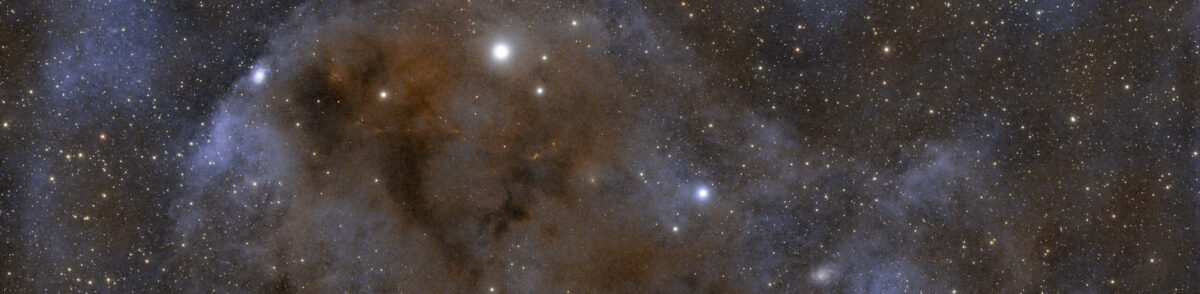

vdB 30 is a very faint reflection nebula located in the northern constellation Camelopardalis. This nebula is part of the van den Bergh (vdB) catalog of reflection nebulae. Astronomer Sidney van den Bergh originally published the catalog in 1966.
It is primarily a reflection nebula, meaning it consists of interstellar dust that reflects the light of nearby stars. The nebula surrounds the bright star Alpha Camelopardalis. Because this star is quite brilliant (magnitude ~4.3), the faint nebulosity can be difficult to capture and is often overwhelmed by the star’s glare. While categorized as a reflection nebula, it is rich in ionized hydrogen (HII) and some sulfur.
Modern narrowband imaging often reveals a bow shock in the gas. These are visible as curved structures in hydrogen-alpha (Ha) light. This phenomenon is caused by the star moving through the interstellar medium. It is estimated to be approximately 5,000 light-years away from Earth.
vdB 30 is considered a very faint and challenging target for amateur astronomers. It requires long exposure times (often 5 to 10+ hours) to detect the subtle dust and gas structures. Its coordinates place it at a high northern declination (+66 degrees), making it a circumpolar object for many observers in the Northern Hemisphere.
VdB 30 is a reflection nebula in the constellation Camelopardalis. It is a very extensive gas cloud. Observing it is difficult due to the low amount of light reflected and its relatively low temperature. It appears to surround the star α Camelopardalis. This star is located in the centre of the image. It is a blue supergiant from apparent magnitude 4.26 and spectral class O9Ia. The cloud extends for about 29 parsecs. It is composed of cold dust. The dust emits infrared radiation due to the weak heating received from the supergiant. The emissions from the supergiant are especially ultraviolet because of its surface temperature equal to 30,000 Kelvin.
The nebula has a ring shape. It is impressed by the strong stellar wind of the supergiant. This wind is responsible for creating a bubble in the interstellar medium surrounding it. As a result, it disperses the cloud itself.
I photographed this difficult target from my driveway in the foothills of the Blue Ridge Mountains in Burke County, NC. I use APT for image acquisition and session automation to capture 159 5 minute exposures across 4 nights. Subframes calibrated, debayered, aligned, integrated, and processed in PixInsight 1.9.3