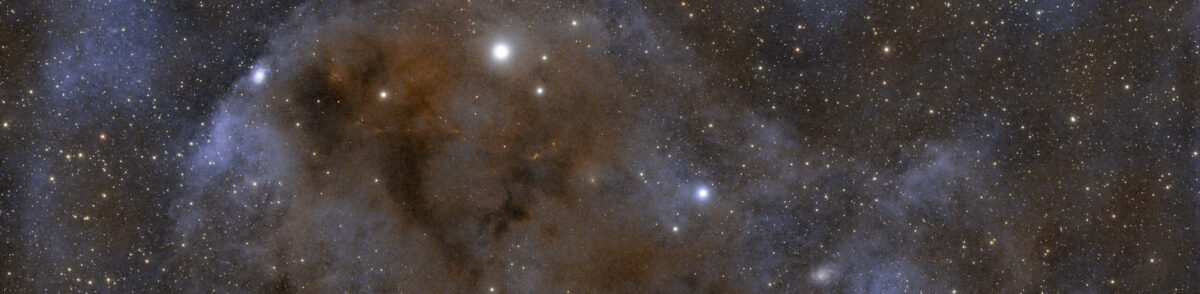

I’ll start by sharing that this may very well be the most difficult target I have ever imaged. It is shrouded in dark nebula. So much dust that there was at most two guide stars for the OAG on the RC8 to guide on. Processing wasn’t much easier. A slight reflection in the dust off my Antlia Quad-band light pollution filter has caused me to stop it’s use. Going back to the LPro. This target truly needs to be shot with a mono camera.
Cataloged as Sh2-239 and LDN 1551, the region lies near the southern end of the Taurus molecular cloud complex. It is some 450 light-years distant. The region stretches for nearly 3 light-years. It abounds with signs of embedded young stellar objects. These objects drive dynamic outflows into the surrounding medium.
Near the center of the frame is a compact, tell-tale red jet of shocked hydrogen gas. It is close to the position of infrared source IRS5. IRS5 is known to be a system of protostars surrounded by dust disks. Just below it are the wings of HH 102. They are broader and brighter. HH 102 is one of the region’s many Herbig-Haro objects. These are nebulosity’s linked to newly born stars. Estimates suggest that the star forming LDN 1551 region contains a large amount of material. This amount is equivalent to about 50 times the mass of the Sun.
The image was captured with a RC8 f/8 telescope. The focal length was 1625mm. An ASI071MC camera was used atop a Skywatcher Eq6r Pro mount. Imaged from my driveway in the hills of western North Carolina. Session management by Astro Photography Tool (APT 4.60). Image calibrated, aligned, integrated, and processed in a natural colors manually in PixInsight.