IC 2177: The Stunning Seagull Nebula Explained

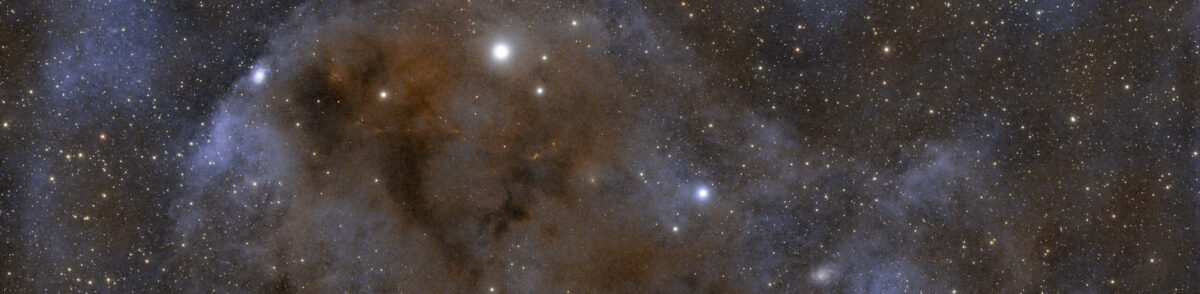
IC 2177 - The Seagull in Monoceros

The first thing that struck me was the vast number of stars. I noticed them as I began to see this image unfold in the illuminated sky. Varying temperatures are seen in the gases with hot Hydrogen gases glowing in reddish hues with cooler gases expanding outward.

IC 2177 is a region of nebulosity that lies along the border between the constellations Monoceros and Canis Major. The name Seagull Nebula is sometimes applied by astronomers to this emission region. It resembles a gull in flight. It also includes the neighboring regions of star clusters, dust clouds, and reflection nebulae.

Astronomers catalog the nebula as IC 2177. This cosmic cloud is one of many sites of star formation within the Milky Way galaxy. It is located 3,800 light-years away from Earth. It resides inside the Orion spur. This is the same partial spiral arm of the Milky Way where our solar system is located. The nebula is nearly 240 light-years across.

NGC 2327 is located in IC 2177. It is also known as the Seagull’s Head, due to its larger presence in the Seagull nebula. The region near the seagull’s eye (or lizard’s hip) is listed as NGC 2327 by astronomers. It contains a cluster of stars born about 1.5 million years ago. The eye is the brightest and hottest of the newborn stars in the entire nebula. It heats up the dust. Consequently, the dust glows in infrared light.

The complex of gas and dust clouds is dominated by the reddish glow of atomic hydrogen. It spans over 100 light-years. Bright young stars are within it at an estimated distance of 3,800 light-years.

Astrobin link for acquisition details and annotated image.

Astrophotography Insights: NGC 247 and Its Mysteries

NGC 247 - Needle's Eye in Cetus

NGC 247 (also known as Caldwell 62) is an intermediate spiral galaxy located approximately 11.1 million light-years away in the constellation Cetus. It is a prominent member of the Sculptor Group, one of the closest galaxy clusters to our own Local Group. At a dec of -20, it’s as far south as I can image. I do this from my driveway here in the forest of western North Carolina.

The “Needle’s Eye” / “Claw” Galaxy: It has an unusual nickname. It’s called the “Needle’s Eye” because of an unusually large void or “hole” on one side of its spiral disk. This region contains older, redder stars. It lacks younger, bluer stars. This indicates that star formation there stopped about a billion years ago. Spanning about 70,000 light-years in diameter, it is smaller than the Milky Way and is viewed nearly edge-on from Earth.

Burbidge’s Chain: In deep images, a striking string of four distant background galaxies is visible. They are roughly 300 million light-years away. This string is located just to the north-east of NGC 247. These were a bonus I found in my image as I was processing it. I never saw them in the faint subframes. The difference between 11 million and 300 million light-years.

Astronomers speculate the galaxy’s distinctive void may have been caused by gravitational interaction with a “dark subhalo.” Another possibility is that another galaxy passed through its disk. While the void is quiet, the rest of the disk features bright pink H II regions. These are knots of glowing hydrogen gas where new stars are actively forming.

Astrobin version for acquisition details and annotated image.

What Makes vdB 13 a Captivating Celestial Object?

vdB 13 - Reflection in Aries

vdB 13 is a bluish reflection nebula cataloged in Sydney van den Bergh’s 1966 VdB Catalogue of 159 reflection nebulae.

Situated approximately 1,000 light-years away in the constellation Aries (at the northeast corner). It is part of the western edge of the Perseus Molecular Cloud.

The nebula is illuminated by the star HIP 15984, a blue star of spectral type B8. It has an apparent magnitude of approximately 8.25.

VDB 13 is surrounded by dust and a dark nebula structure. The dusty blue reflection nebula shines prominently through the darkness. It is these dark lanes that provide the contrast and thus the eerie beauty within the image.

Astrobin link for acquisition details and an annotated image.

Discovering Messier 96

Messier 96

Messier 96 is also known as M96 or NGC 3368. It is an intermediate spiral galaxy. It is located approximately 31 million light-years away in the constellation Leo. It is the brightest member of the M96 Group (or Leo I Group). This group includes other prominent galaxies, such as M95 and M105.

M96 has an asymmetrical structure with unevenly distributed dust and gas and ill-defined spiral arms, likely due to gravitational interactions. Its core is not perfectly centered. It has a diameter of about 100,000 light-years. It contains an estimated 100 billion stars. This makes it comparable in size and mass to the Milky Way.

Astrobin link for the acquisition details.

Exposing Sh2-225 / LBN 778

Sh2-225 - Very Faint Emission Nebula

Sh2-225 (also known as LBN 778) is a faint emission nebula and H II region located in the constellation Auriga. It is situated within the Perseus Arm of the Milky Way. The nebula is estimated to be approximately 12,060 light-years (3,700 parsecs) away from Earth.

I found this to be a fascinating area. There are large bulges of Hii in the background. They are partially obscured by foreground dust. A bright patch of Hii is lit up in the middle. That bright bit is Sh2-225.

Often described as extremely faint, it appears near the more prominent supernova remnant Sh2-224 (the “Rice Hat” nebula). Some deep imaging suggests it may be part of a larger ring-like or ball-shaped structure obscured by dark nebulosity. Due to its low surface brightness, it is a difficult target for astrophotography.

Astrobin link for the acquisition details and annotated image.

Discovering The Broken Heart Cluster in Auriga: NGC 2281

NGC 2281 - The Broken Heart Cluster of Auriga

NGC 2281 is popularly known as the Broken Heart Cluster. It is a bright open star cluster. It is located in the northern constellation of Auriga. Located in the eastern part of Auriga. It is southeast of the star Menkalinan and about halfway between Castor, Pollux, and Capella.

Estimated to be between 435 and 660 million years old. Recent 2023 studies suggest an age of 435 ± 50 million years. This makes it similar in age to clusters like M37 and M48.

NGC 2281 is often described as having a sparse but pleasing arrangement of stars. Notable visual features include:

Central Rhombus: A prominent group of four stars forming a parallelogram or diamond shape at its center.

Member Stars: Contains more than 400 cataloged members. The brightest stars are mostly white A-type stars, with a few evolved red and yellow giants.

Besides the “Broken Heart,” some observers describe the arrangement as resembling a “floppy fish” or the Greek letter lambda (λ).

This image contains 114 60s subs captured using APT for acquisition and session automation. Telescope – Skywatcher Esprit 120ED; Camera – ZWO ASI2600MC Pro; Filter – Antlia Quad light pollution filter; Mount Skywatcher Eq6r Pro

Astrobin link for all of the details

The Double Cluster in Perseus

Caldwell 14 - The Double Cluster

Caldwell 14 is popularly known as the Double Cluster in Perseus. It is a pair of bright open star clusters, NGC 869 and NGC 884. They are located approximately 7,500 light-years from Earth.

Double clusters are not all that common. Thus, this pair has special recognition as being relatively young, separated by only .5 degrees and are visible to the naked eye as a hazy patch in dark skies.

For me it’s the vibrant star colors that catch my eye. There are a few very bright red giants and several yellow stars similar to our sun. The bright blue stars are the youngest within the clusters.

There are more than 300 blue-white supergiant stars in each of the clusters. The clusters are also blue-shifted. NGC 869 approaches Earth at a speed of 39 km/s. NGC 884 approaches at a similar speed of 38 km/s. Their hottest main sequence stars are of spectral type B0. NGC 884 includes five prominent red supergiant stars. All are variable and all around 8th magnitude: RS Persei, AD Persei, FZ Persei, V403 Persei, and V439 Persei.

Astrobin link for the acquisition details and an annotated version of the image.

Capturing the Elusive Sh2-224 Supernova Remnant

Sh2-224 - The Rice Hat

Sh2-224 is a faint supernova remnant (SNR) located in the constellation Auriga. It is most commonly known as the Rice Hat Nebula. This is because its unique asymmetrical shape resembles a traditional Asian conical hat.

It is the expanding shell of debris. It was left over from a massive star’s explosion. This explosion occurred between 13,000 and 24,000 years ago. There are also 7 galaxies in the photograph.

The nebula spans roughly 163 light-years in diameter. The “hat” shape results from the supernova’s shockwave interacting with a lower-density cavity in the interstellar medium. This interaction allowed part of the shell to expand more rapidly into a “wing” or arc.

Sh2-224 is considered an extremely difficult target for amateur astronomers and astrophotographers because it is exceptionally dim. Capturing its detailed filamentary structure typically requires Long Integration Times: Often 20 to 60+ hours of total exposure.

This image is right at 8 hours of exposure. Image acquisition and session automation using APT. Subframe calibration, alignment, integration, and processing with PixInsight. Astrobin link for all the details.

Discovering the Peanut Nebula

Sh2-205 - The Peanut

Sh2-205 is a large, reddish H II region. It is a cloud of interstellar gas and dust where stars are forming. It is located on the border of the constellations Camelopardalis and Perseus. Within Sh2-205 is LBN 696, the big round ball of gas in the center of the image.

Also known as the “Peanut Nebula,” it is approximately 3,200 light-years from Earth and spans about 100 light-years across. It’s not often that the entire frame is filled with various gases. In this case, there’s really no background “sky”. It’s entirely nebulae.

Additionally, it is a faint nebula. Long exposure times are needed to image it. Its brightest part is a peanut-shaped area. I’m guessing the round bit in the middle is the “peanut”. The bright round ball in the center of the photograph is LBN 696. The image encompasses about half of the much larger Sh2-205 nebula.

This image contains 163 5 minute subframes acquired over three nights using APT for session control and automation. Subframe calibration, alignment, integration, and processing with PixInsight. Astrobin link for acquisition details and annotated image.

Verified by MonsterInsights