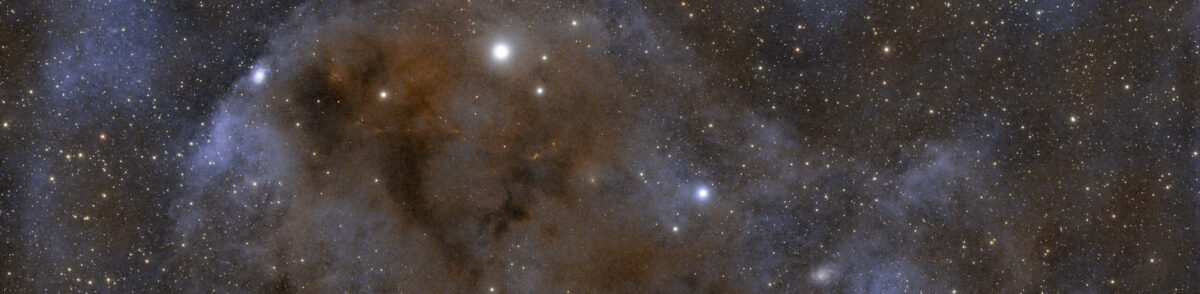
The Angel Nebula is a reflection nebula and stellar nursery in the Monoceros constellation. It is located about 2,400 light-years away at the edge of the star-forming molecular cloud Monoceros R2.
In this classic celestial still life created with a digital paintbrush the Angel Nebula shines near the image center. Reflecting the light of nearby hot stars, NGC 2170 is joined by other bluish reflection nebulae, a red emission region, many dark absorption nebulae, and a backdrop of colorful stars.
I’ve presented this in a portrait mode to highlight the angel appearance.
Sh2-232, Sharpless 232, referred to as the Great Pumpkin Nebula.
Sh2-232 is a faint, small, and diffused nebula ball in the constellation Auriga. It is located in the pentagon of Auriga, about 3 degrees northeast of IC405.
Sh2-232 is the largest and faintest of a group of diffuse nebulae in Auriga. It is ionized by two giant stars, the O9.5 III HD 37737 and an anonymous B0 II class star.
A unique feature of this target is the Planetary Nebula found in the middle of those three central stars (blue dot) – it’s named PK173+03.1. LDN1525 also features prominently as a black vein. SH2-235 looks like a companion ball of gases.
NGC 3180, also catalogued as NGC 3184, is a small, relatively faint face-on symmetrical spiral galaxy in the constellation Ursa Major located just east of Tania Australis (μ-UMa), which is one of the hind paws of the Great Bear (using the convention of the Big Dipper’s handle as the tail). It is located about 40 million light years away, north of the celestial equator at a declination of +41 degrees. The faintness of the galaxy caused me to shoot 5 minutes exposures for four nights, collecting 17.75 hours of usable data. I was counting on the big variable star GP UMa shining brightly in my image. At mag 6.5 it is a bright, but manageable, yellow star.
NGC 3180 is sometimes referred to as the Little Pinwheel Galaxy. The Little Pinwheel has two prominent spiral arms that have constant pitch angles, which makes them both symmetrical. Being a face-on spiral galaxy with a diameter of about 119,000 light-years, which is roughly the same diameter as the Milky Way galaxy it somewhat resembles Messier 101, a closer and thus brighter galaxy of similar appearance. Some sources list NGC 3184 as the galaxy and refer to NGC 3180 and 3181 as HII regions of ionized hydrogen gas. Seems someone got their bits flipped somewhere, sometime. Stellarium lists it as NGC 3180, so I’ve gone with that. The catalogue in APT has the galaxy as NGC 3180 as well.
I used a GSO 8″ Ritchie-Creighton design f8 telescope at 1626mm and a ZWO ASI071MC Pro astrophotography camera riding a Sky Watcher EQ6r Pro German equatorial mount to photograph this galaxy. To overcome the faintness caused by distance, I used 213 300″ exposures captured used Astro Photography Tool (APT) and integrated them using PixInsight 1x Drizzle Integration.
This image is taken from within the constellation Canes Venatici. My intention was to capture as many galaxies as I could within an image and have them resolvable at a focal length of 840mm.
NGC 4231 and NGC 4232 are the two galaxies at the center of this image. NGC 4232 is a Spiral Galaxy in the Canes Venatici constellation. NGC 4232 and NGC 4231 are situated north of the celestial equator and, as such, are more easily visible from the northern hemisphere. NGC 4231 is a Lenticular Galaxy.
NGC 4218 is an intermediate spiral galaxy between NGC 4232 and M 106. It is 57 million light-years from Earth.
The giant in the image is Messier 106. It is an intermediate spiral galaxy about 23 million light-years from earth. It is one of the largest and brightest nearby galaxies, similar in size and luminosity to the Andromeda Galaxy.
NGC 4217 is an edge-on spiral galaxy at the top of the image, which lies approximately 60 million light-years away. It is a possible companion galaxy to Messier 106. One supernova, SN 2022myz (type I, mag. 19), was discovered in NGC 4217 on 19 June 2022.
To the bottom left is the spiral galaxy, NGC 4220. Estimated at 63.8 million light-years away.
A bright Starburst galaxy located in the constellation Ursa Major, about 12 million light-years away. It’s also known as the Cigar Galaxy because of its elliptical shape.
M 82 is generally photographed with M 81, Bode’s Galaxy. I pointed the 8″ RC telescope at it to get as much detail as I could on just this galaxy.
M82 is a spiral galaxy that’s undergoing a starburst, a massive burst of star formation in its core. It has a gravitatioonal interaction with its nearby galaxy, M81, which causes it to have an extremely high rate of star formation.
M82 is a prototype starburst galaxy and the second-largest member of the M81 group. It’s bright at infrared wavelength and has over 30 billion stars.
M82 can be found in the northern skies in the direction of Ursa Major, also known as the Great Bear.
Astronomers like to name things, based upon resemblance if possible, to make them easier to remember. LDN 1622 is called the “Boogeyman Nebula”.
I chose to image it because of the dense dark molecular cloud structure against the hydrogen rich background. I chose the wider field of the SkyWatcher Esprit 120ED triplet refractor telescope to capture the space behind the huge Barnards Loop hydrogen cloud that is home for the Boogeyman. A cloud within a cloud within a cloud, if you will.
LDN 1622 is close to the plane of our Milky Way Galaxy, close to Barnard’s Loop, a large cloud surrounding the Belt and Sword of Orion. It is a fairly dim target, at 1,300 light-years away, requiring long exposure photography to illuminate its beauty. My image consists of 20.5 hours of exposure using an Antlia quadband light pollution filter with a ZWO 2600MC pro camera on a Skywatcher Eq6r Pro mount.
I hope you enjoy this unique image from the Orion Constellation.
The Silver Sliver Galaxy Caldwell 23, also known as NGC 891, is an edge-on unbarred spiral galaxy located in the constellation Andromeda.
It is about 30 million light-years away from Earth and is best viewed in our fall season. A spindle-shaped galaxy that is viewed almost edge-on, it is also known as the Silver Sliver Galaxy, the Outer Limits Galaxy, and the Silver Needle Galaxy.
C 23 is visible in small to moderate size telescopes as a faint elongated smear of light with a dust lane visible in larger apertures. Its outskirts are populated by multiple low-surface brightness, and vast substructures, like giant streams that loop around the parent galaxy. The bulge and the disk are surrounded by a flat and thick cocoon-like stellar structure.
In popular 1960’s culture, NGC 891 appears alongside M67, the Sombrero Galaxy, the Pinwheel Galaxy, NGC 5128, NGC 1300, M81, and the Andromeda Galaxy in the end credits of the Outer Limits TV series, which is why it is occasionally called the Outer Limits Galaxy.
This image was taken December 19th, 2023 and January 31st 2024 with a RC8 telescope at 1625mm and ASI071MC camera riding an EQ6r Pro mount. I hope you enjoy this galaxy image.
IC 2574, also known as Coddington’s Nebula, is a dwarf spiral galaxy in the Ursa Major constellation in our northern sky. It’s located 12 million light-years away and is about 50,000 light-years across.
Looking up towards the North in my bortle 4 sky reveals bright stars which are somewhat recognizable like Cygnus, Cassiopeia, The Big Dipper, and the rectangle of the big bear (Ursa Major). There doesn’t appear to be much else this time of year, especially with a bright moon, but looks can be deceiving.
When imaging this target with 5 minute exposures (071mc) at a 1625mm focal length (RC8), a faint smudge appears where the galaxy is supposed to be. This is not one of those big bright galaxies we so often see photographed. This image is an integration of 11 hours of exposure. Even then it’s a fairly faint target. A plate-solved version is available here on my Astrobin collection including all of the imaging technical details.
American astronomer Edwin Foster Coddington discovered IC 2574 in 1898. It’s classified as a dwarf irregular galaxy because of its small size and lack of structure. IC 2574 is a member of the M81 group of galaxies (Bode’s, Cigar, Garland galaxies), which is one of the closest groups to our local group. It contains active star-forming regions that show strong H-alpha emissions, especially in the lower left part of the galaxy in my image.
Astronomers consider IC 2574 an irregular dwarf galaxy because it’s small, lacks structure, and is forming stars. Dwarf galaxies are small galaxies made up of a few billion stars. In 1898 it looked like a smear and therefore was called a nebula by Edwin Coddington. Improved resolution of telescopes over time revealed it to be a galaxy. Of course now with the Hubble Telescope, a population census is possible. Cheers!
Hidden in the outskirts of the Orion constellation, close to the Witchhead Nebula (IC 2118), we can find an area rich in interstellar gas and dust around the reflection nebula NGC 1788. This bright deep sky object attracts our attention among all that faint dust and gas. It is flanked by the dark nebula known as Lynds 1616.
I began imaging NGC 1788 on January 1st and continued on the nights of Jan 4th, 7th, 10th and 11th. I acquired a touch over 200 5 minute exposures. I remember it was bloody cold! This was imaged with the Skywatcher Esprit 120ED telescope at 840mm focal length using a ZWO ASI2600MC camera.
NGC 1788 is about 2,000 light years away from Earth and is sometimes called the “Cosmic Bat” nebula. It is made up of blue reflection regions, lots of dust, and a glowing area of hydrogen gas. It is close to the celestial equator, so it is sometimes visible from both hemispheres at certain times of the year. The brightest star in the nebula is 10th magnitude and is in the northwest sector.
Although this ghostly cloud is rather isolated from Orion’s bright stars, their powerful winds and light have a strong impact on the nebula, forging its shape and making it a home to a multitude of newborn stars.
I’ve enjoyed imaging these reflection nebula showing something a little different in our night sky.
I produced a short video highlighting my astrophotography in 2023. I was fortunate to have had a good year after the smoke cleared from the Canadian wildfires. Let me know what you think.
I also had the pleasure of photographing the Tosco Music Holiday Party at Charlotte’s Knight Theater in December. It’s always a pleasure!
A galaxy image from 2023.
Caldwell 65 – The Sculptor Galaxy This target is very low in my southern horizon and is imageable for about 90 minutes per session this time of year. It is considered one of the most easily viewed galaxies in the sky after the Andromeda Galaxy. Caldwell 65, also known as NGC 253, is a spiral galaxy in the constellation Sculptor, about 10 million light-years from Earth. Caldwell 65 is a starburst galaxy, which means it’s currently undergoing a period of intense star formation. It has a disk-like appearance, since we see it almost edge on, which has led some to nickname it the Silver Coin or Silver Dollar galaxy. Most people, however, call it the Sculptor galaxy after the constellation it resides in. This galaxy is one of the nearest beyond our local neighborhood of galaxies, making it an ideal target for many Astro photographers.