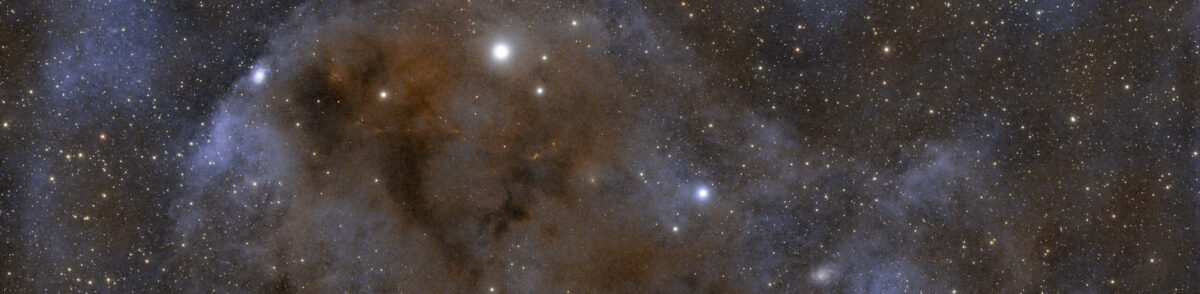
Sh2-274, also known as the Medusa Nebula or Abell 21, is a planetary nebula in the constellation Gemini.
It is located 1,500 light-years away and has an estimated diameter of 4 light-years. The nebula is around 8,800 years old and was discovered in 1955 by UCLA astronomer George O. Abell
A planetary nebula is a region of cosmic gas and dust formed from the cast-off outer layers of a dying star. Despite their name, planetary nebulae have nothing to do with planets.
When stars with an intermediate mass (greater than 80% of the Sun’s mass, but less than eight times its mass) die, they expand to form red giants. The dying star will continue to expel gas, whilst simultaneously the remaining core of the star contracts and temporarily begins to radiate energy again. This energy causes the expelled gas to ionise, meaning that the atoms and molecules in the gas become charged and begin to emit light. The cast-off glowing gas is known as a planetary nebula. Therefore, planetary nebulae are classified as emission nebulae, and are entirely unrelated to planets.
The misnomer came about because of a historical misclassification. 250 years ago, astronomers thought they were looking at gas planets when they observed the colourful spectacle of planetary nebulae through their less powerful telescopes. Planetary nebulae only last for about 20 000 years, making them a very short-lived part of the stellar life cycle.
Messier 92 (M92) is a globular cluster of stars in the constellation Hercules, about 26,740 light years from Earth. It’s one of the brightest globular clusters in the Milky Way, with an apparent magnitude of 6.3, and can be seen with the naked eye in good observing conditions.
M92 is very tightly packed with stars, containing roughly 330,000 stars in total. M92 is visible in the summer sky for observers at mid-northern latitudes. It can be seen with 10 × 50 binoculars, and a small telescope can resolve the outlying stars in the cluster.
M92 is a great target for beginner Astro photographers and stays high in the sky for several months. John Herschel described it as a “globular cluster; very bright; very large; extremely compressed toward the middle; well resolved; small stars”
I like the Red and Yellow stars found within the image.
Imaged with a Sky Watcher Esprit 120ED and a ZWO ASI2600MC Pro camera riding a Sky Watcher EQ6r Pro mount. 256 60s subs. Image capture by APT Astro Photography Tool. Image processing with PixInsight.
This is a wide field view of the Virgo Cluster of galaxies. There are 14 galaxies solved and annotated. A brief description of several galaxies is provided. An annotated version is available in the astrobin link – click the image.
NGC 4638 is a lenticular galaxy in the Virgo constellation with a magnitude of 12.1. It’s about 50 million light-years away and is a member of the Virgo Cluster. Astronomer William Herschel discovered NGC 4638 on March 15, 1784. NGC 4638 is very bright and moderately large, with an edge-on disk and a diffuse, boxy halo. The halo has a shallow surface brightness gradient, which is characteristic of a large spheroidal galaxy.
NGC 4637 is a lenticular galaxy in the Virgo constellation with a magnitude of 12.711. It was first discovered by R.J. Mitchell on March 1, 1854, and is located near the celestial equator.
M 59 – Messier 59 (M59), also known as NGC 4621, is an elliptical galaxy in the constellation Virgo, about 50 million light-years away from Earth. It is part of the Virgo Cluster, which contains about 2,000 galaxies, and is one of the largest elliptical galaxies in the cluster. M59 has an absolute magnitude of -22.82 and a magnitude of 9.6. It has an estimated mass of 250 billion suns, which is greater than the Milky Way, but only a quarter of that of its nearby companion M-60.
M 60 – Messier 60 (M60), also known as NGC 4649, is an elliptical galaxy located in the Virgo constellation, about 54 million light-years from Earth. It’s about half the size of the Milky Way, but contains an estimated 400 billion stars, which could be four times the amount in our galaxy. M60 is about 60,000 light-years across and has an apparent magnitude of 9.8. M60 contains one of the most massive black holes known, with a mass of about 3.4 billion times the Sun’s mass. This black hole makes up 15 percent of the galaxy’s mass, which is too big to have formed inside a dwarf galaxy. The black hole is not producing any big outbursts of energy, and unlike the black holes in many other galaxies, it is not beaming out strong “jets” of charged particles.
NGC 4660 – NGC 4660 is an elliptical galaxy in the Virgo constellation, about 63 million light-years away. It has a magnitude of 12.16 and is part of the Virgo Cluster. Astronomer William Herschel discovered NGC 4660 on March 15, 1784. NGC 4660 contains 205 globular clusters, which is typical for its size and brightness. Globular clusters often contain hundreds of thousands of old stars
NGC 4647 – NGC 4647 is a faint, intermediate spiral galaxy in the Virgo constellation, about 63 million light-years away. NGC 4647 is about two-thirds the size of Messier 60, the third brightest galaxy in the Virgo cluster. The two galaxies have overlapping optical disks, suggesting they may be interacting. However, photographic images don’t show any evidence of gravitational interaction between the two galaxies. Studies with the Hubble Space Telescope show that a tidal interaction may have begun. NGC 4647 is part of a pair of galaxies known as Arp 116, along with Messier 60, which is an elliptical galaxy. NGC 4647 is much lower in mass than Messier 60, and is roughly the size of the Milky Way.
NGC 4607 – NGC 4607 is a barred spiral galaxy in the Virgo constellation, about 56 million light-years away. It has a magnitude of 13.75 and is located near the celestial equator. Astronomer R. J. Mitchell discovered NGC 4607 on April 24, 1854.
NGC 4606 – NGC 4606 is a barred spiral galaxy in the Virgo constellation, about 55 million light-years away. It has a magnitude of 12.67, an apparent diameter of 2.8 arc minutes, and is located near the celestial equator. Because of this, it is at least partially visible from both hemispheres at certain times of the year.
IC 3704 – IC 3704 is a barred spiral galaxy in the Virgo constellation, near the celestial equator.
Sh2-302, also known as the Snowman Nebula, is a red emission nebula located in the constellation Puppis, about 5,800 light years away. It’s part of the Gum Nebula, which occupies the lower southern skies in winter. The nebula has a visual diameter of 15 arc minutes and is located near the boundary between Puppis and Canis Major.
Sh2-302 is one of many objects in a catalog compiled by astronomer Stewart Sharpless to identify areas of interstellar ionized hydrogen, or HII regions.
I captured this photograph Feb 18, 2024 and March 13, 2024 using a Skywatcher Esprit 120ED telescope at a fl of 840mm and a ZWO ASI071MC Pro astrophotography camera with an Antlia quad-band light pollution filter. These are mounted on a Skywatcher EQ6r Pro German Equitorial Mount. The image acquisition software that controls everything is APT (Astro Photography Tool). Total exposure of 4.4 hrs. 75 exposures were integrated and processed using Pixinsight.
The M81 galaxy group is a group of over 40 galaxies
The M81 galaxy group is a group of over 40 galaxies located in the constellations Ursa Major and Camelopardalis. The group includes the galaxies Messier 81, Messier 82, and NGC 3077 which are found in this image. The M81 group is one of the closest galaxy groups to the Local Group, which includes the Milky Way, Andromeda, and Triangulum galaxies. The M81 group is about 12 million light-years from Earth.
This image consists of 215 3 minute exposures captured using APT with guiding by PHD2 from the end of January 2024. I imaged this when the moon loomed high in my sky. SkyWatcher Esprit 120ED telescope paired with the ZWO ASI2600MC camera and the Antlia quadband light pollution filter. An annotated version is available on my Astrobin page here.
Bode’s Galaxy, or Messier 81 (M 81), is a spiral galaxy in the constellation Ursa Major. It’s about 11.8 million light-years away from Earth and has an apparent magnitude of 6.94. M81 is one of the brightest galaxies in the night sky and is visible with binoculars or a telescope. Its size and well-defined spiral arms make it an enjoyable sight. M81 is nicknamed “Bode’s Galaxy” after it was discovered by German astronomer Johann Elert Bode in 1774.
Messier 82 (M82) is a spiral galaxy located in the constellation Ursa Major, about 12 million light-years away from Earth. It’s also known as the Cigar Galaxy because it’s undergoing a burst of star formation in its core. M82 is the second-largest member of the M81 Group, with a mean radius of 18,500 light-years. The galaxy’s center is forming stars 10 times faster than the Milky Way due to gravitational interactions with its neighbor galaxy, M81. M82’s star formation powers a bipolar superwind that originates near the core of the galaxy. The superwind compresses enough gas to trigger the ignition of millions more stars. The galaxy also expels violent winds that blow gas and dust out of the galaxy. In visible light, the only hint of M82’s star formation is fountains of hot hydrogen gas streaming out of its disk.
NGC 3077 is a small, disrupted elliptical galaxy in the constellation Ursa Major. It is a member of the M81 group of galaxies and is located about 13 million light-years away from Earth. At first glance NGC 3077 looks like a typical, relatively peaceful elliptical galaxy. However, it is actually a hotbed of very energetic star formation and the whole galaxy is laced with dusty tendrils. Despite being similar to an elliptical galaxy in appearance, it is peculiar for two reasons. First, it shows wispy edges and scattered dust clouds that are probably a result of gravitational interaction with its larger neighbors, similar to the galaxy M 82. Second, this galaxy has an active nucleus.
Sometimes you are pleasantly surprised by what comes from these reflection nebula. Other times not so much. This image was centered on VdB 27 (catalogued also as Ced 31) – a small reflection nebula in the constellation Taurus. The nebula is illuminated by the radiation of the variable star RY Tauri.
All the image acquisition info, along with an annotated version of this image, is here in my Astrobin page. A dark nebula (B 214) and a bright nebula (LBN 785) along with a few stars.
This small reflection nebula is usually captured as part of a wide field image of this part of the Taurus Molecular cloud. From my driveway here in the hills of NC, I chose to narrow that view a bit and image it with a RC8 at a focal length of 1628mm using the ASI071MC Pro camera with a Antlia Quadband light pollution filter.
This is 110 3 minute exposures taken Feb 13 and 14, 2024 for 5.5 hours of total exposure.
M 81 is a spiral galaxy with long thin faint dust trails extending from its arms in the constellation Ursa Major. It’s about 11.8 million light-years away from Earth and has an apparent magnitude of 6.94. M81 is one of the brightest galaxies in the night sky and is visible with binoculars or a telescope.
Its size and well-defined spiral arms make it an enjoyable sight through almost any telescope or even a pair of binoculars. A telescope with an aperture of 8″ or more will show more detail under dark skies.
This image consists of a little over 9 hours of exposure taken with a RC8 telescope at 1625mm, the ASI071MC Pro cooled astro camera, all riding on an EQ6r Pro German Equatorial Mount. Image acquisition was controlled by APT with long exposure guiding by PHD2. The image was processed manually in PIxinsight.
M81 is nicknamed “Bode’s Galaxy” after it was discovered by German astronomer Johann Elert Bode in 1774.
M51, also known as Messier 51a or NGC 5194, is a spiral galaxy in the constellation Canes Venatici. It’s located 31 million light-years from Earth. M51’s arms are made of long lanes of stars, dust, and gas, and appear like a staircase. Sometimes the designation M51 is used to refer to the pair of galaxies, in which case the individual galaxies may be referred to as M51a (NGC 5194) and M51b (NGC 5195).
The Whirlpool Galaxy has two, very prominent spiral arms that wind clockwise. One arm deviates from a constant angle significantly. The pronounced spiral structure of the Whirlpool Galaxy is believed to be the result of the close interaction between it and its companion galaxy NGC 5195.
As a result of the Whirlpool Galaxy’s interaction with NGC 5195, a variety of tidal features have been created. The largest of these features is the so-called Northwest plume, which extends out to 43 kiloparsecs (140,000 light-years) from the galaxy’s center. This plume is uniform in color and likely originated from the Whirlpool Galaxy itself due to having diffuse gas. Adjacent to it are two other plumes that have a slightly bluer color, referred to as the Western plumes due to their location. These plumes are what I was trying to capture and highlight in my image. Very faint trailing dust.
NGC 5195 (also known as Messier 51b or M51b) is a dwarf galaxy that is interacting with the Whirlpool Galaxy (also known as M51a or NGC 5194). Both galaxies are located approximately 31 million light-years away in the constellation Canes Venatici. Together, the two galaxies are one of the most widely studied interacting galaxy pairs.
A plate-solved and annotated version is available on my Astrobin page.
Basically there’s this dust patch in Camelopardalis – fairly tightly circling Polaris. How anyone ever saw and cataloged in when they did I’ll never understand. LBN 629 is a faint dust cloud in the constellation Camelopardalis, which is located in the northern celestial hemisphere.
I stretched this image beyond imagination as I processed it for the third time. The first was so bad I deleted it. The second I kept but it was horrid – this one, well it’s the best I can do with almost 28 hours of exposure from a f7 esprit 120ed and the 2600mc camera.
Personally I see a stretched view of Willie G. You?
NGC 3628, also known as the Hamburger Galaxy or Sarah’s Galaxy, is a unbarred spiral galaxy located in the Leo constellation, about 35 million light-years away.
NGC 3628 is part of a small group of galaxies located in the Leo constellation, including M65 and M66 they are commonly referred to as the “Leo Triplets”. It has a puffy galactic disk divided by dark dust lanes, young blue star clusters, and pinkish star forming regions. Its most notable feature is a broad band of dust along the outer edge of its spiral arms.
The name “Hamburger Galaxy” comes from its shape, which resembles a hamburger. The name “Sarah’s Galaxy” may refer to poet Sarah Williams (1837–1868), who is famous for the poem “The Old Astronomer”.