NGC 5982 Group: A Stunning Galaxy Trio in Draco

NGC 5982 and the Draco Trio

The NGC 5982 group is also known as the Draco Triplet or Draco Group. It is a striking trio of galaxies located approximately 100 to 140 million light-years away in the constellation Draco. The group is a favorite for Astro photographers. This is because it features three distinct types of galaxies in a single field of view. The view spans about the width of a full moon. There are 10 galaxies in this photograph total.

The “triplet” is composed of the following galaxies, typically seen in a line:

NGC 5982 (Center): A bright elliptical galaxy (type E3). It features a “decoupled nucleus.” This is a core that rotates perpendicular to the rest of the galaxy. It also has faint shells. Both are strong evidence of past galactic mergers.

NGC 5985 (Top): A large, nearly face-on barred spiral galaxy. It is classified as a Seyfert galaxy. This classification means it has an extremely bright and active nucleus. This is powered by a supermassive black hole.

NGC 5981 (Bottom): A faint spiral galaxy seen almost edge-on. Its thin profile shows a prominent dust lane similar to the famous “Needle Galaxy”.

This photograph was captured from my driveway in the hills of western North Carolina. I set up my RC8 with an ASI071MC camera atop an Eq6r Pro mount. I use Astro Photography Tool (APT 4.70.1) for session management and acquisition automation. The 96 3 minute subframes were calibrated, aligned, integrated, and processed manually with Pix Insight 1.9.3. Astrobin link for acquisition details and annotated image.

Exploring NGC 2655: A Seyfert Galaxy in Camelopardalis

NGC 2655NGC 2655 is a lenticular galaxy in the constellation Camelopardalis. It is at a distance of 60 million light years from Earth. NGC 2655 is a Seyfert galaxy. This means it has an extremely luminous core powered by matter falling into a supermassive black hole.The galaxy has asymmetric dust lanes in the center of the galaxy, tidal arms and extended neutral hydrogen gas and may have recently experienced a merger.  It is situated near the north celestial pole, making it circumpolar and visible year-round for observers in the Northern Hemisphere. Imaging session management and control using Astro Photography bTool (APT 4.70.1).  Subframe calibration, debayer, alignment, integration, and processing using PixInisght.

NGC 2655 is a lenticular galaxy in the constellation Camelopardalis. It is at a distance of 60 million light years from Earth. NGC 2655 is a Seyfert galaxy. This means it has an extremely luminous core powered by matter falling into a supermassive black hole.

The galaxy has asymmetric dust lanes in its center. It features tidal arms and extended neutral hydrogen gas. It may have recently experienced a merger. It is situated near the north celestial pole, making it circumpolar and visible year-round for observers in the Northern Hemisphere.

Imaging session management and control using Astro Photography bTool (APT 4.70.1). Subframe calibration, debayer, alignment, integration, and processing using PixInisght. Astrobin link for acquisition details and annotated image.

Discovering NGC 3384: The Lenticular Galaxy in Leo

NGC 3384

NGC 3384 (also known as NGC 3371) is a lenticular galaxy. It is located approximately 35 million light-years away. This galaxy is in the constellation Leo. It is a prominent member of the M 96 Group. This group is also called the Leo I Group. It includes the well-known Messier objects M 95, M 96, and M 105.

NGC 3384 and its neighbor M 105 are surrounded by a massive ring of neutral hydrogen. This ring is 650,000 light-years wide. Sparse star formation still occurs there. In the night sky, NGC 3384 forms a visual trio with the elliptical galaxy M 105. It forms this trio with (NGC 3379) and the spiral galaxy NGC 3389.

While M 105 and NGC 3384 are physical companions, NGC 3389 is a background galaxy located significantly further away. The galaxy hosts a supermassive black hole at its core. It has an estimated mass of 16 million times that of the Sun. This black hole is considered “quiet,” producing very little radio energy.

Image acquisition details in Astrobin. APT used for image acquisition and session automation. PixInsight used for subframe processing.

Exploring Sharpless 282: A Hidden Gem in Monoceros

Sh2-282

Sh2-282 (Sharpless 282) is a very faint Hii emission nebula in the constellation Monoceros. It is approximately 4,075 to 5,000 light-years away from Earth. It belongs to the second Sharpless catalog. It is situated in the north-central part of its constellation. The nebula is roughly 3° south of the famous Rosette Nebula.

The nebula is characterized by red hydrogen gas energized by radiation from nearby bright blue stars. It spans approximately 40 light-years in diameter. In apparent view, that’s 35 arc-minutes. The nebula contains eight cometary globules. These are dense, eroded pillars of gas and dust that are sculpted by stellar winds.

Astrobin link for acquisition details and an annotated version.

Exploring Sh2-223: The Faint Emission Nebula in Auriga

Sh2-223 - Faint Nebula in Auriga

Sh2-223 is a faint emission nebula (H II region) located in a dense starfield in the constellation Auriga. It is a huge H II region, a large cloud of partially ionized gas where star formation can occur. It appears as a large, faint red arc or “wing” in deep-sky images. Its red glow comes from ionized hydrogen-alpha (Hα) emissions. The nebula is believed to be ionized by the star BD +41 1144 (an O7.5 V star) or possibly LS V +40 46.

In addition to the predominant Hii, there is also a significant amount of Oiii in the area. This leads to a bluish tinge or a slight purplish hue in parts of the image.

It is considered a difficult target for astrophotographers because of its extreme faintness. It often requires long total integration times, such as 25+ hours, to resolve clearly. Separating the IFN from the Hii nebula requires data. This photograph is only 11.4 hours. More to come in the future if the opportunity presents itself.

Image acquisition using Astro Photography Tool (APT). Subframe calibration, alignment, integration, and processing using PixInsight. Astrobin link for acquisition details and an annotated image.

Messier 88: Characteristics of a Unique Galaxy

M 88 - A Virgo Cluster Galaxy

Messier 88 (M88 or NGC 4501) is a bright, multi-arm spiral galaxy located in the constellation Coma Berenices. As a prominent member of the Virgo Cluster, it is roughly 47 to 60 million light-years from Earth. M88 is one of the fifteen Messier objects that belong to the nearby Virgo Cluster of galaxies. It is galaxy number 1401 in the Virgo Cluster Catalogue (VCC). The catalogue includes 2096 galaxies that are candidate members of the cluster.

The galaxy is inclined at about 30 to 64 degrees to our line of sight. This inclination gives it an elongated, elliptical appearance through telescopes. It spans about 100,000 to 130,000 light-years in diameter, making it comparable in size to our Milky Way. It contains about 400 billion stars.

With an apparent magnitude of 9.6, it is visible in large binoculars as a blurry patch and reveals its spiral structure in larger amateur telescopes. The galaxy is best observed during the spring months, particularly in May.

Image acquisition using APT. Image processing using PixInsight. Astrobin link for acquisition details and an annotated image.

Antennae Galaxies – NGC 4038 & 4039

Antennae Galaxies in Corvus

NGC 4038 and NGC 4039 are known as the Antennae Galaxies. They are a famous pair of interacting spiral galaxies. They are located in the constellation Corvus. They are currently undergoing a violent galactic collision that began approximately 900 million years ago.

Key Characteristics
Nicknames: Commonly known as the Antennae Galaxies or the Ringtail Galaxy. They are also cataloged as Caldwell 60/61 and Arp 244.

Distance: Estimates of their distance from Earth range between 45 million and 65 million light-years.

Appearance: Their name comes from two long “tidal tails” of ejected stars, gas, and dust that resemble an insect’s antennae. These tails span over 500,000 light-years.

Starburst Activity: The collision has led to a massive “starburst” phase. In this phase, clouds of gas and dust are being compressed. This compression forms billions of new stars and super star clusters.

Astrobin link for acquisition details and annotated image

NGC 1999 – The 13th Pearl Nebula or the Keyhole Void

The 13th Pearl Nebula - NGC 1999

NGC 1999 is a bright reflection nebula in the Orion constellation, located about 1,500 light-years away near the Orion Nebula. Illuminated by the variable star V380 Orionis, it features a distinctive, T-shaped dark void in its center. Once thought to be a dust cloud, this “cosmic keyhole” is actually a hole in the nebula. Energetic stellar winds likely caused this hole. It is also called the “Rubber Stamp” nebula. This name is for those familiar with the use of stamps for marking items.

The nebula is part of the remnants of star formation, surrounded by a network of dusty filaments. It is often observed alongside Herbig-Haro objects, which are small, glowing patches of gas associated with newly formed stars.

The “Keyhole” Void: The most distinctive feature is a dark, T-shaped patch at its center. The region was long thought to be a dense Bok globule. A Bok globule is a cold cloud of dust and gas that blocks light. However, 2010 observations from the Herschel Space Observatory revealed it is actually an empty region of space. It is a literal hole in the nebula.

It is part of the Orion Molecular Cloud Complex and is located just south of the famous Orion Nebula (M42). The region is rich in Herbig-Haro (HH) objects, which are luminous shock waves created by jets from newborn stars. The entire field of view is but a tiny portion of the massive Orion molecular cloud (the Orion A Cloud). A surprise for me is the amount of Oiii in the region. The blue hues highlight its presence.

Session management and automation with APT. I Captured 262 subframes with 180s exposure each. This amounts to about 13 hours of exposure from my driveway. I used an RC8 telescope and an ASI071MC Pro camera cooled to 14f.

Astrobin link for acquisition details and annotated image

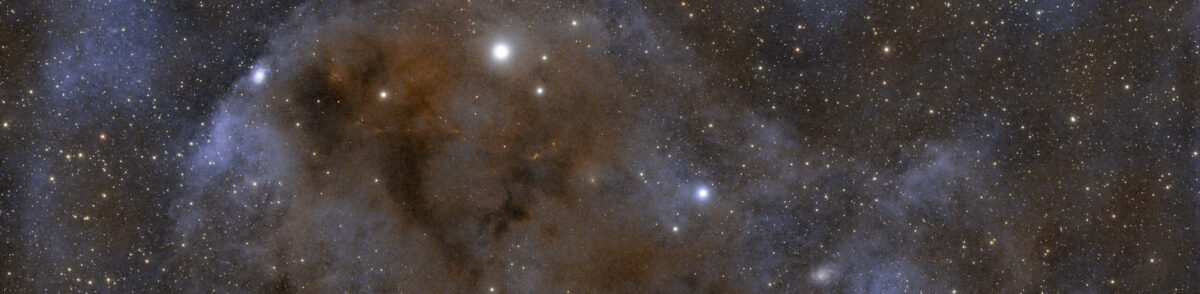
The Cosmic Wonders of Cederblad 51 and Nearby Nebulae

Reflections, Hydrogen and Dust in Orion - Ced 51

Ced 51 may be the most colorful an visually appealing areas of our night sky I have photographed. What a star-field! Orion has a plethora of targets including the beautiful Hind’s Variable and Dreyer’s Nebulae.

Cederblad 51 (often abbreviated as Ced 51) is a faint blue reflection nebula located in the constellation Orion. It is part of the larger star-forming region known as the Lambda Orionis Ring.

This region is also called Sharpless 2-264. It forms the “head” of Orion. Located approximately 1,300 to 1,500 light-years away from Earth. It typically appears as a blue reflection nebula, often appearing divided into two parts by a foreground dust cloud.

The reflection nebula is embedded within the much larger red H-alpha emission nebula Sh2-264. Nearby objects include the dark nebulae Barnard 30, 31, and 32. The region contains several Herbig-Haro (HH) objects, which are indicators of active and recent star formation. LDN 1582 and 1584 provide dark lanes for contrast. So much to see!

Astrobin link for acquisition details and annotated image

Coma Berenices Galaxy Cluster

The Coma Galaxy Cluster

Abell 1656

I generally like to image open star clusters, globular clusters, and galaxies. However, it is fairly rare for a “starfield” to actually be a galaxy cluster. Hundreds of galaxies within my single field of view at 840mm fl. Challenges the mind.

Abell 1656, also known as the Coma Galaxy Cluster, is a massive and dense collection of galaxies. It contains more than 1,000 identified galaxies. These galaxies are located in the constellation Coma Berenices. It is situated approximately 321 million light-years from Earth. The cluster has a diameter of about 20 million light-years.

The central region is dominated by two supergiant elliptical galaxies: NGC 4874 and NGC 4889. Most central members are ellipticals, while spiral galaxies like NGC 4921 are typically found on the outskirts. Important to look at the astrobin platesolve for this image to see what’s actually in there.

Verified by MonsterInsights