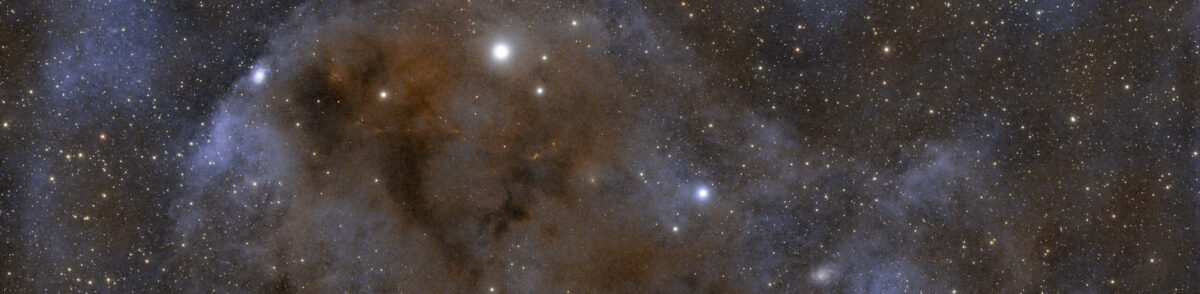
Sh2-155 The Cave Nebula

Sh2-155 / C  9 - The Cave Nebula

Sh 2-155 (also designated Caldwell 9) lies in the plane of our Milky Way galaxy. It is a diffuse nebula in the constellation Cepheus. It resides within a larger nebula complex containing emission, reflection, and dark nebulosity. It is widely known as the Cave Nebula. Sh 2-155 is an ionized H II region. There is ongoing star formation activity. It is at an estimated distance of 2400 light-years from Earth.

Patrick Moore coined the name “Cave Nebula” for this object. The name was presumably derived from photographic images showing a curved arc of emission nebulosity. This arc corresponds to a cave mouth. The “Caldwell Cave” is a bright H II emission nebula. It curves around in an arc and resembles the mouth of a cave. The nebula is part of a much larger Cepheus B molecular cloud. It contains hot, young stars that illuminate and ionize hydrogen gas.

This image is presented in the HOO “hubble palette”.

NGC 1579 – Northern Trifid

NGC 1579 - Northern Trifid

NGC 1579 (also known as the Northern Trifid) is a diffuse nebula located in the constellation of Perseus. It is referred to as the Northern Trifid because it resembles the Trifid Nebula. The Trifid Nebula is located in the southern celestial hemisphere of our sky. It is a H II region, a region of star formation. It is smaller and further away than its namesake, lying 2,100 light years away in the constellation Perseus. It is about 3 light years across and contains both reddish and blue components. The blue is reflection nebula, where dust behind the stars reflects starlight. The red in this case is not from the usual emission of hydrogen.

The star cluster contains the emission-line star LkHα 101, which provides much of the ionizing radiation in the nebula. This massive young star emits light strongly in hydrogen alpha. Dust within the core of the nebula dims and reddens this light. Additional dust and soot is evident above and below the nebula in large areas that contain few stars.

NGC 1579 lies within a giant molecular cloud known as the California Molecular Cloud.

Image acquisition, focusing, guiding and mount control with APT, Astro-Photography Tool. Light calibration, integration, and image processing performed manually in PixInsight. Skywatcher Esprit 120ED at f/7 and ZWO 2600MC Pro with a Radian Ultra Quad-Band narrowband filter at 4nm. 164 5 minute exposures for a total of 13.6 hours of exposure.

M 74 – Phantom Galaxy

M 74 - The Phantom

Messier 74, The Phantom Galaxy, is a large spiral galaxy in the equatorial constellation Pisces. It is about 32 million light-years away from Earth. The galaxy contains two clearly defined spiral arms. Therefore, it is used as an archetypal example of a grand design spiral galaxy. It is estimated that there are 100 billion stars in M 74.

The galaxy’s low surface brightness makes it the most difficult Messier object for amateur astronomers to observe. This difficulty gives rise to its nickname, Phantom. M74 has two spiral arms that wind counterclockwise from the galaxy’s center. The spiral arms widen as they get farther from M74’s center, but one of the arms narrows at the end.

This image was taken over two nights, on November 29th and December 3rd, 2024. I used a GSO RC8 telescope at 1625mm. An ASI071MC Pro camera was aboard a Skywatcher EQ6r Pro Mount. Acquisition session management by APT, image processing using Pixinsight.

M 78

Reflections in Orion

NGC 2064 (also designated as LBN 1627) is a reflection nebula. It is located 1600 light years away from Earth in the constellation Orion. It was discovered on January 11, 1864 by Heinrich d’Arrest. It is part of a group of nebulae that includes Messier 78, NGC 2071 and NGC 2067. Objects that appear close to NGC 2064 from our perspective include the Spirograph nebula and Horsehead nebula. Other nearby objects are the Flame nebula, Rosette nebula, and the Orion nebula.

M78 is the brightest diffuse reflection nebula in its group. This group of nebulae includes NGC 2064, NGC 2067, and NGC 2071. This group belongs to the Orion B molecular cloud complex and is about 1,350 light-years distant from Earth. The M78 cloud contains a cluster of stars that is visible in the infrared.[2] Due to gravity, the molecular gas in the nebula has fragmented into a hierarchy of clumps.

Sh2-135 Hii in Cepheus

Sh2-135

Sh2-135 is an H II emission nebula in the constellation Cepheus without a common name.

It is located about 10,000 light-years away in the southern part of the constellation. The most suitable period for its observation in the evening sky falls between July and December. Observatories in Earth’s northern hemisphere find it especially easy. There, it is circumpolar up to warm temperate regions.

I captured this image using APT for session management. It controlled a Skywatcher EQ6r Pro mount. I used a Skywatcher Esprit 120ed telescope at 860mm FL. The camera was an ASI2600MC Pro astro camera. I had an assortment of goodies as well.

Sh2-135 is the bright circular shaped object on the left side of the image. A ball of Hydrogen gas ionized by newly formed stars. The bottom center gas clouds are cataloged as LBN 486 in Lynd’s Bright Nebula catalog (LBN). The bright irregular nebula on the right is a combination of several entries, LBN 489, LBN 490, and LBN 491.

Sh2-112

Sharpless 112 - another Hii region in Cygnus

SH2-112 is also known as LBN 337. It is a diffuse emission nebula located about 5,600 light-years away. It resides in the constellation of Cygnus. Specifically it’s the bright, circular region near the center. But, it’s clear that this is just one small part of a much larger cloud of gas. It just happens to be heavily radiated and so glows much more brightly.

The circular region of HII with dark dust rifts can be seen on the western side. I find that it loosely resembles a cross between the Pacman and Rosette nebulae.

I imaged this using an Antlia broad-band light pollution filter. I connected an ASI071MC OSC camera to a RC8 telescope. The telescope was riding an EQ6r Pro mount. This image consists of 314 180s subframes, or 16.5 hours of exposure.

It is located in a portion of the Orion Spiral Arm that is noted for areas of rich star formation. It does not seem to have an NGC entry, nor does it have a common name that I could find. I have found quite a few sample images of this target on Astrobin. However, it is clearly not well-known in the astro-imaging circles.

Sh2-115 Cottonball in Cygnus

Sh2-115 - Cottonball in Cygnus

SH2-115 is a large emission nebula in the northern regions of the constellation Cygnus. It is about 2° northwest of the bright star Deneb. Located about 7,500 light-years away, this extensive HII region is broken into two basic parts. Sh2-115 encompasses LBN 357 and LBN 358 (the white fluffy ball on the right side). Sh2-116 includes planetary nebula PK085+04.1 and LBN 352 to the left.

I knew very little about this large target but recent images I have seen suggested a dynamic and interesting structure. That’s one of its attractions for me. I have slowly been targeting objects from the Sharpless Catalog of HII regions. There are 456 objects in this catalog. I have found that many of them are relatively unknown by the broader amateur astronomy community. Most are rich with complex regions that are photographically interesting to explore.

I imaged this target on four moonlit nights in October 2024. The sessions ran from dark until 01:20. At that time, the target dips low in the sky as Cygnus fades from my view. I captured 297 subframes at 240 sec each = 19.8 hours of exposure. Session management for my rig is performed by Astro Photography Tool (APT – 4.57). This image was captured with my Skywatcher Esprit 120ED telescope at 860mm FL, and the ASI2600MC Pro camera.

Image processing followed my standard PixInsight HOO workflow for osc captures using my radian ultra quad-band narrowband filter.

I do hope you enjoy it too!!

Sh2-114 Flying Dragon Nebula

Sh2-114 - Flying Dragon

SH2-114, better known as the “Flying Dragon Nebula,” is a VERY faint Hii emission nebula in the constellation of Cygnus. Also cataloged as LBN 347, it is part of a larger complex that includes SH2-113.

This large curving filamentary structure seems to be part of a supernova. However, no supernova remnant has been identified as the source. The shape of the nebula is most often seen as a winged dragon or bat. A combination of intense stellar winds emitted by massive, hot, O and B stars forms this structure. These winds interact with magnetic fields within the interstellar medium.

Other than this – not much more is known about this object. It is certainly not a common target for Astrophotography and is too faint for visual observation.

Directly above the right wing, halfway between the wing and the edge of the frame, is a planetary nebula. This is cataloged as Kronberger (Kn) 26, and it is a bipolar emission nebula.

I chose to image this with my RC8 and 071MC OSC camera. As it is a very dim target, I spent multiple nights gathering data, in a bright moon no less. More data to be acquired in coming years.

Sh2-261 – Lower’s Nebula

SH2-261 / Lower's Nebula

Lower’s nebula (Sh2-261) is found on the outermost edge of our Milky Way between the Orion and Perseus arm. Sh2-261 is a large faint region of predominantly ionized hydrogen. The nebula is named after Harold and Charles Lower who discovered this nebula in 1939.

I took 300 4 minute exposures over the course of 5 nights in October 2024. I used APT, Astro Photography Tool, from my driveway here in the hills of western North Carolina.

As a predominantly ionized hydrogen (Hii) gas cloud, Lower’s Nebula takes on a distinct reddish hue in long exposure astrophotography. I applied an HOO color map to the final image to help highlight structures and dark nebula within.

IC 434 – The Horsehead Nebula

The Horsehead Nebula (B33) is a small dark nebula in the constellation Orion. It is perhaps the most recognizable nebula because of its resemblance to a horse’s head. The Nebula is located just to the south of Alnitak, the easternmost star of Orion’s Belt.

IC 434 is an active star forming H II region located at a distance of approx. 1,260 ly from the Sun. This is an H II region that is being ionized by ultraviolet radiation from the nearby Sigma Orionis multi-star system. The Horsehead Nebula is a dark nebula that is silhouetted against the diffuse background of IC 434.

The photograph consists of 300 180s subs. They were acquired from my driveway using the APT session control software. I used a RC8 telescope and an ASI071MC Pro camera. The camera was riding an Eq6r pro german equatorial mount.

Verified by MonsterInsights